Aadhaar for NRIs & OCIs 2026: Documents, Forms, Process
NRIs can get Aadhaar the day they land; the 182-day rule went in 2019. OCIs need 182 days in India first. Documents, forms 1 to 8 and every step.

Nikhil Varghese, CA · 9 min read

Quick answer: An NRI with a valid Indian passport can apply for Aadhaar the day they land in India: the 182-day waiting period for NRIs was removed in 2019. An OCI cardholder can get Aadhaar too, but only after staying in India for at least 182 days in the 12 months before applying. You enrol in person at an Aadhaar centre in India, with your original documents and the right UIDAI form, and enrolment is free. If an officer quotes the old 182-day rule to you as an NRI, point them to the September 2019 UIDAI circular.
Updated for UIDAI's enrolment forms as revised in 2024. The form for each type of applicant is listed below.
 Watch the 20-minute episode: NRI Aadhaar guide, no 182-day rule explained
What is Aadhaar, and does an NRI really need one?
Aadhaar is an identity and residence document issued by UIDAI. For NRIs and OCIs it is not legally mandatory in most situations: the law gives you an exemption. In practice, though, everyday India runs on Aadhaar.
Without it, opening an NRO account can turn from a 20-minute task into a two-week documentation exercise, if it happens at all. The same question comes up when you:
- register property
- complete KYC for mutual funds
- file an Indian income tax return
- help ageing parents with their finances
- deal with almost any government office
So is Aadhaar mandatory for NRIs? Technically, no. Is it practically essential? Yes, and your next India trip is the time to get it.
Can NRIs get Aadhaar without staying 182 days in India?
Yes. The 182-day waiting period for NRIs was scrapped in 2019. Under "Aadhaar on Arrival", an NRI with a valid Indian passport can walk into an Aadhaar centre the day they land and apply, with no waiting period and no extra conditions, the same as a resident Indian.
Many enrolment centres never caught up with the change, so NRIs are still turned away with the old rule. If an officer quotes it, politely point them to the September 2019 UIDAI circular. It is public and official.
 Watch the 1-minute short: NRIs denied Aadhaar? The 182-day rule is gone
What documents does an NRI need for Aadhaar?
Your valid Indian passport is the one document that matters most. It works as proof of identity, proof of date of birth and, in many cases, proof of address.
The address on your passport decides whether you need anything else:
- Indian address on the passport: nothing more is needed.
- Foreign address on the passport: you choose one of two options.
- Enrol with the foreign address. UIDAI allows this: use Form 2 for adults, or Form 4 or Form 6 for children.
- Give a separate Indian address proof, such as an Indian bank statement, a utility bill, a ration card, a property document or anything on UIDAI's approved list. It doesn't have to be your own home: your parents' or a sibling's address works.
Two more things to sort out before you go:
- An active email address. UIDAI requires one for NRI enrolment and sends updates there.
- An Indian (+91) mobile number. It isn't mandatory at enrolment, but OTPs, status updates and future corrections only work with an Indian number. A foreign number can be recorded on some forms, but it won't receive SMS or OTPs.
Can OCI cardholders get Aadhaar?
Yes, but not on arrival. An OCI (Overseas Citizen of India) is a foreign citizen of Indian origin, not an Indian citizen, and Aadhaar is a residence document. So an OCI cardholder must first have stayed in India for at least 182 days in the 12 months immediately before applying, roughly six months of the past year.
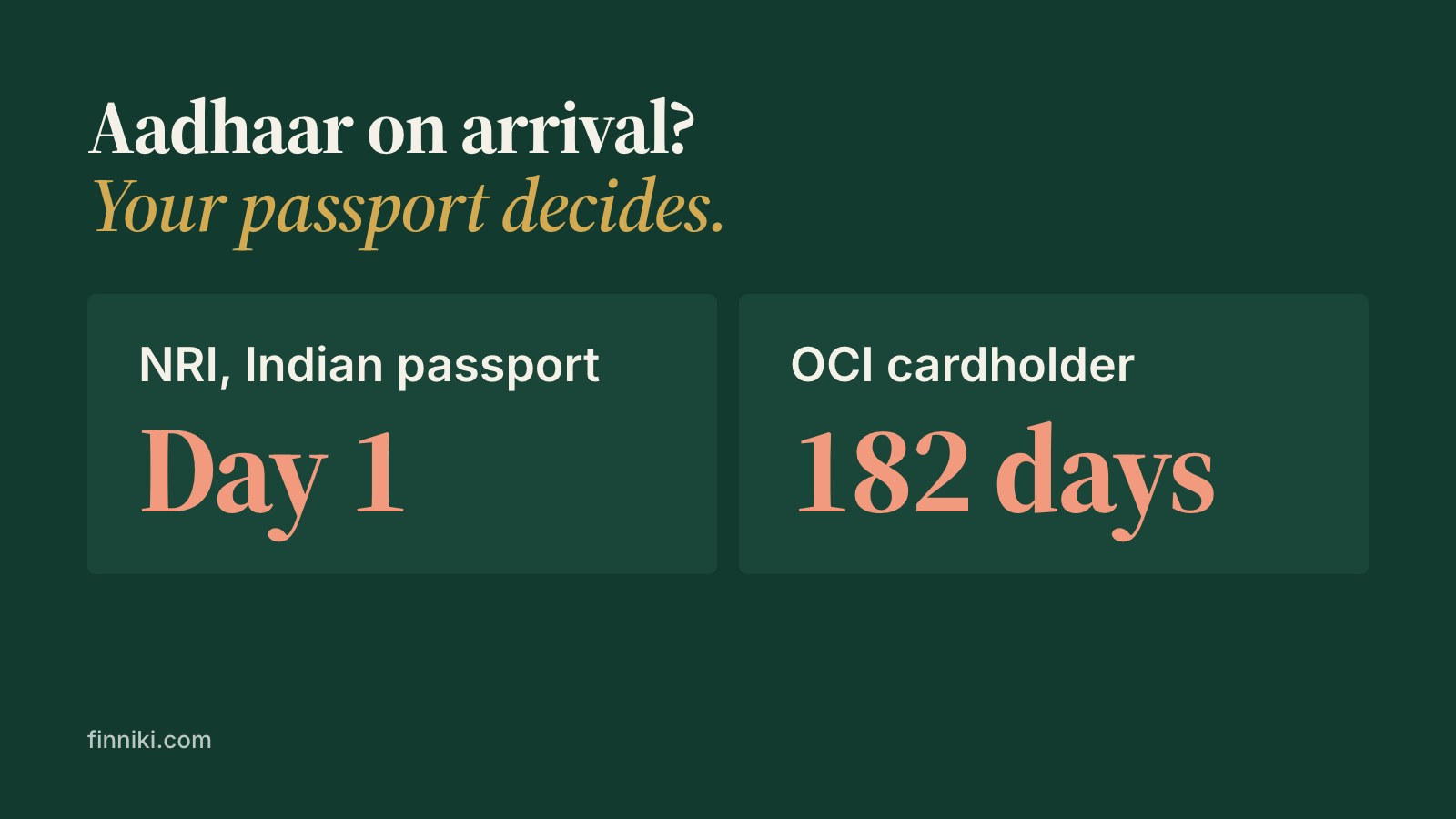
The 182 days come from the Aadhaar Act's definition of a resident. If you visit India for two or three weeks a year, you won't qualify. If you are semi-retired in India, run a business here, work here or spend long stretches here, you can apply.
What documents does an OCI need for Aadhaar?
UIDAI treats OCI applicants as Resident Foreign Nationals. You need:
- a valid foreign passport
- a valid OCI card
- one valid Indian address proof, such as an electricity bill no older than 3 months, a gas connection bill, a registered rent agreement, a sale deed, or any document on UIDAI's approved list
UIDAI doesn't publish a fixed checklist for proving the 182-day stay. Enrolment centres usually look at passport entry and exit stamps, visa records or FRRO registration, so keep these clear and organised.
Expect closer scrutiny than a standard enrolment. Delays and occasional rejections happen, almost always because documents weren't in order or the 182-day stay couldn't be shown clearly. Clean, well-organised papers are the fix.
Which Aadhaar form should NRIs and OCIs use?
UIDAI has a separate form for each type of applicant, updated in 2024. Using the wrong one is the most avoidable reason for delay.
NRIs (Indian citizens)
- Adult (18+), Indian address: Form 1
- Adult (18+), foreign address: Form 2
NRI children
- Age 5 to 17, Indian address: Form 3
- Age 5 to 17, foreign address: Form 4
- Below 5, Indian address: Form 5
- Below 5, foreign address: Form 6
OCIs (Resident Foreign Nationals)
- Adults, 18 and above: Form 7
- Minors under 18: Form 8
All the forms are on uidai.gov.in. Download the right one, fill it in and carry the completed copy to the centre.
How to apply for Aadhaar as an NRI or OCI, step by step
The process is the same for NRIs and OCIs once you qualify.

- Find an enrolment centre. You must apply in person in India; there is no embassy, consulate or online route from abroad. Use the "Locate Enrollment Center" tool on uidai.gov.in to find an Aadhaar Kendra or Aadhaar Seva Kendra. Many UIDAI-approved banks run centres too.
- Book an appointment on the UIDAI website. Walk-ins are accepted, but a booked slot cuts the wait.
- Carry all originals: passport, OCI card if you have one, address proof and your filled-in form. Photocopies alone won't do.
- Declare your category first. As you sit down, say clearly: "I am enrolling as an NRI" or "I am enrolling as an OCI cardholder." NRI and OCI enrolments follow a different workflow from resident ones. If the operator starts a resident enrolment, stop them politely before anything else happens.
- Document check. A mismatch, a missing document or an expired OCI card is flagged here, and means another trip.
- Biometrics. Your photograph, all 10 fingerprints and an iris scan. It is painless and takes a few minutes.
- Sign the declaration. NRIs and OCIs sign slightly different versions; confirm you have the right one.
- Keep the acknowledgement slip. Its Enrolment Number is how you track your application and download your e-Aadhaar.
- Track and download. Check your status on uidai.gov.in. Aadhaar is usually generated within a few weeks and up to 90 days; OCI applications can take longer because of the extra verification. Download your e-Aadhaar from the UIDAI website: it is fully valid. If you want the physical card posted, make sure your Aadhaar address is an Indian address where you can receive mail.
Enrolment is free for residents, NRIs and OCIs alike.
How do NRI and OCI children get Aadhaar?
Children follow the same process, with a few rules parents often miss.
- NRI children need their own valid Indian passport, whatever their age. A parent's passport can't be used instead. The birth certificate plus parent's Aadhaar route (the Head of Family route) is only for resident Indian children, so if your child has no Indian passport yet, get that first.
- OCI children apply as Resident Foreign National minors on Form 8, with their own foreign passport, OCI card and an Indian address proof. The 182-day stay applies to them too, typically assessed on the family's stay in India.
- For both, a parent or legal guardian must be present at the centre to consent and sign for the child.
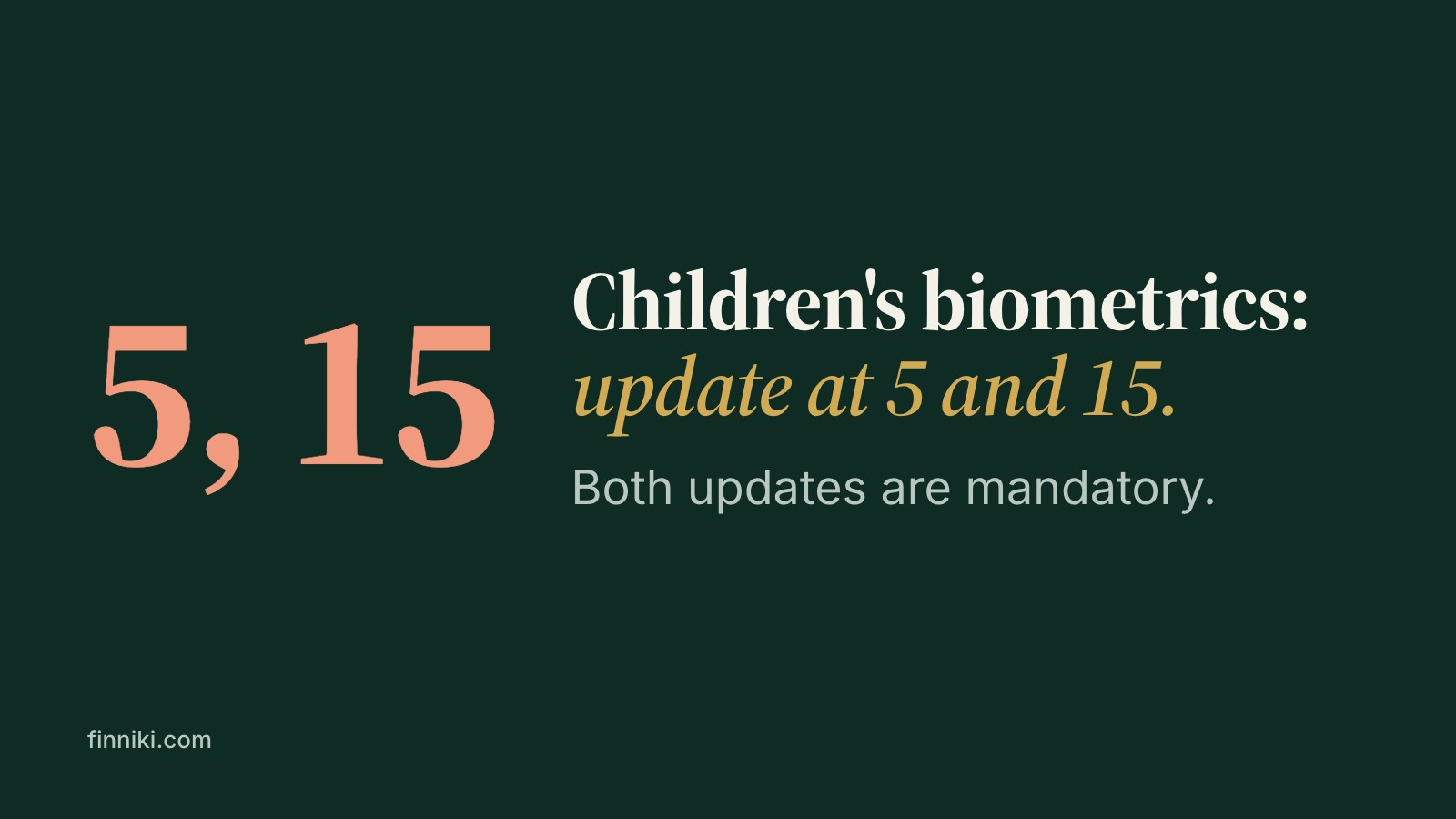
Don't miss the biometric updates. A child's biometrics must be updated twice: at age 5 and again at age 15. They are mandatory. Skipping them can stop the child's Aadhaar working for KYC and authentication, so set reminders now.
How long is Aadhaar valid for NRIs and OCIs?
It depends on your citizenship:
- NRIs (Indian citizens): valid for life. No expiry and no renewal.
- OCIs: valid for 10 years from enrolment. After that, your details must be updated and the Aadhaar renewed.
UIDAI also recommends, without making it mandatory, that every Aadhaar holder updates their supporting documents every 10 years. For Indian citizens that keeps records current; the Aadhaar itself doesn't expire. If you're an OCI, note your enrolment date and set a reminder at the 9-year mark.
Common Aadhaar mistakes NRIs and OCIs make
- Leaving when an officer quotes the 182-day rule. For NRIs it was removed in 2019; cite the September 2019 UIDAI circular.
- Using the wrong form, for example Form 1 with a foreign address on your passport.
- Not declaring your category before the operator starts a resident enrolment.
- Bringing photocopies instead of originals.
- Registering only a foreign mobile number, then finding you can't receive OTPs.
- Turning up as an OCI without proof of the 182-day stay.
- Missing a child's biometric updates at 5 and 15.
FAQs
Is the 182-day rule still applicable for NRIs applying for Aadhaar?
No. It was removed for NRIs in 2019, and an NRI with a valid Indian passport can apply the day they arrive.
Can OCI cardholders get Aadhaar?
Yes, if they have stayed in India for at least 182 days in the 12 months before applying. They enrol as Resident Foreign Nationals on Form 7, or Form 8 for minors.
Is Aadhaar proof of Indian citizenship?
No. Aadhaar is proof of identity and residence, not citizenship; the Aadhaar letter itself says so. Getting Aadhaar doesn't make an OCI a citizen, and not having one doesn't change an NRI's status.
Can NRIs apply for Aadhaar from outside India?
No. NRIs and OCIs must enrol in person at a centre in India. There is no embassy, consulate or online route from abroad.
Can I use an international mobile number for Aadhaar?
Some forms, such as Form 7, accept a foreign number, but UIDAI's OTPs and SMS alerts only work with an Indian (+91) number. Link an Indian number if you want to use Aadhaar online.
What if my passport shows a foreign address?
Enrol with the foreign address on Form 2, or give a separate Indian address proof and use an Indian address. Either is fine.
What happens if my Aadhaar application is rejected?
Rejections are rare for NRIs and happen to OCIs mostly because of missing documents or weak proof of the 182-day stay. There is no penalty for reapplying: fix the gap and go back.
Is PAN–Aadhaar linking mandatory for NRIs?
Mandatory linking under Section 139AA applies to residents under the Income-tax Act who are eligible for Aadhaar, so NRIs who are non-resident for tax are generally exempt, and OCIs fall outside it too. If you're unsure, check with a tax professional, and see PAN for NRIs on fixing an inoperative PAN.
Get your Aadhaar sorted on your next trip
If you're planning an India trip and want your Aadhaar, PAN, bank and tax status lined up together, book a consultation. More explainers are on the videos page, and the NRI status calculator shows your residential status for tax.
General information, not advice for your situation. Rules change; check your own numbers with a CA before you act.