Can You Afford a ₹2 Crore House? The Salary You Need
A ₹2 crore flat needs ₹50 lakh down and costs about ₹1.54 lakh a month to own. The income you really need, and three smarter ways to buy a home.

Nikhil Varghese, CA · 10 min read
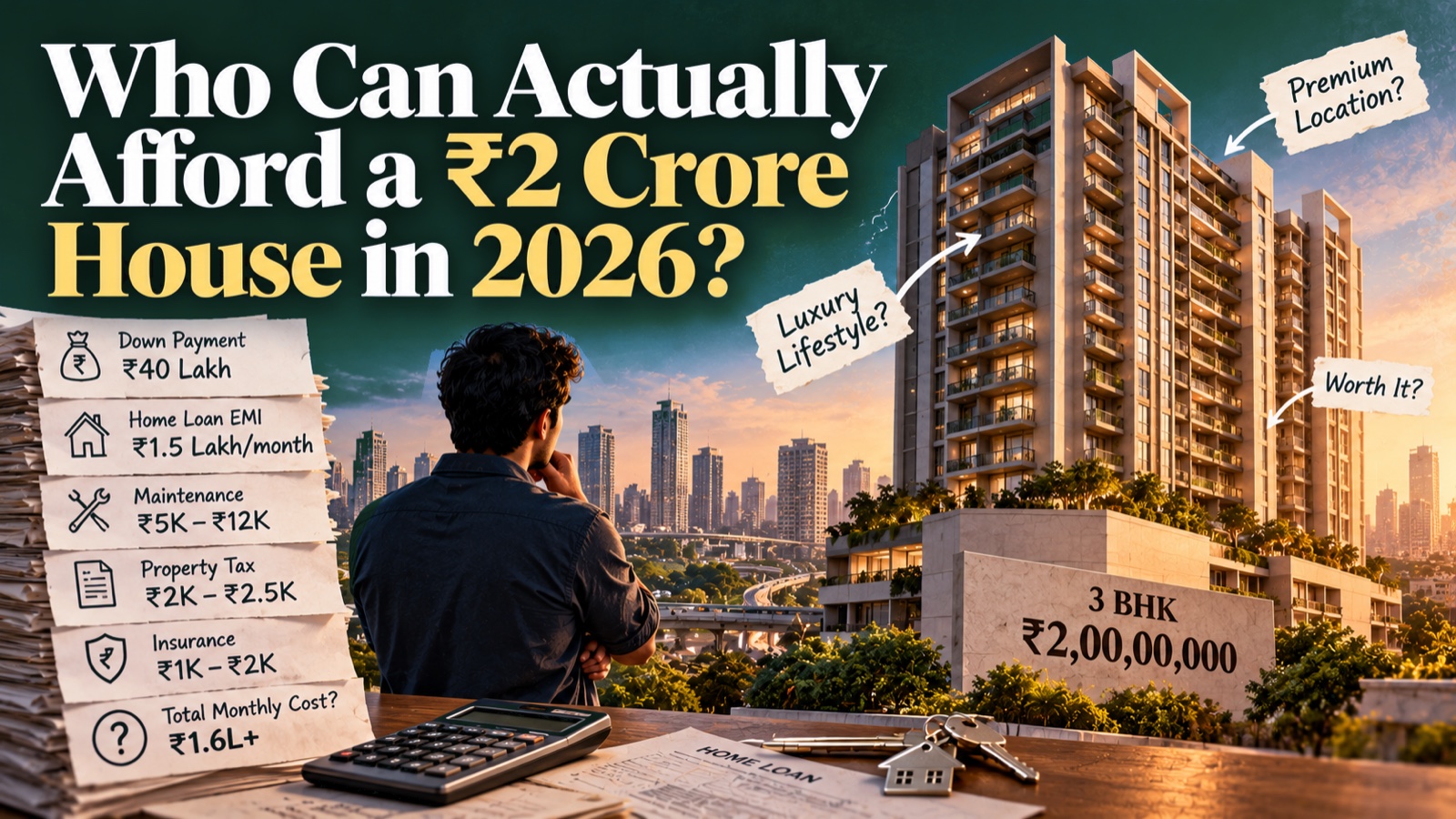
Quick answer: To afford a ₹2 crore home comfortably in 2026, a household needs an income of roughly ₹46 to 62 lakh a year, plus at least ₹50 lakh in cash for the down payment, because banks lend at most 75% of the value on loans above ₹75 lakh. With a ₹1.5 crore loan at 8% for 20 years, the EMI is about ₹1.25 lakh a month, and maintenance, property tax, insurance and repairs take the real cost to about ₹1.54 lakh a month. A couple earning ₹30 lakh a year can get that loan sanctioned, but it would swallow about three-quarters of their take-home pay. The fix is not to give up on owning a home: rent and invest, buy in a cheaper city, or buy smaller.
Updated October 2026. The RBI raised the repo rate to 5.50% on 7 October 2026 and banks have started passing it on (SBI raised its lending benchmarks by 0.25% from 15 October), so home-loan rates of roughly 7.5% to 8.5% for good borrowers may edge up. The episode's example assumed a 10% down payment; RBI rules cap the loan at 75% of the value for loans above ₹75 lakh, so the figures below use a 25% down payment and are recalculated.
 Watch the episode: ₹2 crore house truth, the salary you actually need in India (2026)
What does ₹2 crore buy in an Indian city in 2026?
Less than the brochure suggests. In Bengaluru, ₹2 crore may buy a 3BHK of about 1,600 square feet on the outskirts; in Mumbai, a 2BHK of about 900 square feet. Not a sea view, not a rooftop pool. And the flat you see in a reel often turns out to have dated kitchen tiles, basic bathroom fittings and a balcony facing someone else's balcony, while the broker still calls it "premium".
Then you open your salary slip. A family earning ₹10 lakh a year is being asked to buy a home worth 20 times its annual income. That ratio is as unreasonable as it sounds. Yet the loan agent says you are approved, relatives say property always goes up, and everyone around you nods. Nobody is lying maliciously, but they are all wrong about what "affordable" means, and you are the one who pays for it.
How much down payment do you need for a ₹2 crore flat?
At least ₹50 lakh. Under RBI rules, banks can lend at most 75% of a property's value when the loan is above ₹75 lakh (80% for loans of ₹30 to 75 lakh, 90% up to ₹30 lakh). On a ₹2 crore flat, the loan tops out at ₹1.5 crore, so you need 25% in cash, before stamp duty and registration charges.
Saving that is the first wall. Suppose you earn ₹20 lakh a year, well above the typical Indian salary, and save 15% of it: ₹3 lakh a year. Even if your savings earn 7%, reaching ₹50 lakh takes about 11 years, and if property prices rise 6% a year, the same flat will cost about ₹3.9 crore by then.
So many buyers scrape together what they can: savings, a broken FD, help from family, sometimes a personal loan nobody talks about. Borrowing the down payment is the most dangerous version of all, because the EMIs stack up before you have moved in. And with a smaller cushion, banks tend to offer worse terms: a higher rate, steeper fees, and insurance that protects the bank more than you. Because you were not rich enough to pay more upfront, you pay more every month.
What is the EMI on a ₹2 crore house?
About ₹1.25 lakh a month on the largest loan a bank can give: ₹1.5 crore over 20 years at 8%. At 7.5% it is about ₹1.21 lakh, and at 8.5% about ₹1.30 lakh. That is only principal and interest, not a rupee of what it costs to live there.
(The episode used a ₹1.8 crore loan with ₹20 lakh down, an EMI of ₹1.45 to 1.56 lakh. A bank cannot lend 90% on a home this size, so that gap would have to be filled with a personal loan, which makes it worse.)
What does it really cost to own a ₹2 crore flat each month?
About ₹1.54 lakh a month, every month, for 20 years. Add what the bank leaves out of the brochure:
- Property tax: about ₹15,000 to ₹30,000 a year, roughly ₹2,000 a month.
- Society maintenance: ₹5,000 to ₹12,000 a month in this price range, for security, common-area power and the lift that is always broken.
- Home insurance: still underused in India; budget about ₹1,500 to ₹3,000 a month for comprehensive cover.
- Repairs and upkeep: the 1% rule says budget 1% of the home's value a year. On ₹2 crore that is ₹2 lakh a year, about ₹16,700 a month. Geysers fail, pipes burst, walls need painting, and waterproofing does not ask permission.
Add it up, per month:
- EMI (₹1.5 crore, 20 years, 8%): ₹1,25,500
- Society maintenance: ₹8,000
- Property tax: ₹2,000
- Home insurance: ₹2,000
- Repairs and upkeep (1% rule): ₹16,700
Total housing cost: about ₹1,54,200 a month.
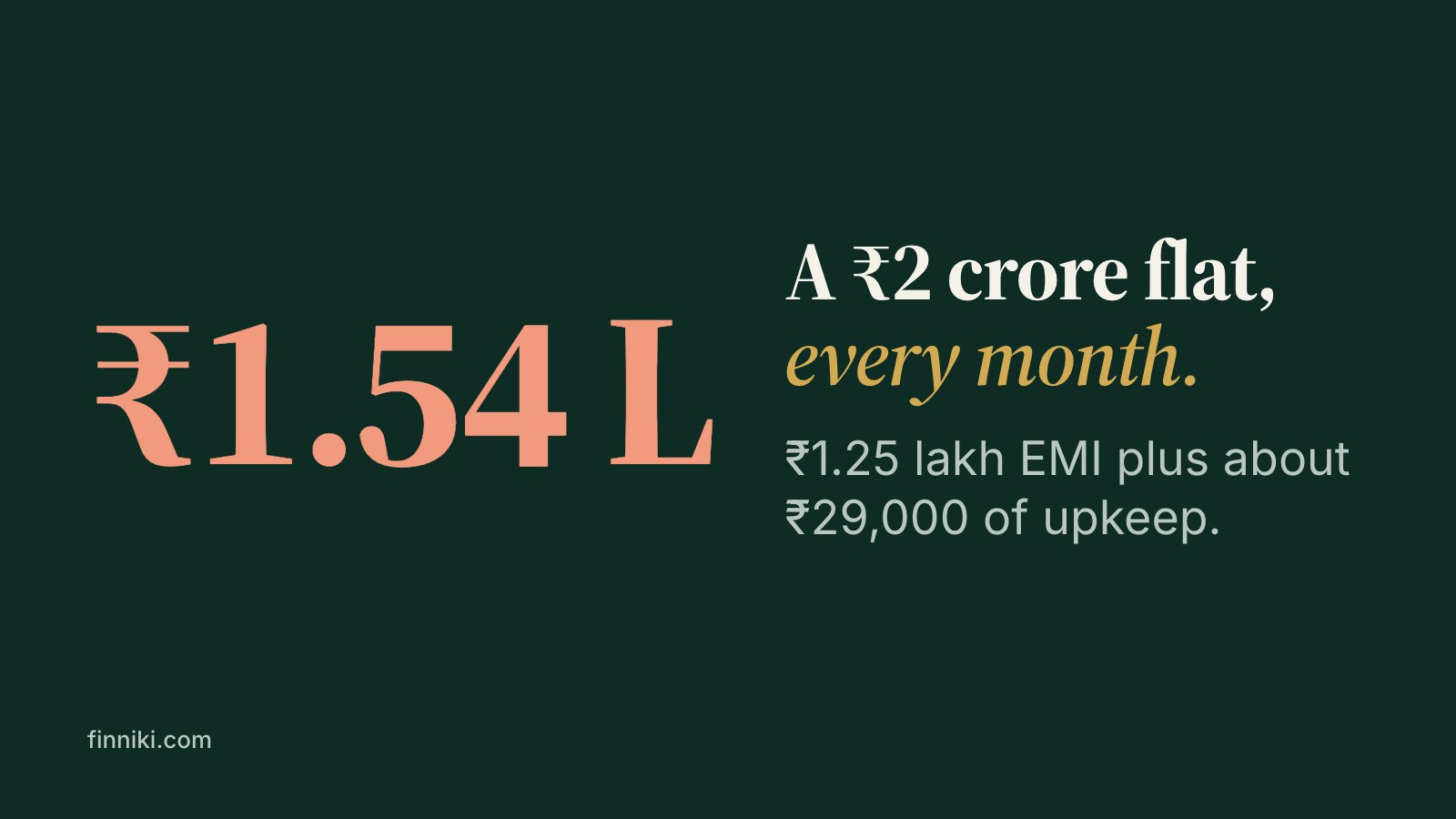
That assumes nothing goes wrong: no special society levy, no builder occupancy-certificate problem that becomes yours, no job loss, no medical emergency.
What salary do you need to buy a ₹2 crore house?
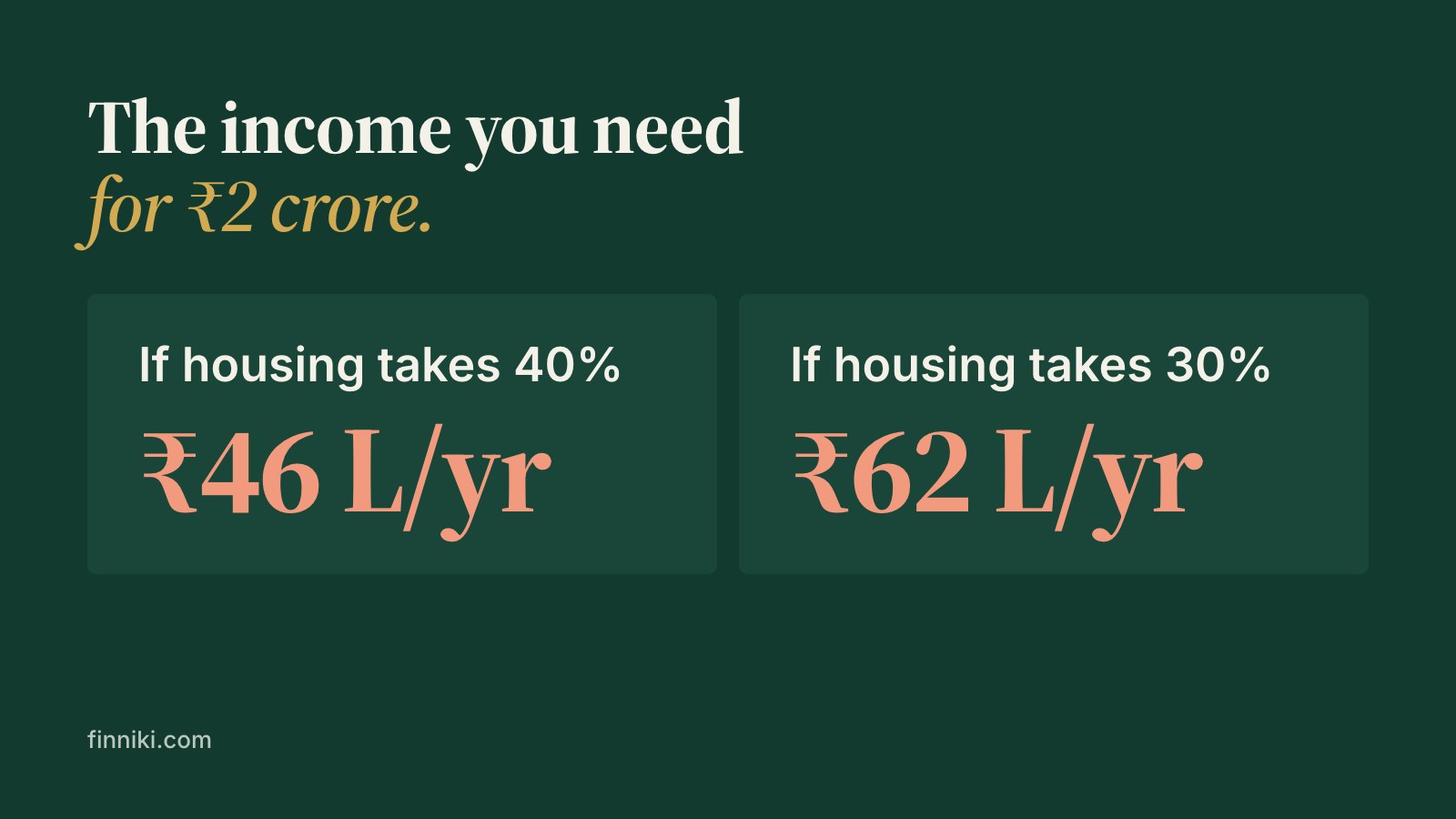
Roughly ₹46 to 62 lakh a year. Most financial advisers suggest keeping housing to 30 to 35% of gross income. Banks go further: they lend until your total EMIs reach about 50% of gross income, the FOIR (fixed obligation to income ratio).
Work backwards from ₹1.54 lakh a month:
- At 30% of income, you need about ₹5.1 lakh a month, or ₹62 lakh a year.
- At a more lenient 40%, you need about ₹3.9 lakh a month, or ₹46 lakh a year.
Only a small fraction of Indian households earn that much, which means the large majority cannot comfortably afford a ₹2 crore home under any reasonable framework. So who is buying? Dual-income IT couples earning ₹20 to 25 lakh each; families whose NRI relatives sent the down payment; people who sold inherited property. And a significant number who are stretched so thin that one job loss or one hospital stay would bring everything down.
Can a couple earning ₹30 lakh afford a ₹2 crore home?
On paper yes, in practice no. Meet the Sharmas: a combined income of ₹2.5 lakh a month (₹30 lakh a year), one in a mid-level IT role, one in a private-sector job. Solidly upper middle class.
The bank will approve them: a ₹1.25 lakh EMI is exactly 50% of their gross income. But look at their take-home. If each earns about ₹15 lakh, income tax under the new regime is about ₹16,000 a month between them; provident fund takes ₹15,000 to ₹20,000 more, plus health insurance and other deductions. They take home roughly ₹2.1 lakh a month.
Housing costs ₹1.54 lakh of it, about 73%. That leaves about ₹56,000 for groceries, transport, utilities, support for parents, medical costs, perhaps a car EMI, some savings, and occasionally something they enjoy. Before children's school fees, travel or a single emergency. And that is after finding ₹50 lakh for the down payment.
The Sharmas are not reckless. No luxury car, no Bali holiday. They are trying to live in a flat the market told them was normal. If financially responsible people cannot make the maths work, the problem is not them.
Why do banks, builders and brokers push you to buy more?
Because everyone in the room profits when you sign, and none of them profits if you walk away.
- The builder prices at ₹2 crore because that is what the last flat in the building sold for, not because of your salary.
- The bank sanctions the loan because your FOIR fits. Getting you in is its business; what happens after is your problem.
- The broker earns 1 to 2% of the price. The bigger the flat, the bigger his cheque.
- Even your adviser might say "buy property, save tax". But the home-loan interest deduction (Section 24(b) of the old Act) is capped at ₹2 lakh a year for a self-occupied home and is available only under the old tax regime. At the 30% slab it saves at most about ₹62,000 in tax, against about ₹15 lakh a year of EMIs.
And once you sign, you are locked in. Walking away means losing your down payment, damaging your credit score and a long legal process. So most people stay, grind at jobs they resent, watch their savings drain and tell themselves this is what building for the future feels like. It is not.
Is buying a house in India still affordable?
Not at ₹2 crore, for most families. Home prices in the big cities have risen much faster than salaries over the last two decades, and that gap is where the whole problem lives. We keep telling people that renting is throwing money away, but an EMI you cannot manage is also throwing money away, with worse consequences and more paperwork. Property may well go up; first, you have to survive the mortgage. If owning the flat means you cannot invest, save, handle an emergency or sleep at night, what is the asset doing for you?
What can you do instead of stretching for a ₹2 crore home?
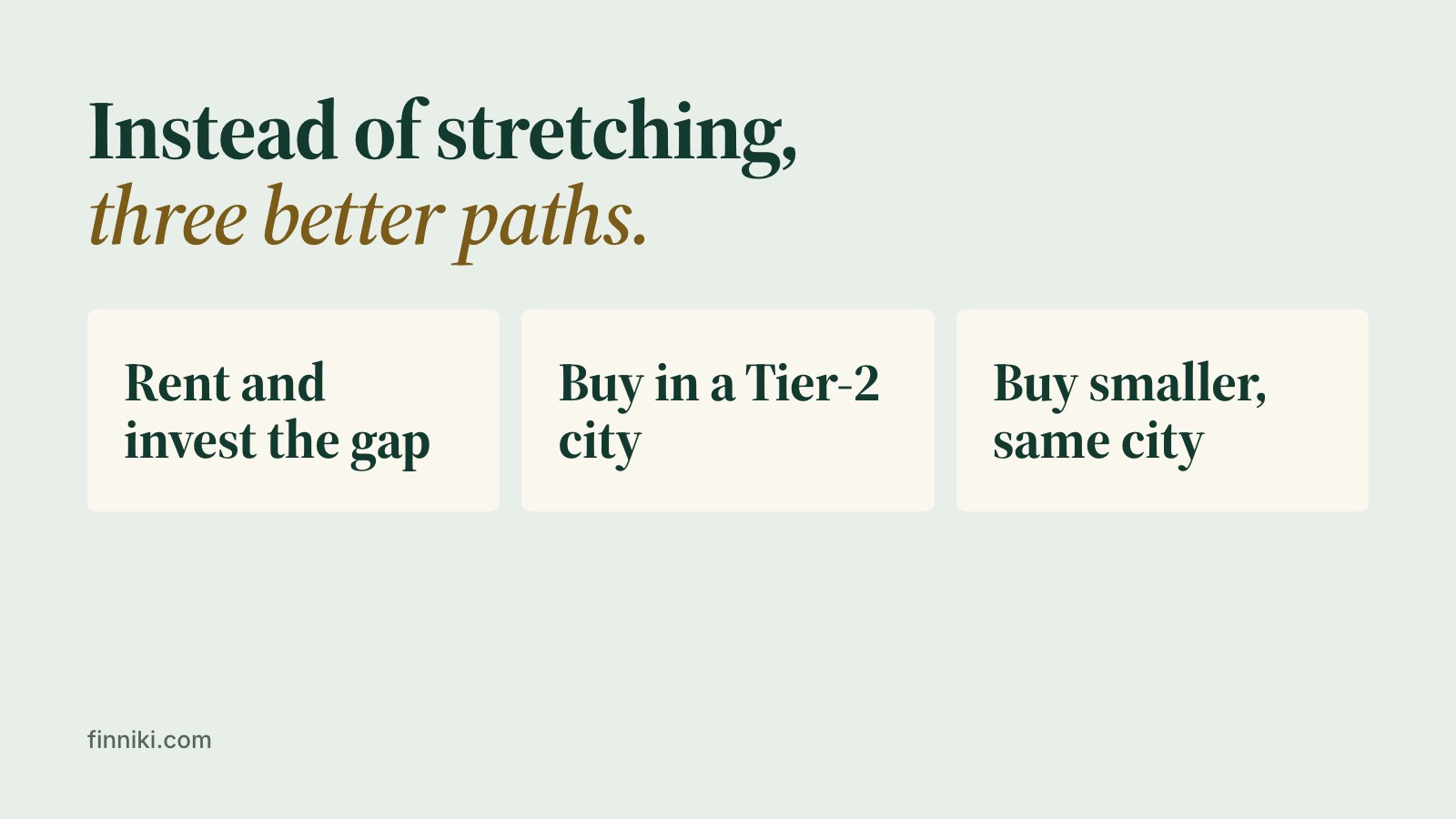
There is a third path between stretching and giving up. Three options:
- Keep renting and invest the difference. A well-located 3BHK in Bengaluru or Hyderabad rents for about ₹45,000 to ₹75,000 a month, against about ₹1.5 lakh to own a similar flat. Invest the gap, ₹80,000 or more a month, in equity mutual funds for 15 to 20 years, and it can match or beat the flat's appreciation, with real liquidity instead of a six-month sale and a broker's commission.
- Buy in a more affordable city. In Tier-2 cities such as Indore, Nashik, Coimbatore and Bhubaneswar, a genuine 3BHK can cost around ₹80 lakh. With 20% down, the EMI on a ₹64 lakh loan at 8% for 20 years is about ₹53,500. Remote work increasingly means your career does not have to suffer.
- Buy smaller in the same city. A ₹1 crore 2BHK with ₹25 lakh down and a ₹75 lakh loan has an EMI of about ₹62,700 at 8% over 20 years. You are in the market and building equity without suffocating. It will not get likes on Instagram, but in ten years you will have savings, investments and options.
None of these is a compromise; they are smarter versions of the same goal. The right question is not "what loan am I approved for?" but "what can I afford without dismantling everything else?" Find the number at which you can pay the EMI, handle repairs, save for emergencies, invest for retirement and still go out for dinner without doing mental maths at the table. For most people, that number is nowhere near ₹2 crore.
FAQs
What salary do I need to buy a ₹2 crore house in India?
Roughly ₹46 to 62 lakh a year, so that the total housing cost of about ₹1.54 lakh a month stays within 30 to 40% of gross income.
What is the EMI on a ₹1.5 crore home loan?
About ₹1.25 lakh a month over 20 years at 8%; about ₹1.21 lakh at 7.5% and ₹1.30 lakh at 8.5%.
How much down payment is needed for a ₹2 crore flat?
At least ₹50 lakh, because RBI rules cap loans above ₹75 lakh at 75% of the property's value; stamp duty and registration are extra.
Can I get a 90% home loan on a ₹2 crore property?
No. A 90% loan-to-value is allowed only on loans up to ₹30 lakh; above ₹75 lakh the limit is 75%.
What is FOIR in a home loan?
The fixed obligation to income ratio: your total EMIs as a share of gross income. Banks usually lend until it reaches about 50%.
Is it better to rent or buy a house in India?
At ₹2 crore city prices, renting and investing the difference often works out better, and keeps your money liquid; buy when the total cost fits comfortably in your budget.
How much tax can I save on a home loan?
Interest on a self-occupied home is deductible up to ₹2 lakh a year, only under the old tax regime, which saves at most about ₹62,000 at the 30% slab.
Decide before you sign
Sometimes the smartest move is recognising that the maths does not work and choosing not to sign. To find the home budget that fits your whole financial life, book a session, or find more episodes on FinNiki videos. Thinking of borrowing to build wealth? Read leverage: can borrowing make you rich.
General information, not advice for your situation. Rules change; check your own numbers with a CA before you act.