Car Buying Tips India: How I Saved ₹2.7 Lakh
Seven ways to pay less for a new car in India: a walk-away price, dealers competing, month-end timing, refusing add-ons, your own loan and demo cars.

Nikhil Varghese, CA · 6 min read
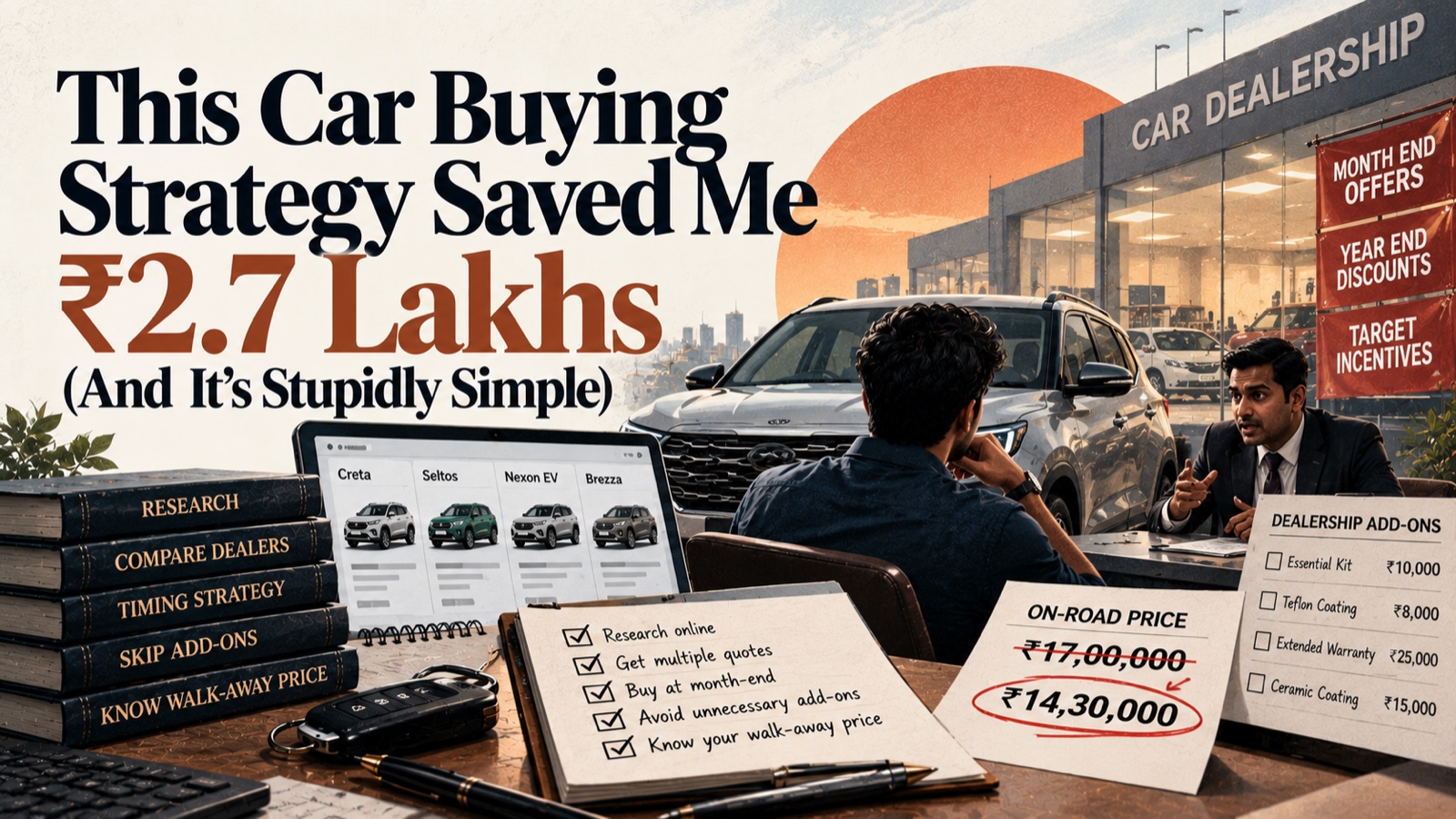
Quick answer: You can save lakhs on a new car by treating the purchase like an audit, not an emotional decision. Work out the true on-road price online and set a walk-away price; get quotes from several dealers and let them compete; buy in the last week of the month, quarter or year; refuse dealer add-ons and buy accessories outside; compare the dealer's loan with your own bank's; consider pre-registered or demo cars; and strike out handling charges. Nikhil saved about ₹2.7 lakh on a compact SUV this way.
Updated October 2026. Car prices fell after GST was cut to 18% on small cars and 40% on bigger cars and SUVs from 22 September 2025, so recheck the on-road price before you negotiate. The episode's loan example has also been corrected below.
 Watch the episode: How I saved ₹2.7 lakh buying my car (dealers hate this)
How do dealers make you overpay for a car?
With confusion. They throw out ex-showroom price, on-road price, RTO, insurance, handling charges and "essential kits" until you stop checking and just agree. When Nikhil was shopping for a compact SUV for his parents, with a ₹15 to 16 lakh budget across the usual suspects (Creta, Seltos, Nexon EV, Brezza), three dealers quoted ₹1 to 2 lakh above what he had worked out online. One even claimed ceramic coating was "mandatory by law". It is not.
Tip 1: How do you find the right on-road price?
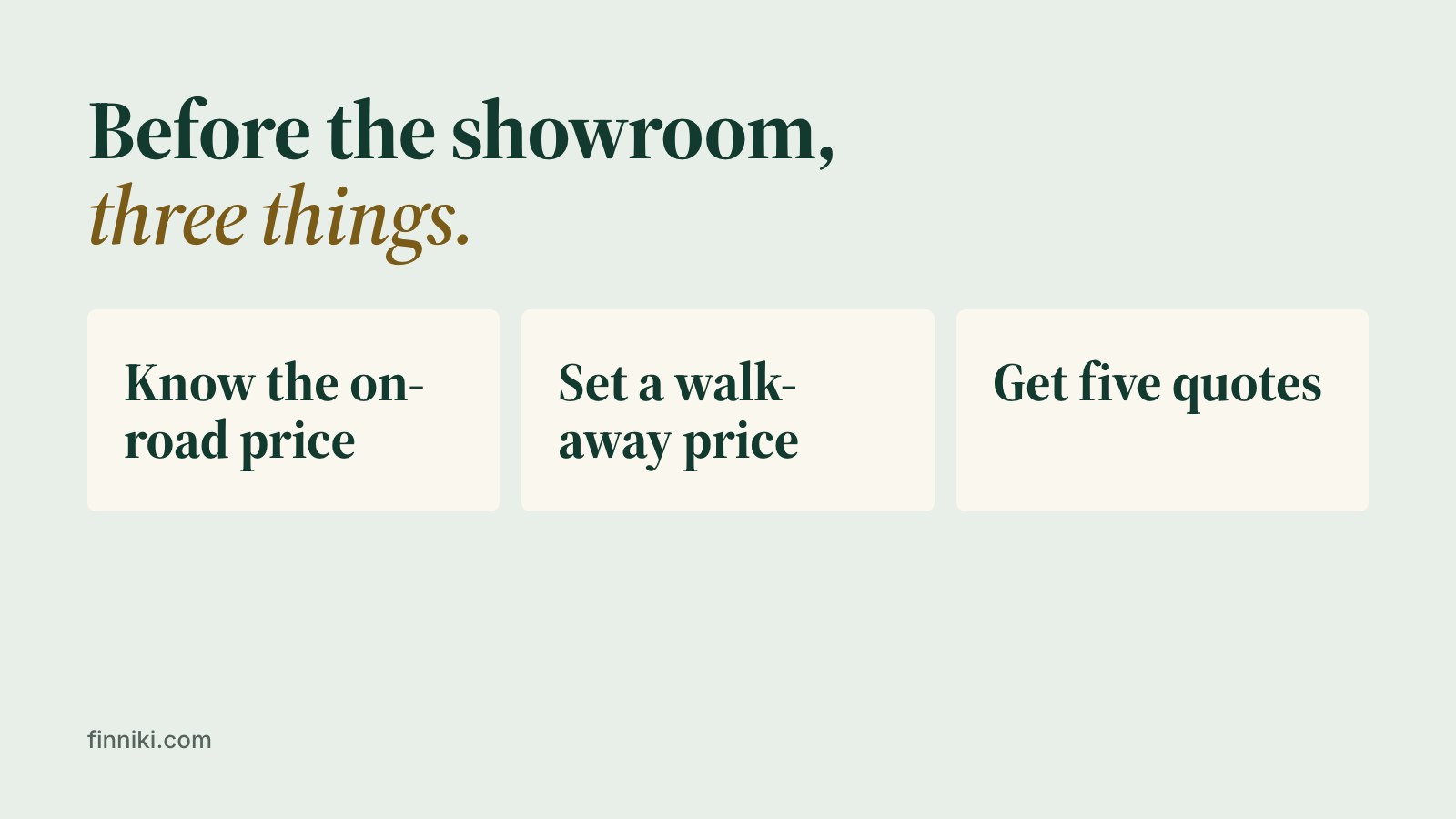
Research before you visit. Spend a few days on car pricing sites and state RTO calculators to see exactly what the road tax, registration and insurance should be, and read real buyers' bills shared online. For the car Nikhil chose, the true on-road price was ₹17 lakh. That became his walk-away price: the moment a dealer quoted more, he would stand up and leave. Suddenly the "impossible" price became possible.
Tip 2: How do you get dealers to compete?
Ask several of them for the same car. Nikhil contacted five dealers, then shared each quote with the others: "Your competitor is offering ₹45,000 off. Your move." Within hours, a dealer who swore his price was "rock bottom" found a "manager's special discount" of ₹65,000. The dealer competition alone cut ₹1.2 lakh.
Tip 3: When is the best time to buy a car?
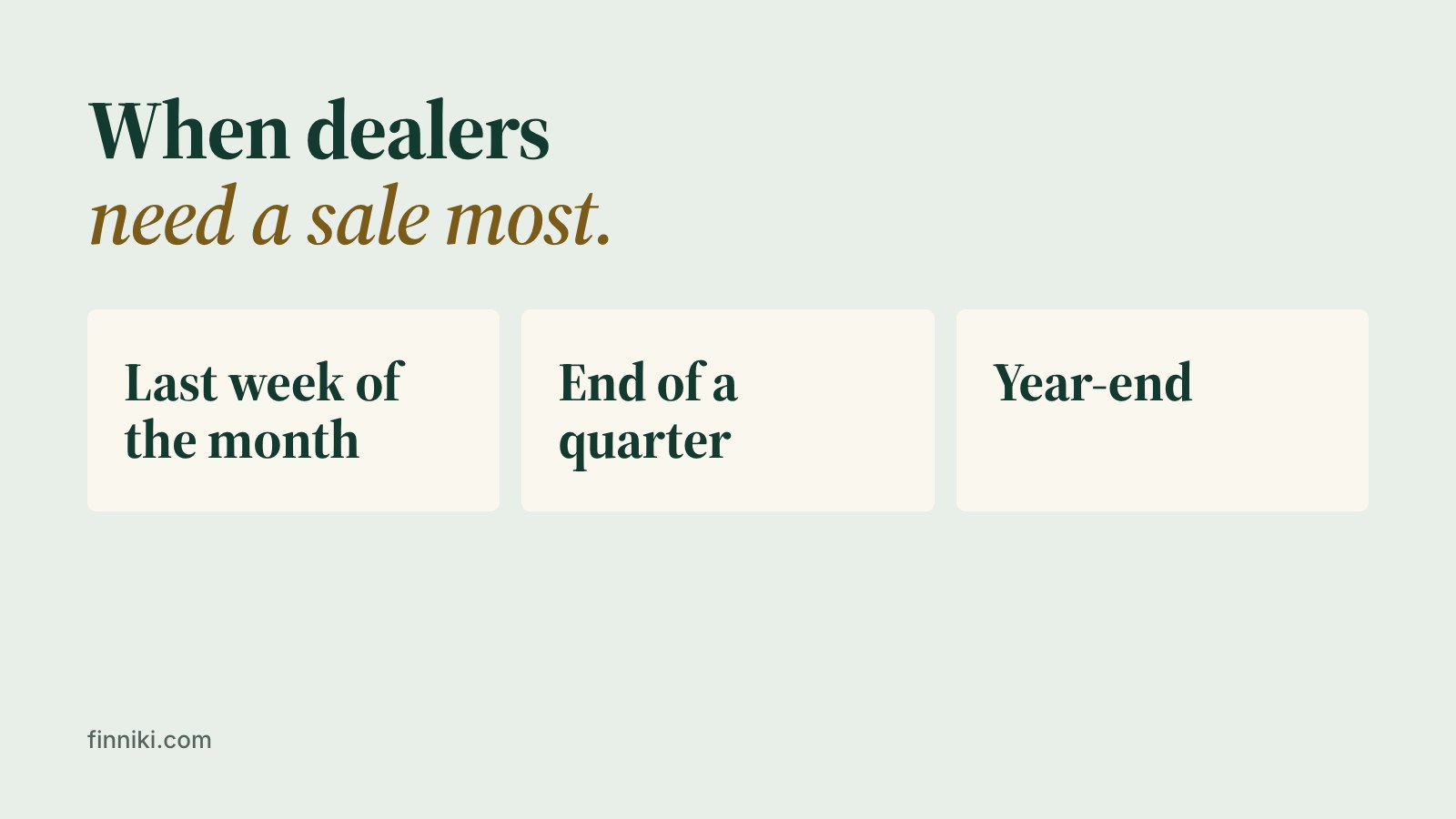
When the dealer needs a sale. Dealers and their staff earn manufacturer incentives for hitting monthly, quarterly and yearly targets, and missing a target by one car can cost them lakhs. So buy in the last week of the month, and better still at the end of a quarter or the year. Nikhil bought on 28 March and got free insurance worth ₹50,000, free accessories and a discount.
Tip 4: Should you buy dealer add-ons and accessories?
Usually not. Add-ons are where dealers make real money:
- "Essential kit" at about ₹10,000, worth about ₹5,000 outside.
- Teflon coating at about ₹8,000, of little use and quick to wear off.
- Extended warranty at about ₹25,000, less useful if you plan to sell within about three years.
- Ceramic coating, never mandatory, whatever you are told.
Nikhil refused everything, took the basic on-road price, and bought better accessories from a local shop at about half the price: ₹50,000 saved.
Tip 5: Should you take the dealer's car loan?
Compare it first. Dealers earn commissions from partner lenders, so their "special rate" is rarely the lowest. Nikhil's dealer offered 8.5%; his own bank offered 8%. On a ₹12 lakh loan over five years, that half-point difference is worth about ₹17,000 in interest (the episode put it at ₹40,000; the correct figure is lower, but it is still money for one phone call).
Whether to pay cash or borrow is a separate question. A car loan at 8% costs more than a fixed deposit at 6% earns, especially after tax on the FD interest, so borrowing only to keep money in an FD does not pay. A loan makes sense if paying cash would empty your emergency fund, or if the money would otherwise stay invested in something that reliably earns more than the loan costs.
Tip 6: Are pre-registered and demo cars worth buying?
Often, yes. They are the dealership's secret menu:
- Pre-registered cars are new, with zero kilometres, but registered by the dealer to meet a target. On paper you become the second owner, but the discount is often ₹1 to 2 lakh.
- Demo cars have been used for test drives, usually with under 3,000 km, and properly serviced, with discounts of up to ₹2 to 3 lakh. One buyer found a top-variant Creta demo car with 2,100 km on it for ₹15.5 lakh instead of ₹18 lakh.
Check the condition, the service record and the remaining warranty.
Tip 7: What should you check before you pay?
Two things:
- The manufacturing date. Decode the VIN (vehicle identification number) online. A car that has been sitting unsold for more than six months has been losing value in the dealer's yard, and that is leverage for a lower price.
- Handling or logistics charges. Transport authorities have held that dealers cannot charge customers separately for these, yet they still appear on invoices. Nikhil found ₹9,000 of handling charges and said: "Remove this or I'm leaving." It was removed.
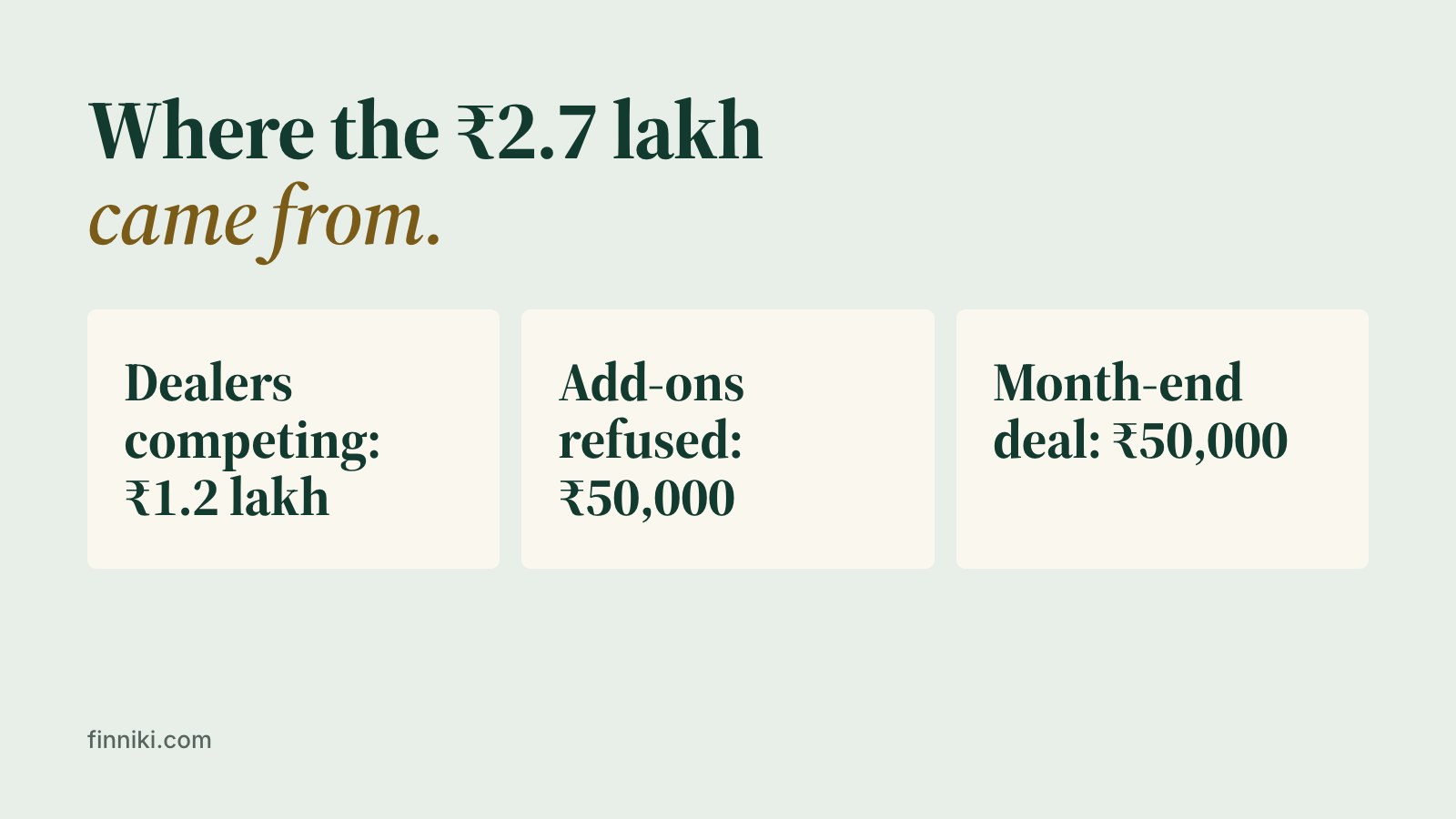
How did the savings add up to ₹2.7 lakh?
- Dealer competition: ₹1.2 lakh
- Add-ons refused: ₹50,000
- Month- and year-end deal (free insurance): ₹50,000
- His bank's loan instead of the dealer's: ₹40,000 in the episode (about ₹17,000 on the corrected maths)
- Handling charges removed: ₹9,000
That is roughly a year of EMIs, a holiday or an emergency fund, saved by preparation rather than luck.
What is the right mindset for buying a car?
Buying a car is emotional: it means freedom, comfort and pride. But the smartest buyers are not the ones who buy the best cars; they are the ones who buy cars the best way. The dealer is not your enemy, but not your friend either. It is a business, and in business the person with information wins. Never fall for "Sir, this offer ends today."
FAQs
What is the best time to buy a car in India?
The last week of the month, and especially the end of a quarter or the year, when dealers are chasing targets and incentives.
How do I negotiate a car price?
Know the true on-road price, set a walk-away price, get quotes from several dealers and let them compete, and refuse add-ons you do not need.
Are handling charges legal?
Transport authorities have held that dealers should not charge buyers separately for handling or logistics. Ask for them to be removed.
Is it better to take a car loan or pay cash?
Pay cash if you can without touching your emergency fund, because a car loan usually costs more than an FD earns. If you borrow, compare the dealer's rate with your own bank's.
Are demo cars a good deal?
Often. They can cost ₹2 to 3 lakh less than new, with low kilometres, but check the condition, service record and warranty.
Do I need the dealer's extended warranty and coatings?
Not usually. Coatings are optional, and an extended warranty matters less if you will sell the car within about three years.
Plan the purchase, not just the price
The cheapest car deal still has to fit your budget. Book a session to see how a car fits your plan, or find more episodes on FinNiki videos.
General information, not advice for your situation. Rules change; check your own numbers with a CA before you act.