Dubai Property 2026: What the Crash Taught Us
Dubai property in 2026: what held up, what didn't, the real net yield, off-plan developer risk, and the Indian tax trap. Two questions before you buy.

Nikhil Varghese, CA · 10 min read

Quick answer: The February 2026 shock showed what Dubai property is really made of. The tax structure, the freehold title registry and the depth of the buyer base held up. The advertised rental yield, apartment supply in a few crowded communities and some developers' balance sheets were shakier than the marketing suggested. A flat advertised at an 8 to 9% gross yield realistically nets 5 to 6% before your home country's tax. Whether it is worth buying depends on the developer, the micro-market, how long you can hold, and two questions: can you see yourself in the UAE for five to ten years, and are your core goals in your home currency already funded?
Updated October 2026. Prices have fallen since the script's January-based forecasts: by August the ValuStrat citywide index was 3.1% below a year earlier, with apartments down 5.3% and villas down 1.7%. The figures below are 2026 data from the Dubai Land Department and research houses, and the market is moving, so check the latest before you commit.
 Watch the 19-minute episode: Is Dubai property overhyped? The real truth
What did the February 2026 shock do to Dubai property?
It turned the market from a sales pitch into a stress test. On 28 February 2026, Iran was struck. In the weeks that followed, the Dubai Financial Market's real estate index, which had more than doubled from late 2023, fell 20 to 30%. Sales activity stopped, and brokers and the local press reported transaction volumes down by a quarter and in some cases nearly half.
Then the quarter closed. The Dubai Land Department, the government registry and not a broker with a sales target, reported about AED 252 billion of transactions for Q1 2026, up roughly 31% year on year, on top of a record 2025. Through September, the market had recorded 165,018 transactions worth AED 574 billion, reported as the second-highest nine-month sales value on record. A market in freefall and a record quarter in the same 90 days is the contradiction worth understanding. A shock shows which claims hold when things go wrong, and which only worked when nothing did.
What actually held up in Dubai?
Two things held, and they are the two that matter:
- The tax structure. No annual property tax, no local capital gains tax when you sell, and no emirate-level tax on rental income. This is how the system is built, and February did not change it.
- Title and depth. Freehold ownership is registered with the Dubai Land Department, and that registry kept working through the disruption. Activity fell sharply at the peak of the panic, but the quarter still closed up 31%. That is the sign of a buyer base big enough to absorb a geopolitical shock without forced selling.
What does a Dubai flat really yield after costs?
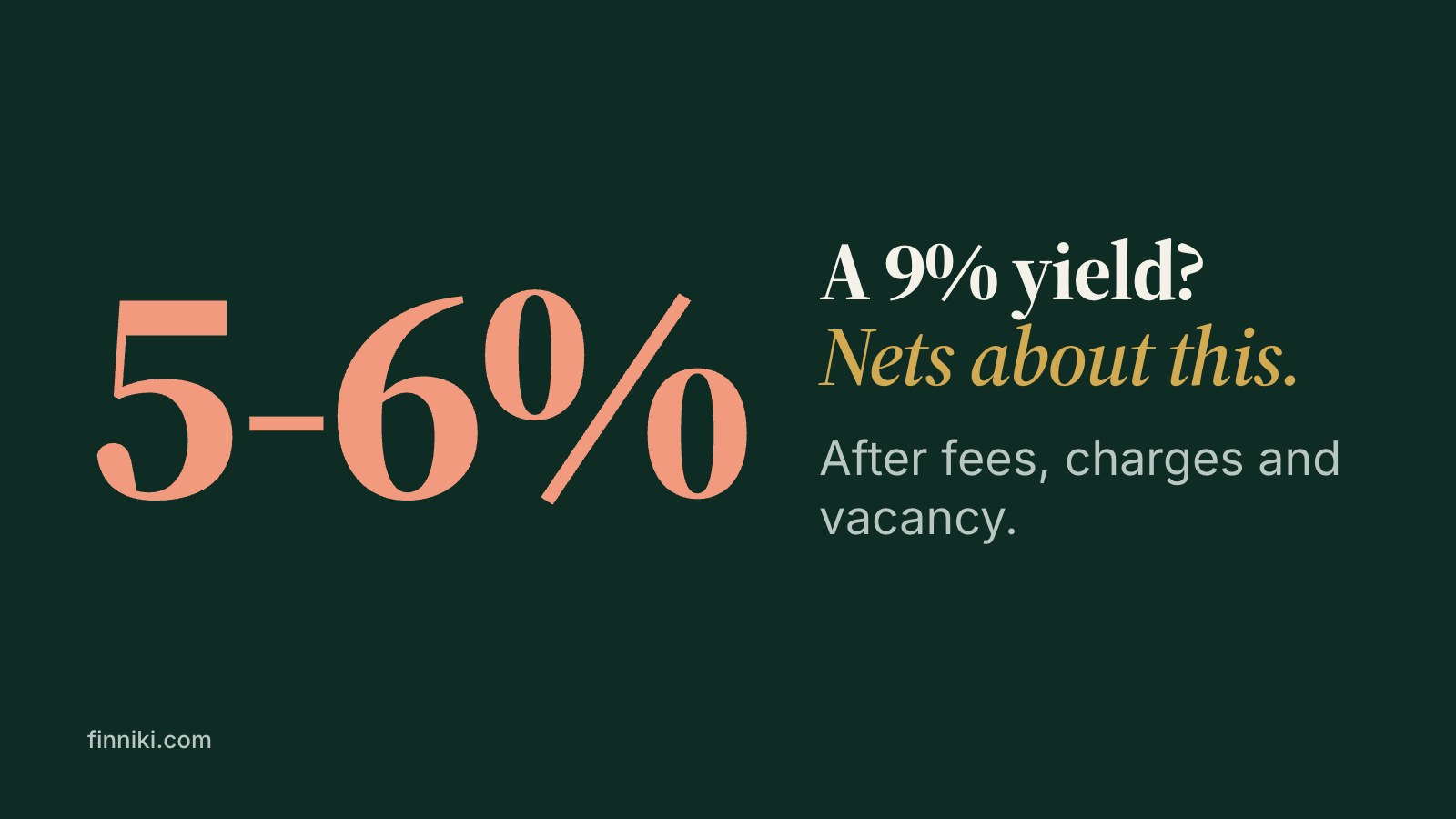
About 5 to 6%, not the 9% on the brochure. Take a compact 2BHK in a mid-market apartment community, advertised at an 8 to 9% gross yield:
- Day one: a transfer fee of about 4% of the property value to register it, before you collect any rent.
- Every year: service charges for the building and common areas, maintenance and repairs on your unit, and, if you do not live in Dubai, a property manager who takes a cut of the rent.
- Reality: two months empty between tenants cost about a sixth of a year's rent. A defaulting tenant or a broken air conditioner costs more.
Realistically the 9% lands as 5 or 6%, which is roughly what a decent fixed-income product would pay without a building, a tenant or an air conditioner. Gross yield gets you to sign. Net yield is what you live on. That is before your home country takes its share, covered below.
Are Dubai rents still rising?
Much more slowly. The residential rent index showed Dubai rents up about 6.2% year on year in December 2025, and about 1.5% by April 2026. This started before February: the conflict did not cause the slowdown, it made people look at it. Two forces are behind it: regulation (RERA's rental index and caps on renewal increases) and supply, which is handing negotiating power back to tenants. ValuStrat's January outlook expected rental growth to be roughly flat in 2026.
Is there too much new supply in Dubai apartments?
In some pockets, yes. Outlooks mostly put new supply at about 100,000 to 120,000 units across Dubai over the next few years, and it is concentrated in apartment-led communities such as JVC, Business Bay, Dubai South and Mohammed Bin Rashid City. In several of them, new homes are running ahead of annual demand. Off-plan is now the majority of Dubai transactions by volume, so most buyers are buying a building that does not exist yet.
When several developers hand over towers on the same street in the same year, landlords compete for tenants, rents soften, yields compress and, if enough investors sell at once, prices follow. This is an apartment problem, not a Dubai problem. Established villa communities and scarce waterfront land behave differently, because land cannot be manufactured. A citywide average describes neither, since it blends the two. The data since January shows the gap closing in the wrong direction: ValuStrat's January forecast was for villas up about 17.7% and apartments 7 to 8% in 2026, but by August both had fallen year on year (villas by about 1.7%, apartments by about 5.3%).
What is the biggest risk in buying off-plan in Dubai?
The developer. When you buy off-plan you are not buying a building, you are buying a promise, and a promise is only as good as the balance sheet behind it. You carry two risks:
- Construction risk: the building is delayed.
- Solvency risk: the company building it does not reach handover.
Cranes on site today tell you nothing about whether your unit is finished in two years. Emaar (listed and government-linked) and Aldar (Abu Dhabi-backed, with a record of on-schedule handovers) carry about the lowest delivery risk in the market. That does not make them the best investment, because a strong developer can still build a flat in a saturated district. If you look outside that tier, do three checks before signing:
- Escrow: check the project's escrow account status on the Dubai REST app, to confirm your money is ring-fenced.
- Registration: confirm the project's RERA registration on the DLD portal.
- Record: check the developer's delivery record: how many projects handed over, and how late.
That is about two hours of work, and no brochure will hand it to you.
Does "zero tax in Dubai" mean zero tax for an Indian?
No. Tax does not follow the property, it follows you. The question is where you are a tax resident.
- NRI, non-resident in India for the year: Dubai rent is not taxable in India. Foreign income of a non-resident sits outside the Indian net.
- Indian tax resident (you never left, or you came back and your RNOR window has closed): your global income is taxable in India. Dubai rent is added to your total income and taxed at slab rates, 30% plus surcharge and cess for most people. The same logic applies to a resident of any other country that taxes foreign income.
- No foreign tax credit. Normally tax paid abroad is credited in India. Dubai charged nothing, so there is nothing to credit.
- Selling: Dubai takes no capital gains tax, but India does if you are a resident.
Disclosure is where it turns from money into risk. An Indian tax resident must report foreign assets in Schedule FA: the property and the UAE bank account the rent goes into. Under the Black Money Act, failing to report a foreign asset can attract a penalty of ₹10 lakh, separate from any tax owed. Current reporting says small non-property foreign assets below ₹20 lakh have been given relief, but foreign immovable property, such as a Dubai flat, does not get that safe harbour. Assume the tax department already knows: the UAE exchanges financial account information with India, so a bank account collecting your rent is reportable.
Zero percent in Dubai does not become zero percent worldwide: it changes who collects and when. If you plan to move back to India, you are building an asset that is tax-free while you are away and taxable once you return, so plan the timing of your return and of any sale in advance. Check where you stand with the NRI status calculator and the RNOR calculator.
Who are you bidding against in Dubai?
Mostly cash. Knight Frank's research is consistent that well over four-fifths of Dubai property transactions are done in cash, not leverage. The market is priced by cash-rich global capital with a different tolerance for pain from yours. If your deal only works because of the mortgage, you are playing a different game from the people setting the price, and they can sit out a February or a sideways market. Can you?
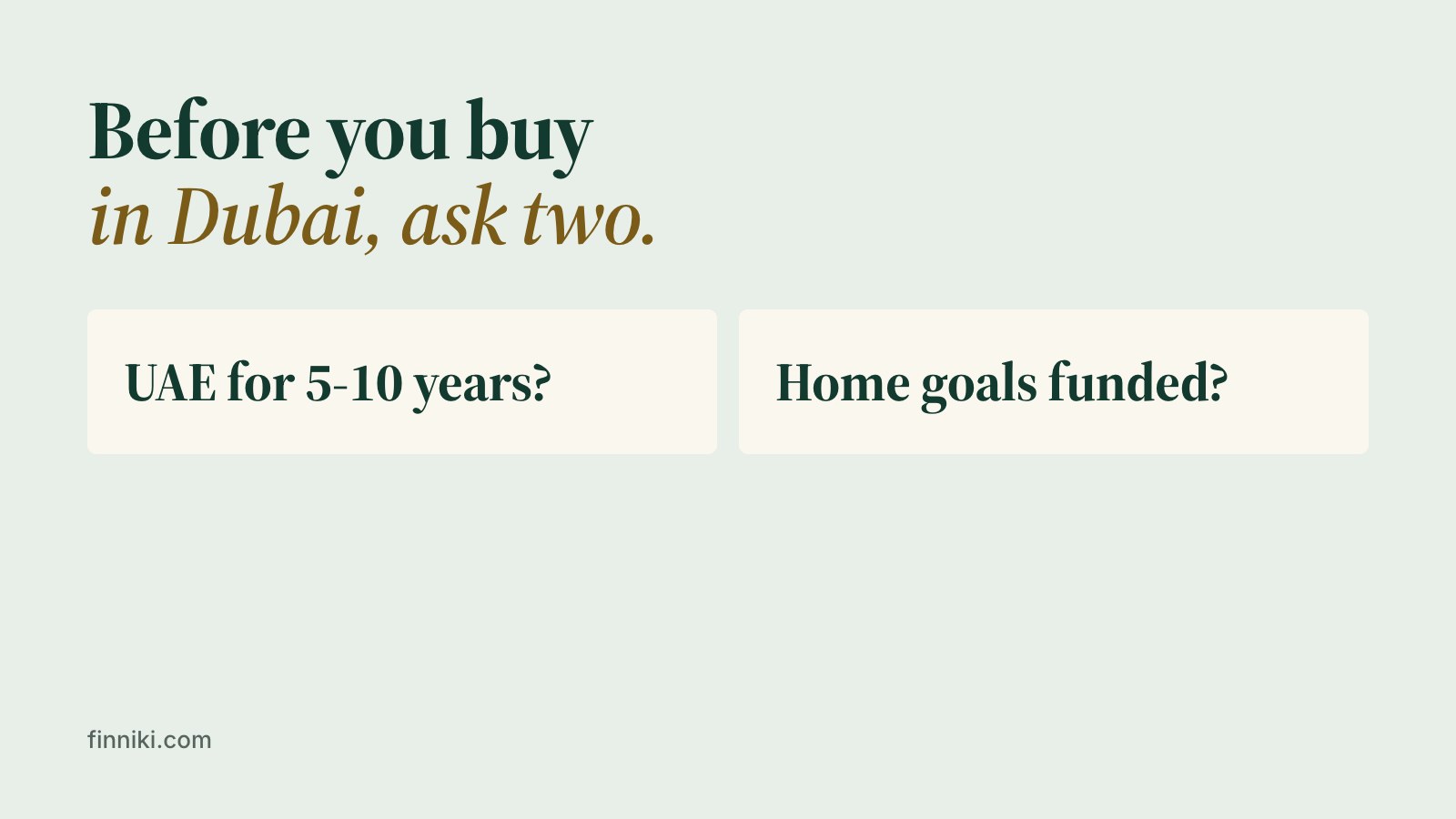
Should you buy Dubai property? Two questions
- Can you honestly see yourself or your family in the UAE for the next five to ten years?
- Are your core goals, in your home currency, already funded?
Here is what happens to the same 2BHK in each case:
- No to both: the flat is the worst thing you could own. Your money is locked in a foreign, illiquid asset while your real life is underfunded. It nets about 5% before home-country tax, you cannot sell in a hurry, and it becomes taxable the day you move back to India. Skip it.
- Goals funded, never moving to the UAE: it is a higher-risk international allocation and should be sized like one. Buy in a community that is not drowning in supply, from a developer whose balance sheet you have checked, expecting a 5% net yield with tax on top. Price in appreciation too, and look at the overall return over time.
- Moving there, home base not secure: it is a distraction with a mortgage attached. Fix the foundation first.
- Yes to both: the flat stops being a trade. You are replacing rent, building a base and picking up residency. The 5% net matters far less, because the property is doing a job a fixed deposit cannot.
Same flat, same price, same developer, four different outcomes. The variable is you. One last gut check: if the property did not come with the words "Golden Visa", would you still want it? If not, you are buying a visa and paying for it in concrete.
Is Dubai property worth it?
Sometimes. The city is not perfect and it is not a bubble. The outcome depends far more on what you buy, who built it and how long you can hold it than on any WhatsApp forward. The shock showed the tax structure, the title system and the depth of the buyer base taking the hit and staying standing, and showed that rents, apartment supply and some developer balance sheets were shakier than the marketing said. These are not contradictory findings. The better question is not "is Dubai a good investment?" but "is this property, at this price, from this developer, in this micro-market, right for my situation and my plan?"
FAQs
Did Dubai property prices crash in 2026?
They fell after the February shock: the DFM real estate index dropped 20 to 30% in the weeks that followed. By August, the ValuStrat citywide index was 3.1% below a year earlier, with apartments down more than villas.
Is Dubai real estate tax-free for Indians?
Dubai charges no annual property tax, no capital gains tax and no tax on rental income. An Indian tax resident still pays Indian tax on the rent and on any gain, with no foreign tax credit.
What is the real rental yield on Dubai apartments?
An advertised 8 to 9% gross yield realistically becomes 5 to 6% after the 4% transfer fee, service charges, maintenance, management fees and vacancy.
Do NRIs pay Indian tax on Dubai rent?
A genuine NRI, non-resident in India for the year, does not. Once you become an Indian tax resident, the rent is taxed in India at slab rates.
Do I have to report a Dubai flat in my Indian tax return?
If you are an Indian tax resident, yes, in Schedule FA, along with the UAE bank account. Not reporting a foreign asset can attract a ₹10 lakh penalty under the Black Money Act.
Is buying off-plan in Dubai risky?
It carries construction risk and developer solvency risk. Check escrow status on the Dubai REST app, the project's RERA registration on the DLD portal, and the developer's delivery record.
Are Dubai villas a better investment than apartments?
They are different assets. Villas in established communities and scarce waterfront land have behaved differently from apartments in crowded, supply-heavy communities, though both fell year on year by August 2026.
Should I buy Dubai property for the Golden Visa?
Only if you would want the property without the visa. If the visa is the reason, you are paying for it in concrete.
Sort out a Dubai property decision before you pay a deposit
If you are weighing a Dubai flat, your tax residency, the timing of a move back to India and the Schedule FA rules matter more than the brochure yield. Book a one-to-one session to work through your own numbers, or watch more explainers on our video page.
General information, not advice for your situation. Rules change; check your own numbers with a CA before you act.