GIFT City for NRIs 2026: Dollar Deposits, Funds & Tax
GIFT City lets NRIs invest in dollars, not rupees. See how a USD deposit compares with an NRE FD if the rupee falls, and how tax works.

Nikhil Varghese, CA · 9 min read

Quick answer: GIFT City (India's International Financial Services Centre, or IFSC) lets an NRI hold and invest in dollars, euros or pounds inside India instead of converting everything to rupees. A GIFT City USD deposit usually pays less than an NRE FD, but the rupee can erase that gap: in the worked example below, a 20% fall in the rupee cuts the NRE FD's yearly lead from about $11,500 to about $5,800. India may exempt certain GIFT City income, but your home country's tax rules still apply. Use GIFT City as one part of a portfolio, not the whole of it.
Updated October 2026. Rates and the exchange rate in the example are illustrative: check the bank's rate on the day you book. IFSCA, the GIFT City regulator, has since notified its Pension Fund Regulations, 2026 (30 March 2026), so a foreign-currency pension framework now exists on paper.
 Watch the 17-minute episode: The rupee trap every NRI falls into
Is a higher NRE FD rate always the better deal for an NRI?
No. A higher rate in a currency you don't use isn't automatically a higher return. The moment you convert dollars (or euros or dirhams) into rupees, your investment stops being a dollar asset and becomes a rupee asset. It can grow every year in rupees and still be worth less when you convert it back, because the rupee moved against you.
The video calls this the Currency Illusion: a return that looks good in rupees can look very different in the currency you spend. So the better question is not "which number is bigger?" but "which investment gives me the better outcome in the currency I need my money in?"
What does an NRE FD return look like next to a GIFT City USD deposit?
Take an NRI in Dubai with a $500,000 retirement corpus. At about ₹95 to the dollar, that is roughly ₹4.75 crore. The figures below are illustrative and cover annual interest only, not a full multi-year, after-tax comparison.
- NRE FD at 6.8%: about ₹32.3 lakh a year, which is about $34,000 at ₹95. The interest is exempt from Indian income tax.
- GIFT City USD deposit at 4.5%: a flat $22,500 a year.
On the rate alone, the NRE FD wins by close to $11,500 a year. For context, large banks' NRE FD rates in October 2026 are mostly in the range of about 6% to 7%, and GIFT City USD deposits have been quoted at roughly 4.5% to 6%, so both rates sit inside today's ranges. Rates differ by bank, tenure and deposit size.
What happens to the NRE FD's lead if the rupee falls 20%?
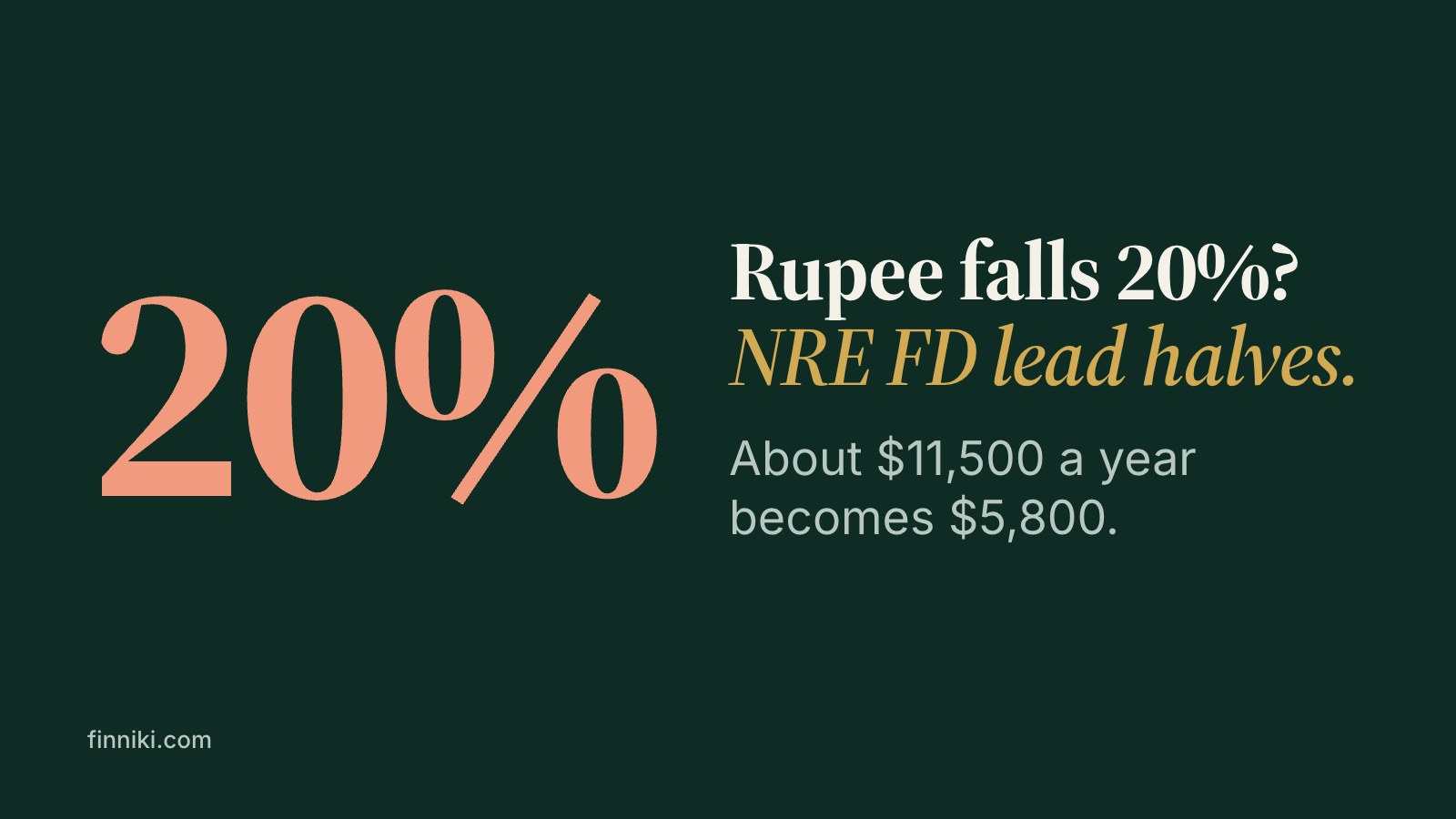
It shrinks sharply. If the rupee weakens 20%, from ₹95 to about ₹114 to the dollar, the same ₹32.3 lakh of interest converts back to about $28,300, not $34,000. The NRE FD's lead over the GIFT City deposit falls from roughly $11,500 to about $5,800, and the NRI took on all the currency risk to earn that narrower gap.
This isn't a prediction that the rupee will fall 20%. It shows what the comparison looks like if it does.
Does a GIFT City deposit remove all risk?
No. It removes one specific risk: the rupee-versus-dollar swing. The $22,500 is still $22,500 after the rupee moves. You still carry bank risk and liquidity risk, and if you spend in euros or pounds, you carry dollar-versus-euro or dollar-versus-pound risk too.
For a Dubai resident, the dirham is pegged to the dollar, so a USD deposit is about as close a currency match as it gets. The point is that you choose your currency exposure instead of inheriting it by default.
Which should I choose: an NRE FD or GIFT City?
It depends on where the money is going:
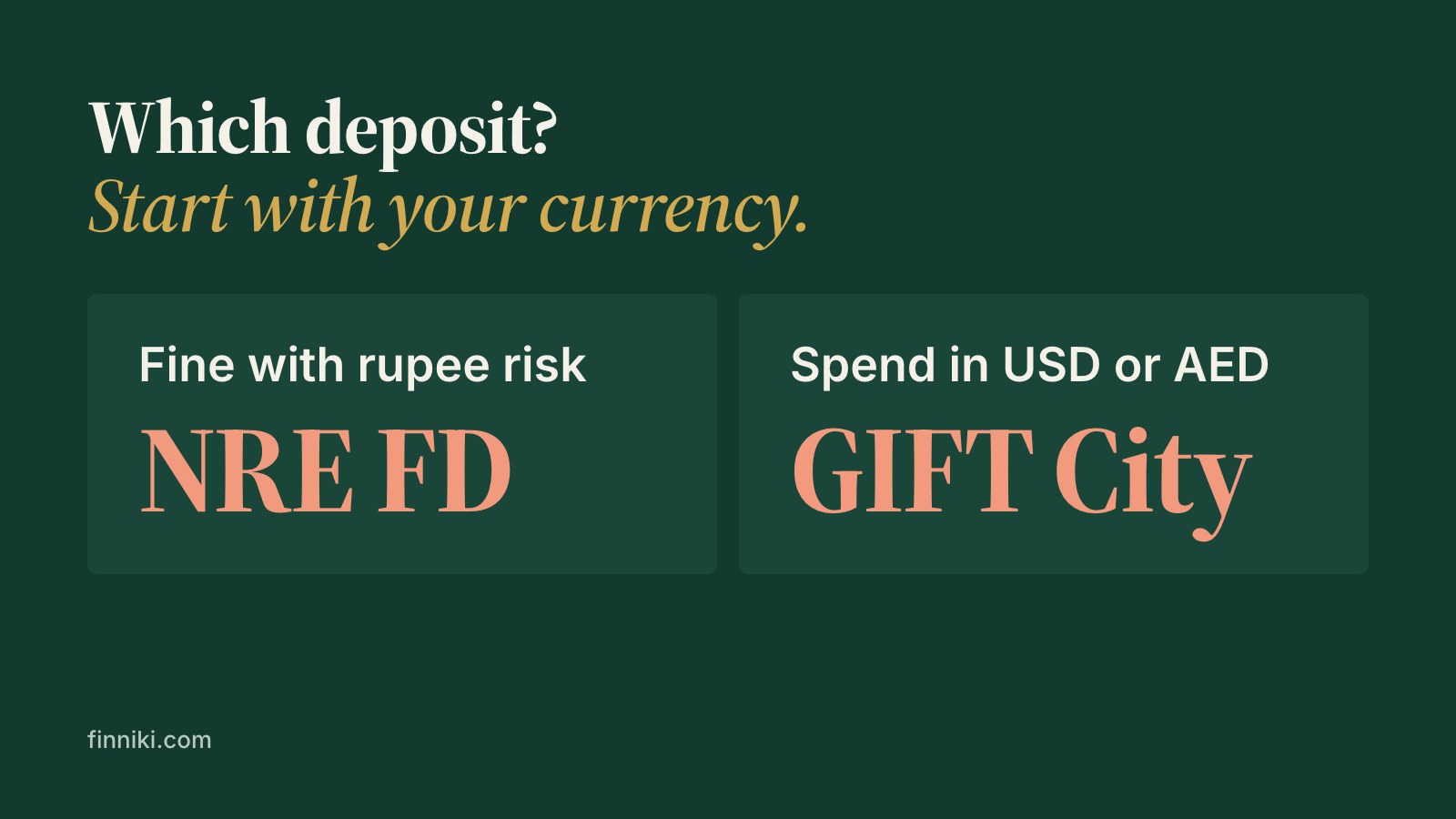
- Fine with rupee exposure: if you believe the higher INR return is worth the risk, an NRE FD can still be the right call.
- Money headed for dollar or dirham spending: a child's college fees in dollars, or a retirement spent partly in dirhams, is where GIFT City starts to matter.
GIFT City doesn't always pay more. Most of the time it won't. It gives you a choice you didn't have before: to let your money be in the currency your life is lived in.
What is GIFT City, and what does it offer an NRI?
GIFT City is India's International Financial Services Centre. It operates under the International Financial Services Centres Authority (IFSCA) and provides financial services in an international environment from inside India.
Banks with International Banking Units in GIFT City can offer foreign-currency accounts in USD, EUR or GBP, depending on the bank and the product. Unlike a traditional NRE account, where your money becomes rupees the moment it lands, the core transaction here can stay in foreign currency throughout. It is a little like a duty-free zone for your money: an Indian institution, on Indian soil, under a different set of rules.
What can an NRI invest in through GIFT City?
Through the IFSC, NRIs can reach exchanges such as India INX and NSE IFSC. Depending on the exchange, your intermediary, your investor category and what is listed at the time, these may give access to equities, ETFs, REITs, InvITs, bonds and certain global securities, potentially including exposure to markets like Europe, Taiwan, Korea and China. What is available depends on your broker, your eligibility and the product documents, so don't assume unrestricted access to any specific market.
Beyond exchanges there are IFSC-based mutual funds, Alternative Investment Funds (AIFs), portfolio management services and other structures. An IFSC AIF can give access to Indian private equity, real estate or infrastructure while letting you invest and redeem in a foreign currency.
Some private-market products have high minimums, potentially around USD 150,000, depending on the scheme and investor category. A smaller investor may find a foreign-currency deposit the more realistic entry point.
If you move from Dubai to Singapore, or back to India, the investment doesn't necessarily have to be rebuilt from scratch. Your tax and compliance obligations can still change with residency, so review them when your circumstances change.
Is a dollar-denominated fund protected from the rupee?
No. Subscribing and redeeming in dollars gives you convenience, not insulation. If the fund owns Indian equities, real estate or infrastructure, its underlying value still moves with the rupee. A dollar-denominated fund is not automatically a dollar-protected investment.
The useful split is this: keep dollars in something genuinely insulated, such as a foreign-currency deposit, and separately choose Indian-market exposure with a clear view of the currency risk.
How is GIFT City taxed for an NRI?
On the Indian side, certain eligible IFSC bank deposits are exempt from Indian income tax, and eligible securities traded on an IFSC exchange may qualify for exemption from Securities Transaction Tax (STT) and Commodity Transaction Tax (CTT). The product, your residency and the structure all matter together.
The Indian exemption is only one side of the calculation. Your home country still has its say:
- US: your worldwide income and holdings can create US tax and reporting obligations, and some fund structures bring extra US complications. Nothing shows up until you file your return and a tax professional asks what foreign holdings you have.
- UAE: there is no personal income tax, so the Indian exemption can mean real savings.
- UK: your worldwide income is still taxable whatever India exempts.
- Singapore or other lower-tax countries: the maths can still work, but check how that country treats foreign-sourced investment income. Lower tax is not no tax.
So never ask only "is this tax-free in India?" Ask what the total tax and reporting cost is, in India and wherever you file.
Is there a GIFT City pension for NRIs?
A framework now exists, but check whether a scheme is actually open to you. The video, recorded earlier, described IFSCA's foreign-currency pension plan as a consultation paper. Since then IFSCA has notified the Pension Fund Regulations, 2026 (30 March 2026). Whether a specific scheme is available for you to buy depends on pension fund managers launching one, so confirm that before planning around it.
The idea behind it is a retirement bridge. A typical NRI saves in foreign currency for 15 to 20 years, then has to decide how much to convert before returning to India. Someone who is 50, has earned in dollars for 20 years and expects to return at 60 doesn't have to turn the whole portfolio into rupees on the day they land. They can build the transition gradually, currency by currency: some US investments, some Indian equity, some rupee assets for expected Indian expenses, and a portion of the corpus in foreign-currency investments through GIFT City.
Can an NRI buy property in GIFT City?
Yes, NRIs can consider residential property in the domestic part of GIFT City, subject to FEMA, RBI and the usual property rules, including the standard carve-outs on agricultural land, plantations and farmhouses. At heart it is an ordinary property investment, with the usual rental income, appreciation, vacancy and liquidity risk.
You can also get real-estate exposure through REITs, InvITs and real-estate funds. These are not interchangeable with a direct purchase or with each other. GIFT City the financial centre and GIFT City the property market are two different decisions that share a name.
Who should consider GIFT City?
- Meaningful foreign-currency savings: you want Indian exposure without converting everything to rupees.
- A long-term retirement bridge: you are building one between life abroad and life in India.
- Low-tax residence such as the UAE: the case can be especially strong, but form your own view.
- UK or US residents: work out the benefit after local tax, not before it.
- A smaller portfolio and a simple parking spot for cash: you may not need the complexity.
Some GIFT City products carry lock-ins or limited liquidity, and regulations can change. Treat it as one building block, not a magic tax-saving button.
FAQs
What is GIFT City?
GIFT City is India's International Financial Services Centre (IFSC), regulated by IFSCA. It provides international financial services, including foreign-currency accounts and investments, from inside India.
Can NRIs open a dollar account in GIFT City?
Banks with International Banking Units in GIFT City can offer foreign-currency accounts in USD, EUR or GBP, depending on the bank and the product.
Is GIFT City deposit interest tax-free for NRIs?
Certain eligible IFSC bank deposits are exempt from Indian income tax. Your home country may still tax the interest, so check its rules before assuming it is tax-free.
Does a GIFT City deposit protect me from rupee depreciation?
A deposit held in dollars avoids the rupee-versus-dollar swing. It does not remove bank risk or liquidity risk, or currency risk if you spend in another currency.
Why do GIFT City deposits pay less than NRE FDs?
You are comparing a dollar return with a rupee return. The two numbers are not like for like, and the NRE FD's rate advantage can shrink if the rupee weakens.
Are dollar-denominated GIFT City funds safe from currency risk?
No. If the fund holds Indian equities, real estate or infrastructure, its value still moves with the rupee even if you subscribe and redeem in dollars.
Can NRIs buy property in GIFT City?
Yes, in the domestic part of GIFT City, subject to FEMA, RBI and the usual property rules. It is a normal property investment with the usual risks.
Is there a GIFT City pension scheme for NRIs?
IFSCA notified its Pension Fund Regulations, 2026 on 30 March 2026. Whether a scheme is open for you to buy depends on fund managers launching one, so check before relying on it.
Plan your currency mix before you move money
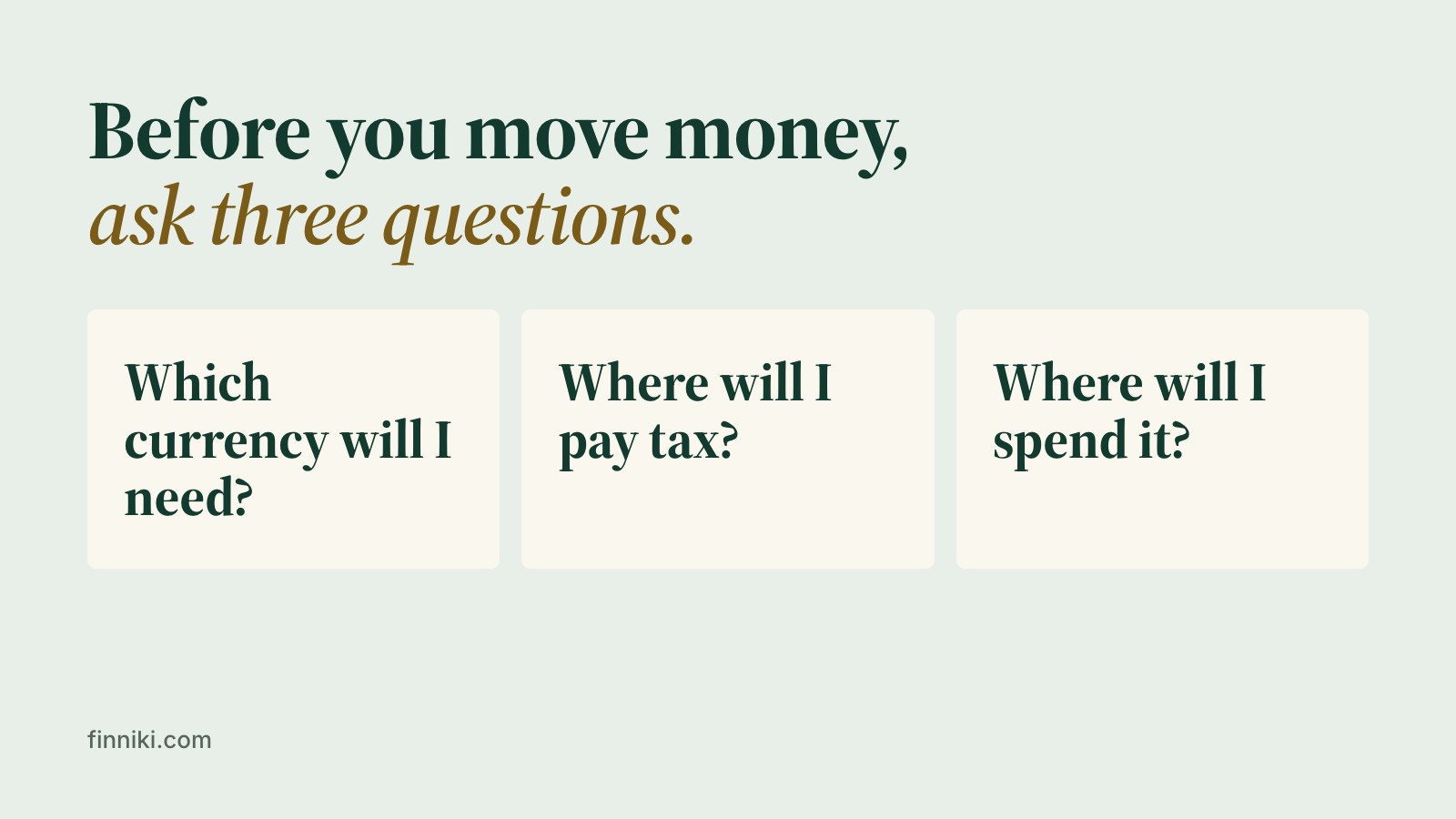
Before you convert a rupee, ask three questions: which currency will I need, where will I pay tax, and where do I plan to spend this money?
If you want help working out your NRE, FCNR, overseas and GIFT City mix, book a session. To compare deposit options, use the NRE vs FCNR tool, and for more explainers see our videos.
General information, not advice for your situation. Rules change; check your own numbers with a CA before you act.