NRI Repatriation: Move Money Out of India Without Delays
How NRIs move money out of India: NRE vs NRO, the USD 1 million NRO limit, Forms 15CA and 15CB, and four mistakes that keep money stuck.

Nikhil Varghese, CA · 7 min read
Quick answer: NRI repatriation means moving money from India to your overseas bank account, legally. Whether and how much you can move depends on two things: where the money came from and which account it sits in. NRE and FCNR balances are fully repatriable with no limit. NRO balances need your taxes settled and Forms 15CA and 15CB, and capital is capped at USD 1 million per financial year. The mistake that keeps money stuck for months is mixing everything into NRO and keeping no papers: plan the account and the documents before you need the money.
 Watch the 11-minute episode: NRI repatriation, why your money gets stuck and how to fix it
What is repatriation for an NRI?
Repatriation is transferring money from India to your overseas bank account. If money leaves India and reaches your foreign account legally, that is repatriation. The rules apply equally to NRIs who are Indian citizens and to OCI cardholders.
The transfer itself isn't the hard part. The rules are: which money can move, how much, and on what conditions. India regulates foreign exchange through FEMA (the Foreign Exchange Management Act). FEMA doesn't stop NRIs taking money abroad; it makes sure the source is legitimate and the taxes are settled first.
Think of it like airport security. Your passport gets you through immigration, but what's in your bag decides whether you walk through or get pulled aside. Your NRI status is the passport. The source of your money and the account it sits in are what's in the bag.
What is the difference between repatriating income and capital?
Repatriation falls into two buckets, and the rules differ:
- Income: money you earn in India, such as rent, interest, dividends, pension or consultancy fees. Income earned legally and taxed properly is generally repatriable.
- Capital: the original amount you invested, such as money used to buy property, mutual funds or shares. This is where limits and FEMA restrictions apply.
Many NRIs assume that if their income can move, their capital can too. That assumption causes problems later.
How does repatriation work, step by step?
Your bank handles the transfer, but only once you've shown where the money came from and that the tax is paid.
- Identify the source. The bank will ask where the money came from: salary, rent, a property sale, an inheritance. Your answer decides everything that follows.
- Settle the tax. Repatriation itself isn't taxed, but the income or gains you earned in India may be. Before the money leaves, the bank must confirm the tax is paid. This is where Form 15CA (an online declaration) and Form 15CB (a chartered accountant's certificate confirming tax compliance) come in.
- Submit your request to the bank. Once your documents are verified, the bank processes the transfer.

In practice, delays happen when documents are incomplete or the source is poorly explained. Most repatriation delays aren't because the rules are strict; they're because the preparation is weak.
 Watch the 2-minute short: the NRO repatriation tax myth
Which NRI accounts allow repatriation: NRE, NRO or FCNR?
India offers NRIs three kinds of account, and each behaves very differently when you want to move money out:
- NRE (Non-Resident External): for income earned outside India. Principal and interest are fully repatriable, with no limit.
- FCNR (Foreign Currency Non-Resident): deposits held in a foreign currency such as USD, GBP or EUR. Also fully repatriable, with no limit, and it protects you against currency risk.
- NRO (Non-Resident Ordinary): for income earned in India, such as rent, dividends and pension. Repatriation is restricted: capital is capped, and every transfer needs documents.
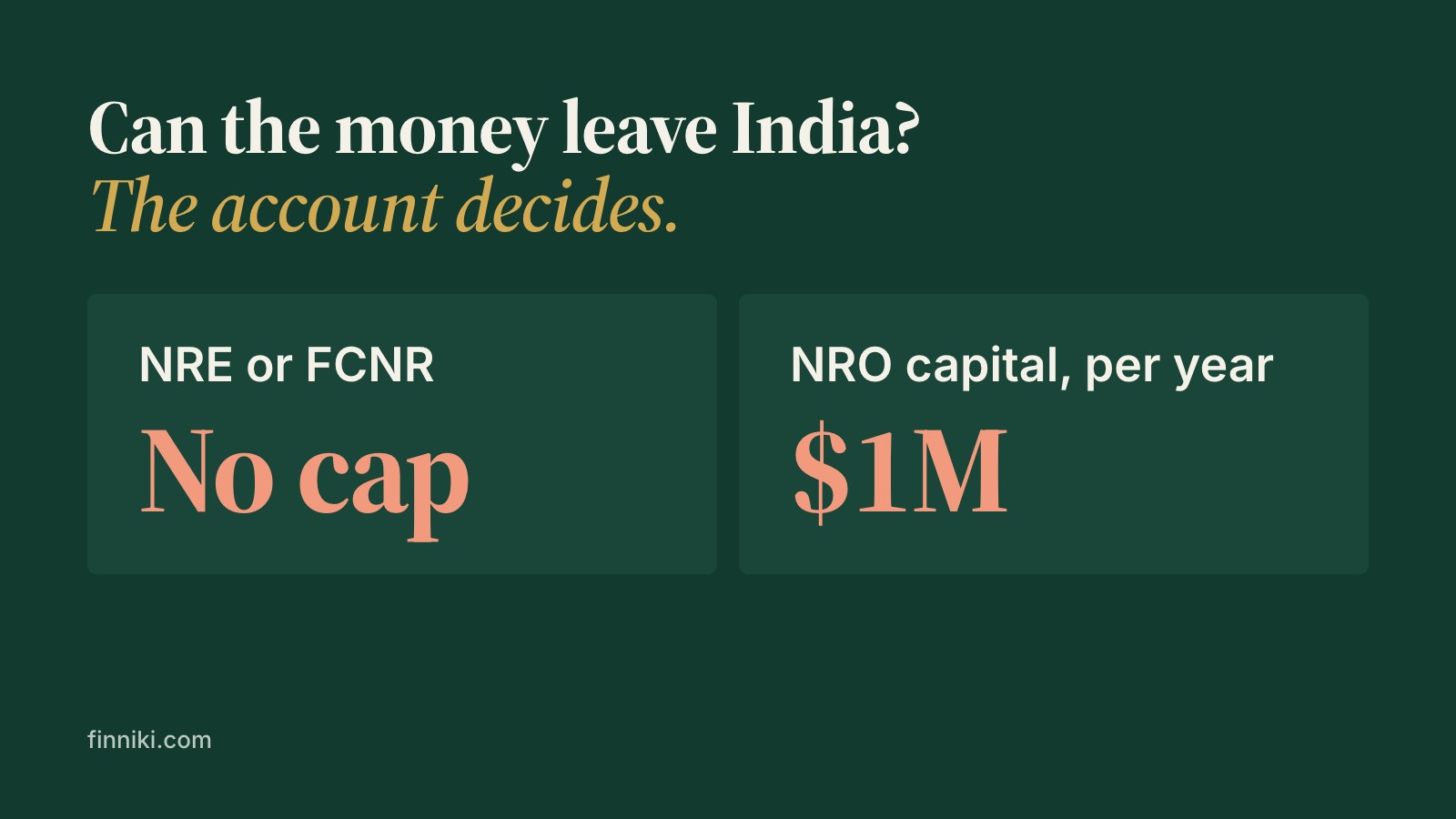
Choosing the account isn't about convenience: it decides how easily your money moves when you need it. For how NRE and FCNR deposits compare, see NRE vs FCNR: which one pays more.
What happens when you repatriate without preparing?
It can take months instead of days. Take an NRI in Dubai who sells his late father's apartment in Mumbai for about ₹2 crore. He puts the money in his NRO account and expects to move it to Dubai within a week or two. It's his money, and he has paid his taxes.
Weeks pass, then months. The bank asks for the property documents. Then the sale deed. Then Form 15CB. Then whether the flat was inherited or bought. Then RBI approval, because the structure of the amount was unclear.
He did nothing wrong. He just didn't know the rules before he started.
What is the USD 1 million limit on NRO repatriation?
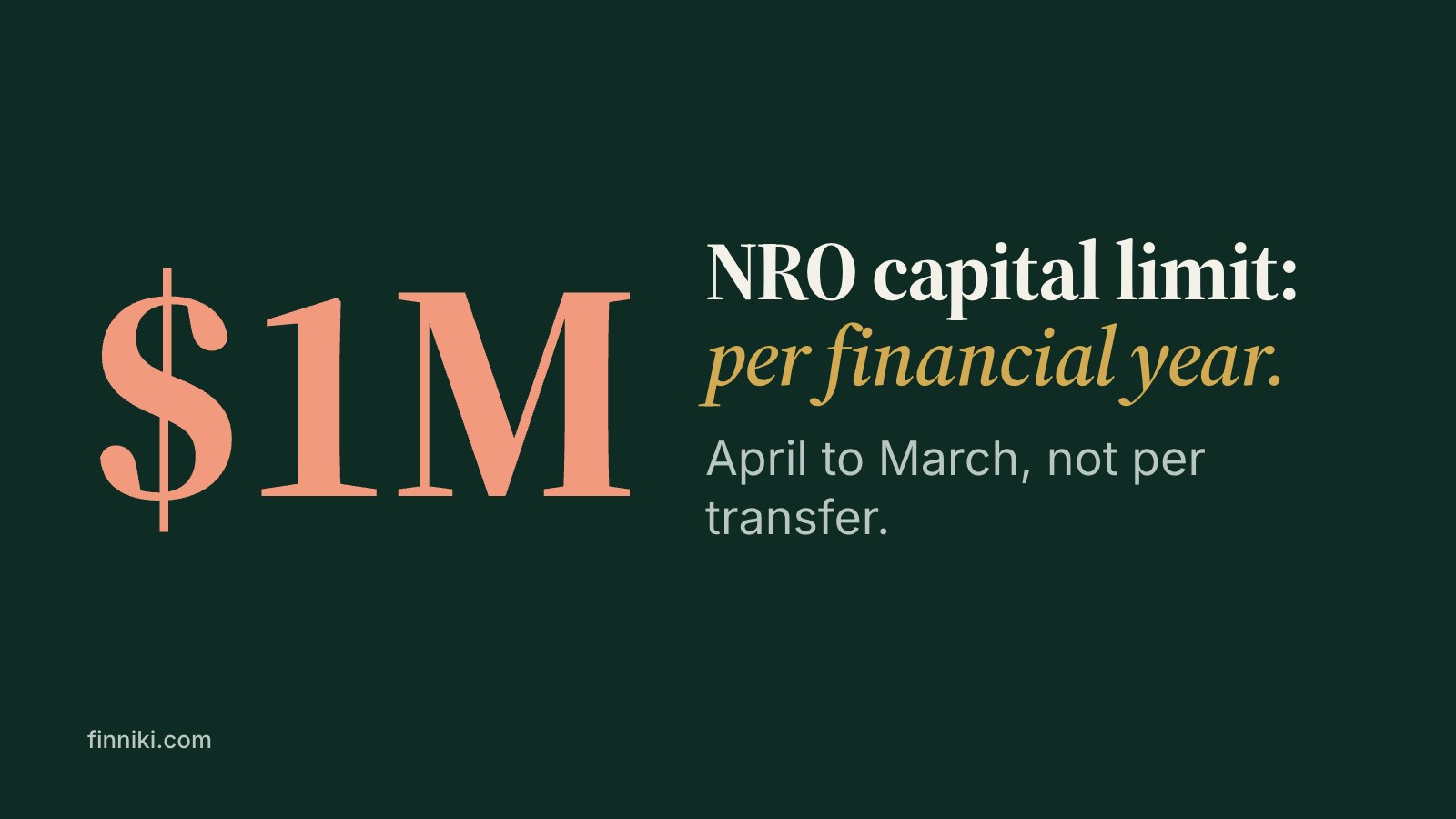
You can repatriate up to USD 1 million per financial year (April to March) from your NRO account, and only after the taxes are paid and the forms are filed. The limit applies to capital, not to current income: rent, dividends and interest are fully repatriable with no limit.
Don't confuse it with USD 250,000. That limit belongs to the Liberalised Remittance Scheme (LRS), which is for residents of India sending money abroad. LRS does not apply to NRIs.
With real numbers:
- Sell a property for ₹2 crore (roughly USD 220,000) and it fits within the limit: you can repatriate it in one year.
- Sell for ₹10 crore (roughly USD 1.1 million) and you're over the limit. Either spread the transfer across two financial years or seek RBI approval.
Above the limit, RBI approval adds time and paperwork, and in most cases approval isn't granted. Plan to stay within the yearly limit.
Common repatriation mistakes NRIs make
Four mistakes cause most of the months-long delays:
- Using the wrong account from the start. Many NRIs put everything into NRO: overseas income, Indian income, property proceeds, all mixed. When it's time to repatriate, the bank can't separate what's freely repatriable.
- Not keeping documents over the years. Repatriation can need proof from years ago: original purchase agreements, inheritance documents, old tax returns. Without them you'll spend weeks hunting.
- Leaving tax until the last moment. Banks won't process repatriation until taxes are settled. If you haven't filed your returns or paid capital gains tax, you're stuck.
- Misreading the USD 1 million limit. It isn't per transaction. It's per financial year, April to March, across all your NRO capital repatriation.
Does the investment decide whether money can be repatriated?
No. The source of the funds decides it, not the investment. Invest ₹50 lakh in mutual funds from your NRE account and it is fully repatriable. Invest the same ₹50 lakh from your NRO account and it falls under the USD 1 million limit.
Same investment, different account, a completely different experience when you want the money out. The account you invest from matters more than most people realise.
How does repatriation work for property, students and foreign currency?
- Property sale proceeds come with extra conditions, especially for inherited property: original purchase documents, proof of inheritance and tax certificates. Above USD 1 million, RBI approval is needed.
- Students who earn income in India are treated as earning Indian income. It goes through an NRO account and follows the same repatriation rules as everyone else.
- Foreign currency you brought into India can be repatriated if you declared it properly. Undeclared currency is very difficult to move back.
How to plan repatriation before you need it
The best decisions are made before you invest, not when you want the money out:
- Choose the right account from day one.
- Route overseas earnings to NRE and Indian earnings to NRO.
- Keep your documents organised, especially for property and inheritance.
- Understand the tax before a transaction, not after.
- Know how the exit works long before you need it.
Had the NRI in Dubai done this, he would have had his father's property documents in order, known the USD 1 million limit before the sale, arranged Form 15CB in advance and had ready everything the bank asked for. Instead of months, it could have taken a couple of weeks.
Repatriation rewards the prepared and punishes the hopeful. Wealth isn't only what you earn or invest; it's what you can reach without friction.
FAQs
Is repatriation from India taxed?
No. Repatriation itself isn't taxed, but the income or gains you earned in India may be, and the bank must see that tax settled before the money leaves.
Can OCI cardholders repatriate money from India?
Yes. The repatriation rules apply equally to NRIs who are Indian citizens and to OCI cardholders.
How much can an NRI repatriate from an NRO account?
Up to USD 1 million of capital per financial year (April to March), after taxes are paid and forms filed. Current income such as rent, dividends and interest has no limit.
Is there a limit on repatriating from an NRE or FCNR account?
No. NRE and FCNR balances, principal and interest, are fully repatriable with no limit.
Does the USD 250,000 LRS limit apply to NRIs?
No. The Liberalised Remittance Scheme limit is for residents of India sending money abroad; NRIs repatriate under the NRO and NRE rules instead.
What are Forms 15CA and 15CB?
Form 15CA is an online declaration made before money is sent abroad. Form 15CB is a chartered accountant's certificate confirming the tax has been paid.
What if a property sale is worth more than USD 1 million?
Spread the transfer across two financial years, or seek RBI approval. Approval adds time and paperwork and is often not granted.
Can I repatriate money from inherited property?
Yes, with extra documents: the original purchase papers, proof of inheritance and tax certificates. Above USD 1 million, RBI approval is needed.
Plan your repatriation
If you're selling property, sitting on a large NRO balance or unsure which account your money should be in, book a consultation and bring your documents. More explainers are on the videos page.
General information, not advice for your situation. Rules change; check your own numbers with a CA before you act.