OCI Card Rules 2026: Passport, Arrival, Cancellation
Six OCI rules changed in 2026: passport update, e-arrival form, restricted activities, cancellation, and the tax and bank traps. What to do before you fly.

Nikhil Varghese, CA · 10 min read
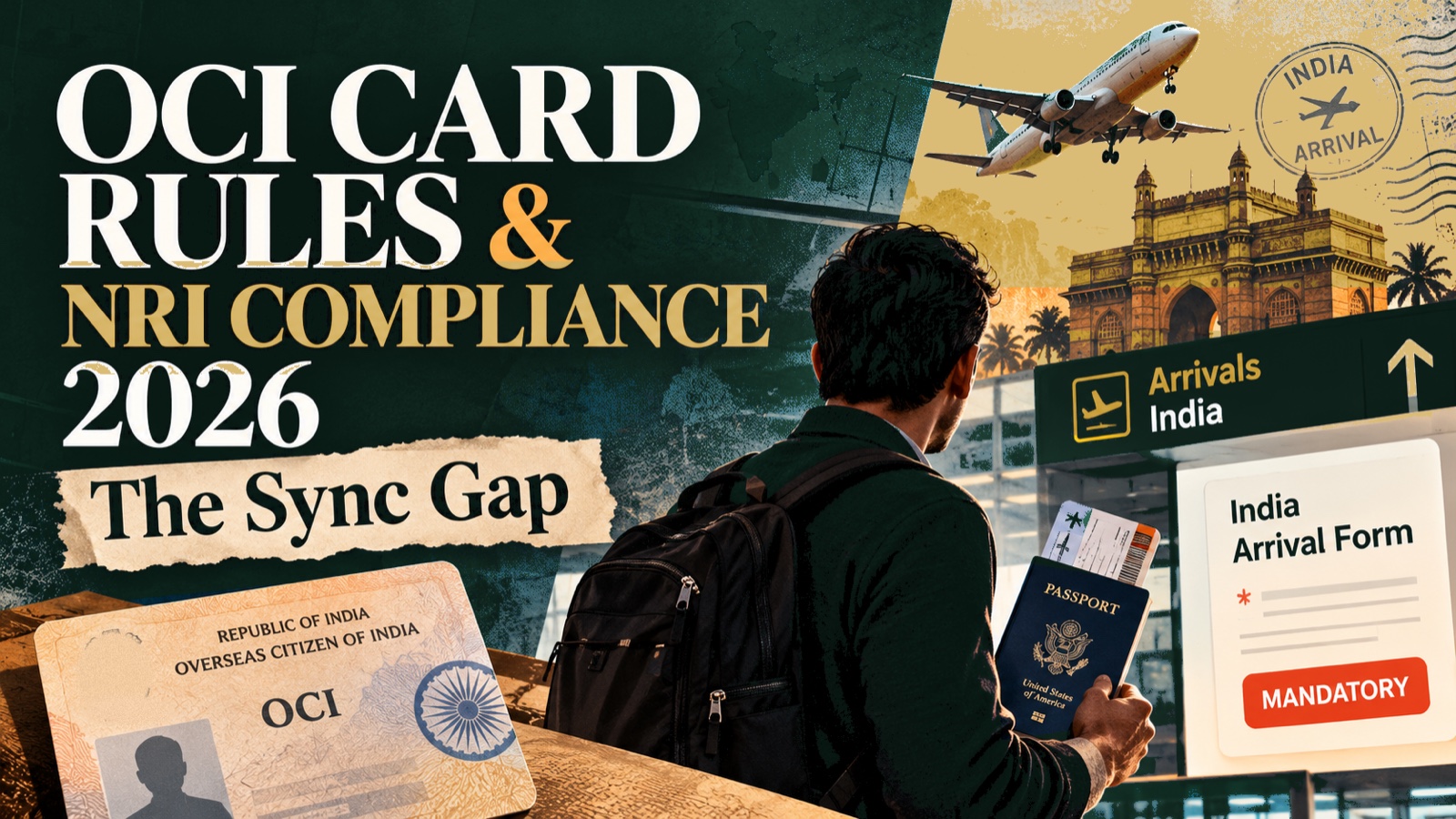
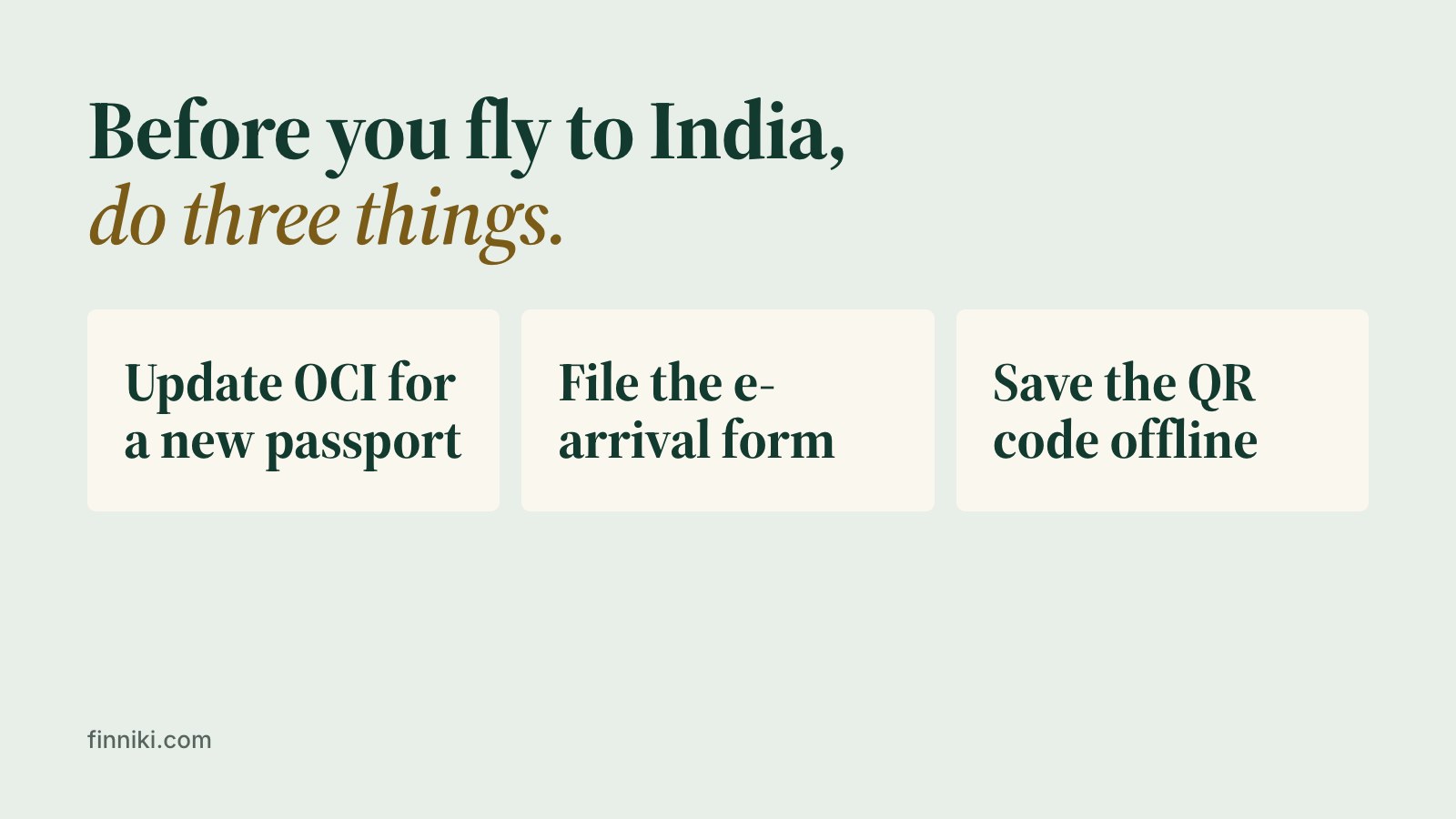
Quick answer: Six things changed or got stricter for OCI cardholders, and they share one cause: your OCI card only works smoothly when it matches what your passport, your bank and the tax department hold about you. Update your OCI record within three months of a new passport, file the e-arrival form before every trip to India, and clear restricted activities such as journalism or research with the FRRO or your mission first. Your OCI card has no say over your tax residency or your NRE and FCNR accounts: your days in India and your FEMA residency do. Check each of the six before you fly, because nothing warns you when they drift.
Updated October 2026. The digital e-OCI launched on 30 June 2026 under the Citizenship (Amendment) Rules 2026, in force from 1 May 2026, and the old paper arrival form was phased out from 1 April 2026. Rules for OCI holders change often, so confirm anything that affects a booking on the official OCI portal or with your nearest Indian mission.
 Watch the 17-minute episode: New OCI rules 2026: passport, travel, cancellation and tax
What is an OCI card, and what does it not give you?
An OCI card is a lifelong, multiple-entry visa, not proof of citizenship and not a passport. India does not allow dual citizenship, so it cannot be either.
It lets you live in India for as long as you like, work in the private sector, own residential and commercial property, and enter without a fresh visa. It does not give you the right to vote, a government job, or the right to buy agricultural land. You cannot hold an Indian passport and an OCI card together, and the day you take Indian citizenship back, your OCI is automatically surrendered.
Think of your passport as your identity and your OCI as an entry pass riding on top of it. The pass is only as good as its link to the identity underneath. The video calls any break in that link the Sync Gap: a mismatch between your OCI, your passport, your bank's records and the tax department's records. None of the six gaps below announces itself. Your card and your accounts keep working until a departure gate, a bank counter or a court filing shows the mismatch.
Do you have to update your OCI when you renew your passport?
Yes. Your OCI record stays linked to your old passport number until you change it yourself, and the system does not do it in the background.
- Deadline: upload the new passport details on the OCI portal within three months of the passport being issued. It costs nothing if you do it in time.
- Late: you are not locked out. A penalty of US$25, plus a small charge that goes to the Indian Community Welfare Fund, applies, and the update still goes through.
- Where: the OCI Miscellaneous Services section of the portal. If your documents are ready, it takes about 30 to 40 minutes.
- If the portal sends you to what looks like a new application: ask your nearest Indian consulate or mission to walk you through it.
Have these ready first: the old and new passports as PDFs under 1 MB each, a photo and signature as JPEGs, your old Indian-linked passport number, your naturalisation date if it applies, and a signed self-declaration explaining the change. Screenshot every confirmation page and acknowledgement number. That is your proof if anything is questioned later.

 Watch the 35-second short: Renewed passport? Your OCI might be flagged
If you travel before the update is done, carry your OCI card and your current passport. The requirement to carry your old, expired passport has been dropped, but some missions still recommend it, because the new passport may not be fully linked yet. Packing it costs nothing.
Does your age change what you must do with your OCI?
Less than it used to. The 2026 change removed the last age trigger for a physical reissue.
- Under 20: every new passport, upload a copy and a recent photo. No physical card is needed.
- Turning 20: this used to force a new physical card in person. The e-OCI rules replaced that with an online passport update. An official Indian mission notice dated 23 July 2026 says holders now update their passport details online and give biometric information to the mission or FRRO, either during the update or at their next entry or exit.
- 21 to 49: nothing new this year. You have been able to update online without a reissue under an older relaxation.
- 50 and over: the one-time reissue people still ask about was dropped before 2026, not by the 2026 rules.
So at 25, 45 or 65, a new passport means an online update. Keep the same screenshot habit. Skipping an update does not lock you out, but it means redoing the upload later under time pressure.
Is the India e-arrival form mandatory for OCI cardholders?
Yes. Every OCI cardholder must complete an electronic arrival form before landing in India, and this has applied since October 2025.
- Where: indianvisaonline.gov.in/earrival, or the Indian Visa Su-Swagatam app.
- When: within 72 hours before landing. The video's practical tip is to do it at least 48 hours before you depart, once the system on India's side has your details. Check you are still inside the 72-hour window if your journey is long or has a long layover.
- Airlines can refuse boarding. The form is checked at your departure gate, before you leave your own country, not only at an Indian immigration counter. The video's example is an NRI at New York's JFK, asked 40 minutes before boarding whether the form was done.
- Save the QR code offline. Some travellers have reported immigration officers struggling to find a completed form in the system. Screenshot the confirmation and QR code and keep them where you can open them without the internet, not only in an email.
Reporting says the paper disembarkation form was phased out entirely from 1 April 2026, with airlines facing fines for passengers who arrive without the e-arrival form. The date comes from travel-advisory and news reports, not one government notice that the video could point to, so treat it as the safer assumption either way.
Which activities need government clearance for an OCI cardholder?
A specific list needs prior approval from the FRRO or your Indian mission, and skipping it can trigger cancellation of your card.
- Journalism and media work
- Academic or field research
- Mountaineering and certain adventure sports
- Work connected to a foreign government organisation or diplomatic mission in India
This is not only for working journalists. An extended stay where you plan to write about your trip, do academic fieldwork, or take on research work for a foreign university is on the list too. If your stay involves any consulting, writing or research, check this before you land, not after. Getting the clearance is the easy part.
Can your OCI card be cancelled?
Yes, though not automatically. These are the grounds the video lists:
- False information in your original application, even if it surfaces years later.
- Activities considered against national interest, such as certain demonstrations, specific social media content or unauthorised engagement with foreign government organisations.
- A conviction carrying a sentence of two years or more in prison.
- A formal charge for an offence that carries a possible sentence of seven years or more. Under the August 2025 notification, the charge alone is enough for the process to start, without a conviction.
These apply worldwide, not only to what happens in India. For the criminal grounds, the offence is covered whether it happened in India or abroad, as long as it is recognised as an offence under Indian law.
For almost every OCI holder none of this applies. If the government believes there is a reason, it sends a formal notice first and gives you a chance to explain. Courts have set aside cancellation orders where the process was not followed. There is no simple appeal form, so a dispute that goes further means the legal system.
 Watch the 43-second short: You can lose your OCI without a conviction
If your work touches journalism, research, politics or anything that could end up in a headline or a charge sheet, get a lawyer's view of your own situation early. One conversation costs an afternoon. Losing the card costs far more.
Does your OCI card decide your tax residency or your bank accounts?
No. This is the biggest misunderstanding in the whole list, and the one the video says costs people the most.
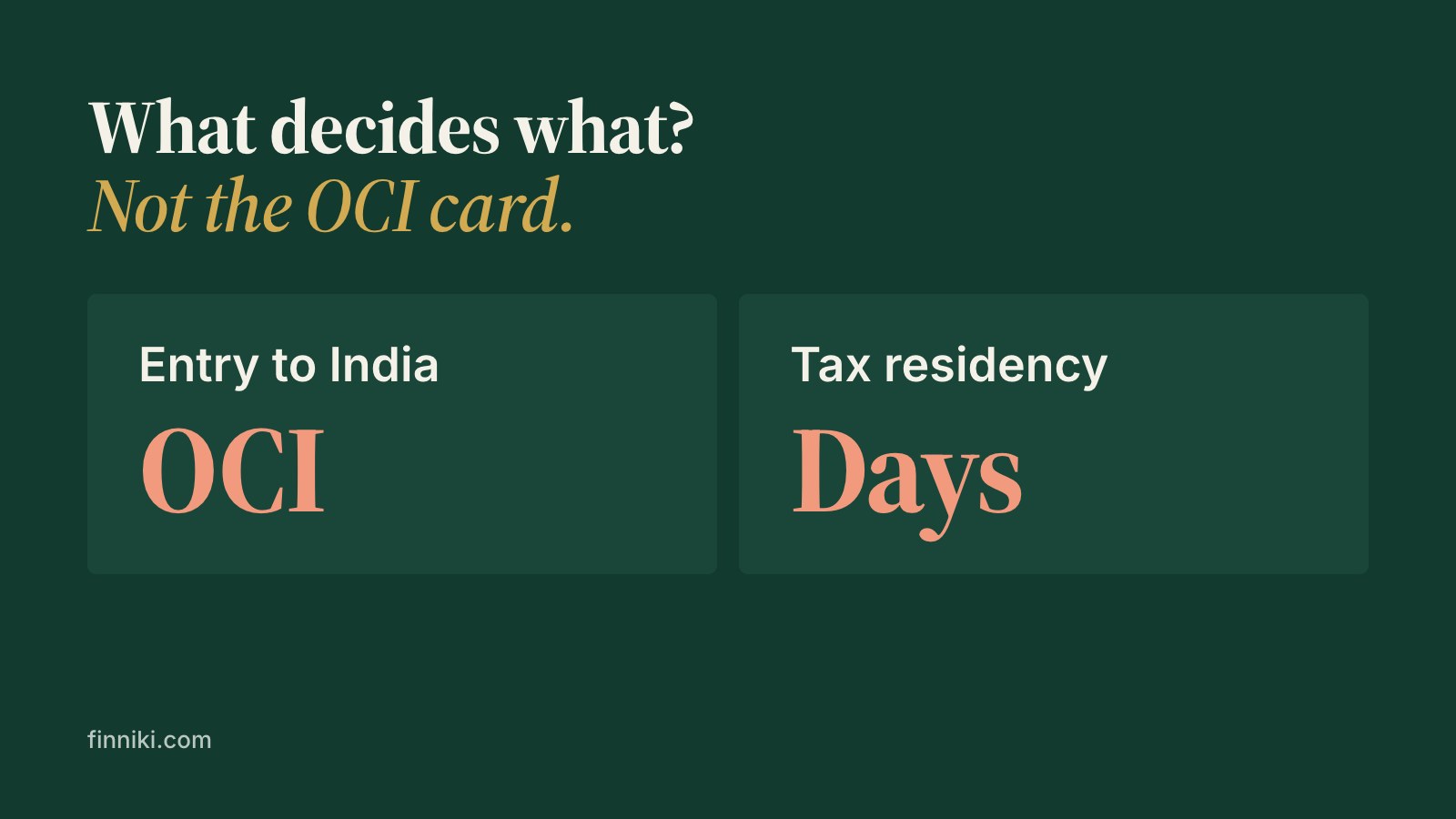
- Tax residency depends on how many days you spend in India in the financial year. Your OCI card does not move that number. Keep your own running day count, updated every time you fly. The NRI status calculator shows where you stand.
- Banking status follows your residency under FEMA, not your OCI status. The moment you become a resident under FEMA rules, your NRE and FCNR accounts have to be redesignated. Plan this before you move back, not after. Your bank will not find out on its own, any more than your OCI record learns about a new passport.
- Property: an OCI holder can buy and hold residential and commercial property in India. Agricultural land, farmland and plantation property are generally off the table. If your family owns farmland and you expect to inherit it, talk to a lawyer well before that day.
- Citizenship: taking Indian citizenship again surrenders your OCI automatically.
One myth to drop: an OCI holder does not have to register with the FRRO just for staying in India more than 180 days. That rule is for certain visa holders. You only need to inform the FRRO if your permanent address or your occupation changes.
What are the six Sync Gaps in one list?
- Passport number: update within three months, free. After that, US$25 plus a small charge, and you are still fine.
- Age: under 20, upload every passport change. After 20, no physical card reissue; update online.
- Arrival: e-arrival form within 72 hours before landing, ideally about 48 hours before you fly. Keep the QR code offline.
- Activities: journalism, research, mountaineering and foreign-government work need clearance first.
- Record: false declarations or serious offences, in India or abroad, can cost you the card.
- Money: property yes, farmland no. Your OCI card has no say over tax residency or banking status.
The rules themselves have got simpler: the physical booklet reissues at 20 and 50 are gone, and most updates take under an hour online. The real risk is running on the old rules and finding out at a check-in counter, a bank branch or a government office.
FAQs
Is an OCI card the same as an Indian passport or citizenship?
No. It is a lifelong, multiple-entry visa. You cannot hold it together with an Indian passport, and taking Indian citizenship surrenders it automatically.
How long do I have to update my OCI after a new passport?
Three months from the date the new passport is issued. It is free in that window. Later, a US$25 penalty plus a small Indian Community Welfare Fund charge applies, and the update still goes through.
Do I need to do anything to my OCI card when I turn 20 or 50?
No physical reissue is required at either age. At 20 you update your passport details online and give biometrics to the mission or FRRO at the update or at your next entry or exit. The age-50 reissue was dropped before 2026.
Is the e-arrival form compulsory for OCI holders?
Yes, since October 2025. File it within 72 hours before landing at indianvisaonline.gov.in/earrival or in the Indian Visa Su-Swagatam app, and save the QR code offline.
Can an airline stop me from boarding without the e-arrival form?
Yes. Airlines can deny boarding at the departure gate if the form is missing, before you leave your home country.
Can my OCI be cancelled if I have not been convicted?
It can start with a charge for an offence carrying seven years or more, under the August 2025 notification. Cancellation is not automatic: you get a formal notice and a chance to respond.
Does my OCI card affect my tax residency in India?
No. Your days in India in the financial year decide tax residency. Your OCI card does not change that count.
Do I have to register with the FRRO if I stay in India more than 180 days on an OCI?
No. That requirement is for certain visa holders. An OCI holder only informs the FRRO if their permanent address or occupation changes.
Get your OCI, tax residency and bank accounts in sync
If you are planning to move back, your OCI card is the easy part: tax residency and bank accounts are where people get caught. Book a one-to-one session to work through your own day count and account status, or watch more NRI explainers on our video page.
General information, not advice for your situation. Rules change; check your own numbers with a CA before you act.