Tax-Free Shopping Abroad: How VAT Refunds Really Work
How tourist VAT refunds work in Europe, Japan and Dubai, how much you really get back after fees, why governments offer them, and why India has none.

Nikhil Varghese, CA · 6 min read

Quick answer: Tax-free shopping lets tourists claim back the consumption tax (VAT, GST or sales tax) on goods they buy abroad and take home, because they will not use them in that country. You pay the full price in the shop, get a refund form, have the goods checked by customs at the airport and receive the refund, minus a commission. On a €10,000 bag in France, the 20% VAT inside the price is about €1,667, and after fees you might get roughly €1,200 to 1,500 back. Governments offer it because tourists then spend more, and many refunds go unclaimed. India's law allows refunds for foreign tourists, but the scheme has never been switched on.
Updated October 2026. Japan is moving from tax-free prices at the till to a refund system: for purchases from 1 November 2026, tourists pay the full price including the 10% consumption tax and get it back after a customs check when they leave. The examples below also correct the episode's arithmetic: a price that "includes 20% VAT" contains one-sixth of the price as tax, not one-fifth.
 Watch the episode: Don't pay tax when you travel! The trick behind tax-free shopping
What is tax-free shopping?
A refund of the local consumption tax on goods a tourist takes out of the country. Residents pay that tax because it funds the roads, hospitals and schools they use. A visitor is taking the purchase home and not using those services, so many countries let tourists reclaim it. The tax has different names: VAT in Europe and the UAE, consumption tax in Japan, sales tax in the US, where there is generally no tourist refund.
How does a tourist VAT refund work?
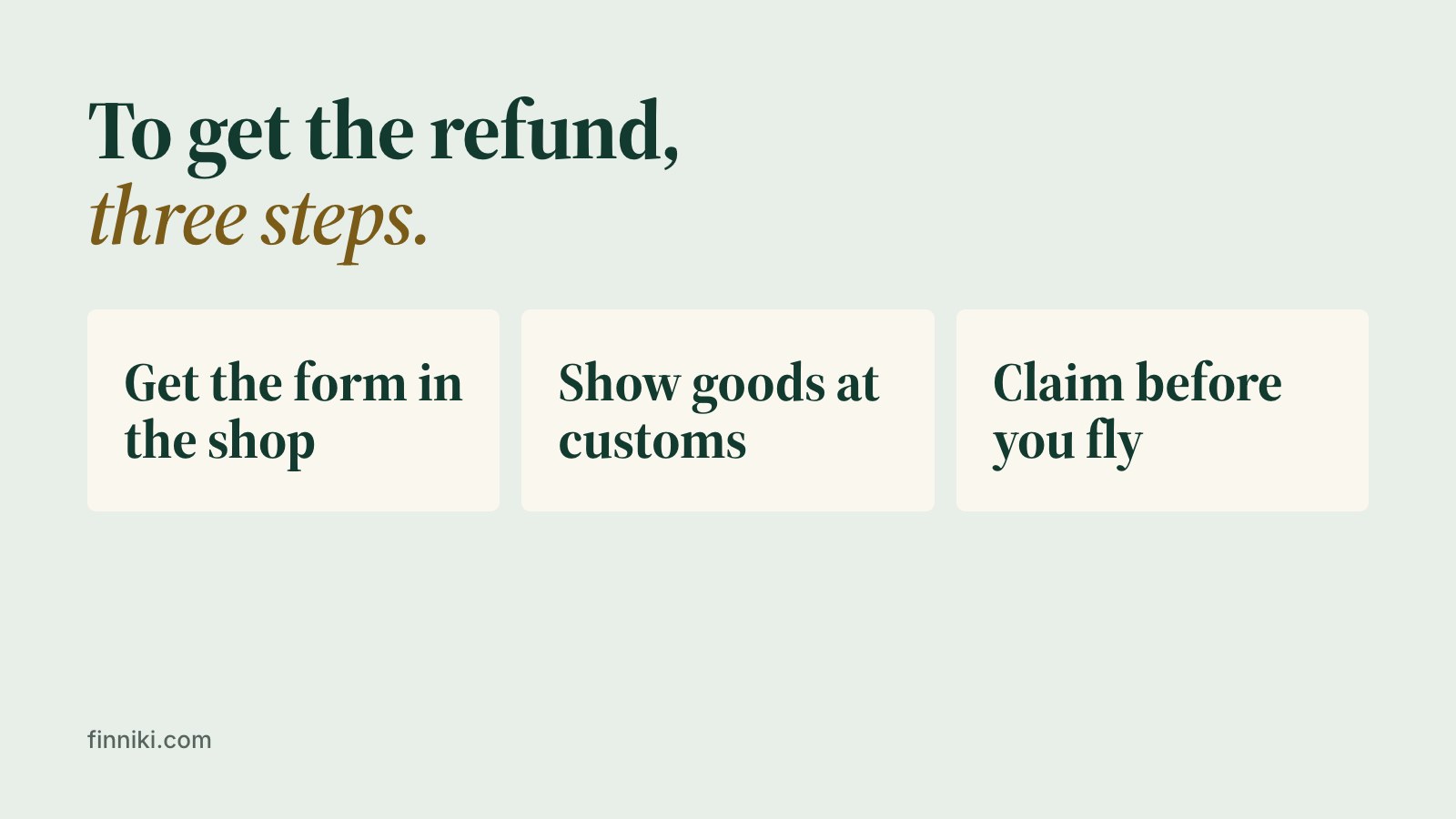
In four steps:
- Pay the full price in the shop, tax included, and ask for a tax-free or VAT refund form. Shops usually need your passport and a minimum spend.
- Keep the goods unused and the receipts with you.
- Get the form validated by customs or at a refund kiosk at the airport before you fly home. Customs may ask to see the goods, so do this before checking your bags.
- Receive the refund, from the government or a refund company such as Global Blue or Planet, to your card or in cash.
How much do you actually get back?
Less than the headline tax rate. Two things reduce it:
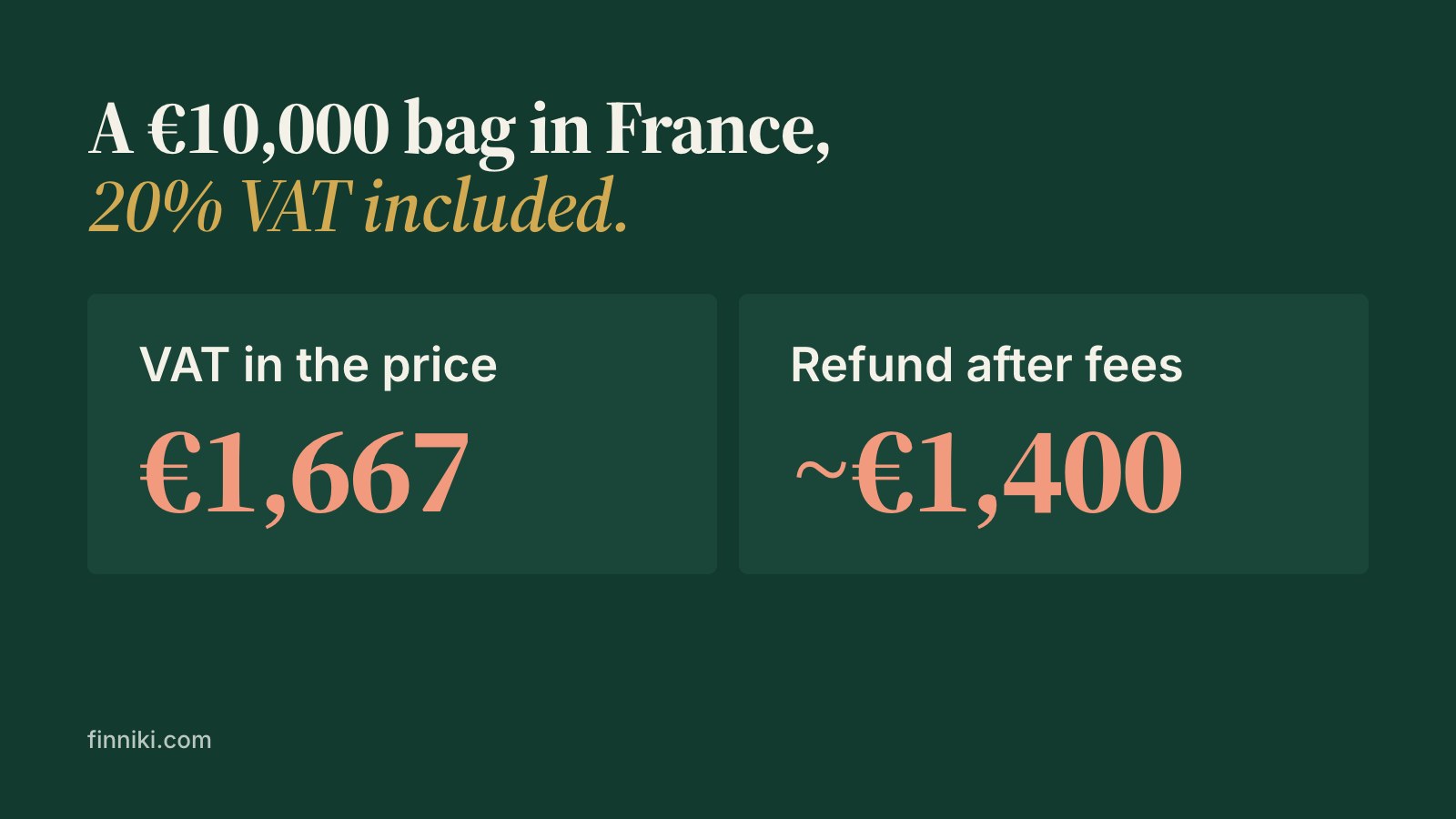
- The tax is inside the price. A €10,000 bag in France, where VAT is 20%, contains about €1,667 of VAT (one-sixth of the price), not €2,000.
- Refund companies take a commission, which can be a sizeable share of the refund.
So on that €10,000 bag you might walk away with roughly €1,200 to 1,500. The same arithmetic applies to a ₹10 lakh purchase: about ₹1.67 lakh of VAT inside it, and less after fees. It still feels like a big saving, which is the point.
Where can tourists shop tax-free?
- Europe: visitors from outside the EU can reclaim VAT across the European Union, which is why Paris, Milan and Madrid are global shopping magnets. Switzerland, outside the EU, has its own scheme at its lower VAT rate of 8.1%. The UK ended tax-free shopping for tourists in 2021.
- Japan: tourists can avoid the 10% consumption tax on purchases above a minimum (¥5,000 per shop per day). From November 2026 it becomes a refund: pay in full, then reclaim at departure after a customs check.
- Dubai and the UAE: when the UAE introduced 5% VAT in 2018, it launched a digital tourist refund system with airport kiosks where you scan receipts and passport and get the refund within minutes. It helped Dubai stay competitive with Singapore and Hong Kong.
- Elsewhere in Asia: South Korea, Singapore and Thailand run similar schemes.
Why do governments give tax back to tourists?
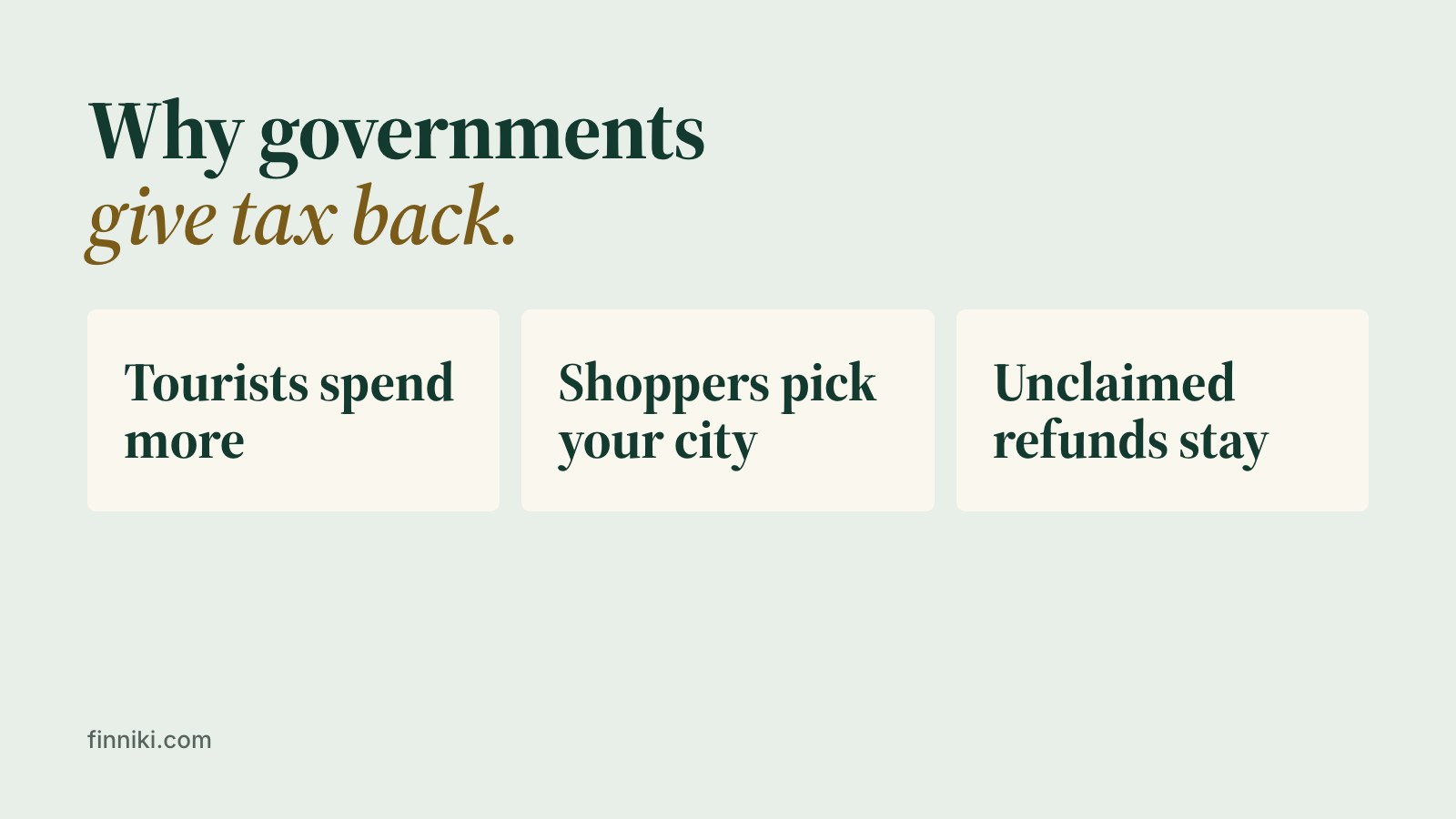
Because it pays them back in other ways:
- Tourists spend more. A refund makes a purchase feel like a smart deal, just as cashback does, so shoppers spend bigger.
- It wins shoppers from other countries. High-spending tourists choose cities where luxury goods effectively cost less.
- It boosts local business. More sales mean more jobs, fuller hotels and more flights, and the government collects other taxes on all of it.
- Many refunds are never claimed. Tourists forget, do not qualify or skip the queue to catch a flight, and that money stays with the government.
What are the catches?
For tourists, the paperwork: keeping receipts, filling in forms, airport queues, sometimes unpacking for customs, and commissions that can eat a large part of the refund. For governments, fraud: fake invoices and goods resold rather than exported, which is why there are minimum spends, time limits and restricted goods. And there is a fairness question, since locals pay the full tax while tourists get it back.
Can foreign tourists get a GST refund in India?
Not in practice. Section 15 of the IGST Act allows a refund of GST on goods that foreign tourists take out of India, but the rules and airport refund counters have never been put in place since GST began in 2017. Foreign tourists pay full GST and do not get it back. That is a missed opportunity: an easy refund could make India's luxury and retail sectors more attractive to international shoppers, as it has for Paris and Dubai.
Why does tax-free shopping make you spend more?
Because of how the refund reframes the purchase. When you expect money back, a luxury item feels like a sensible financial decision, even though you are spending more than you planned. It works like a limited-time offer, but gentler: instead of urgency, you feel the comfort of getting something back. That is why luxury brands love it.
Where is tax-free shopping heading?
Towards digital, frictionless refunds: app-based claims, QR-coded receipts and electronic verification at customs to cut fraud and queues. The easier the refund, the more tourists spend, and in the race for tourists the smoothest system wins.
FAQs
How do I claim a VAT refund when travelling?
Ask the shop for a tax-free form, keep the goods unused, get the form validated by customs or at a refund kiosk before you fly, then collect the refund to your card or in cash.
How much VAT do I get back in Europe?
Less than the VAT rate suggests. The tax is inside the price (about one-sixth at 20% VAT), and refund companies take a commission, so the refund on a €10,000 purchase is roughly €1,200 to 1,500.
Is shopping in Japan still tax-free for tourists?
Yes, but from 1 November 2026 it works as a refund: you pay the full price including 10% consumption tax and reclaim it after a customs check at departure.
Can tourists get VAT back in Dubai?
Yes. The UAE refunds the 5% VAT to tourists through a digital system with kiosks at the airport.
Can tourists claim GST back in India?
Not in practice. The law allows it under Section 15 of the IGST Act, but the refund scheme has never been put into operation.
Can I claim a tax refund in the UK?
No. The UK ended VAT-free shopping for tourists in 2021.
Spend smarter when you travel
A refund is only a saving if you would have bought the item anyway. Book a session to plan travel and big purchases within your budget, or find more episodes on FinNiki videos.
General information, not advice for your situation. Rules change; check your own numbers with a CA before you act.