Will the Dollar Reach ₹100? What It Means for Your Money
The rupee went from ₹3.30 in 1947 to about ₹96 in 2026. Why it keeps sliding, who wins and loses, and how to protect your portfolio from a weaker rupee.

Nikhil Varghese, CA · 5 min read

Quick answer: Probably, and sooner than many expected. The rupee has slid from about ₹3.30 a dollar in 1947 to about ₹96 in October 2026, after hitting record lows earlier in the year. It weakens because India's inflation runs above America's, productivity is lower, and India imports more than it exports, especially oil and gold. The RBI smooths the fall but does not reverse it. A weaker rupee raises the cost of fuel, foreign travel and study abroad, and helps exporters and NRIs. Protect yourself with some international funds and gold, and plan any dollar goal, such as a child's foreign education, in dollars.
Updated October 2026. When the episode was recorded in December 2025, the rupee had just crossed ₹90. By October 2026 it was around ₹96, so ₹100 is no longer a distant scenario.
 Watch the episode: Will the dollar reach ₹100? What it means for your money in India
How has the rupee moved against the dollar?
Steadily downwards, over decades:
- 1947: about ₹3.30. The rupee looked stable because exchange rates were fixed under the post-war Bretton Woods system and India tightly controlled its currency and trade.
- 1966: after wars in 1962 and 1965 drained reserves, India devalued the rupee.
- 1990: about ₹17 to 18.
- 2000: in the mid-40s.
- 2013: past ₹60, after the US Federal Reserve's "taper tantrum".
- The 2020s: into the ₹80s, then the ₹90s in late 2025, and about ₹96 by October 2026.
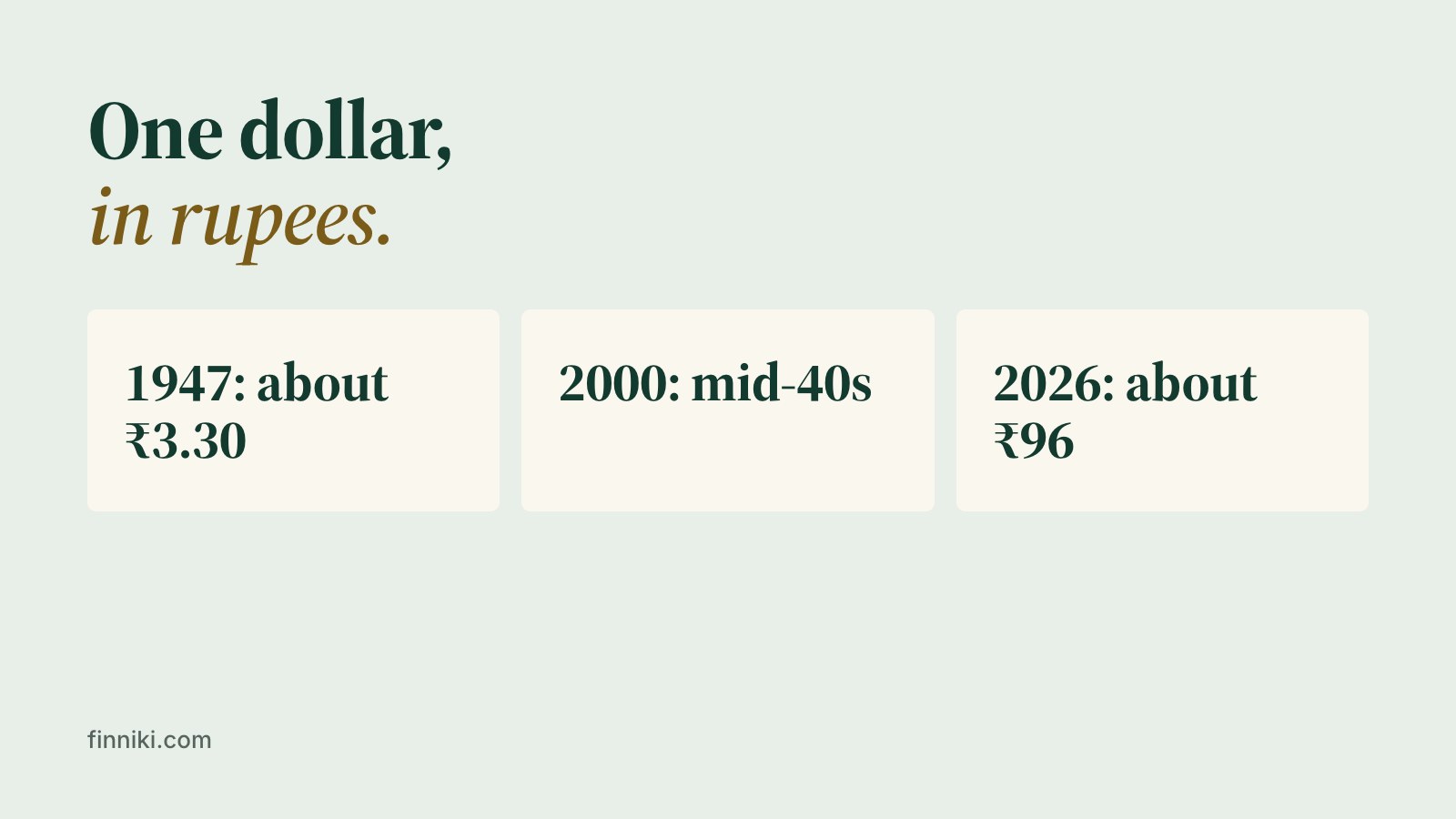
This is not a crash but a long drift that happens a little each year. At the time of the episode, many forecasts put ₹100 around 2029 or 2030; the rupee has moved faster than that.
Why does the rupee keep weakening?
Three structural reasons:
- Higher inflation. India's inflation has usually been 2 to 3 percentage points above America's. Over decades, that gap means each rupee buys fewer dollars: this is purchasing power parity at work.
- Lower productivity. A US worker produces far more value per hour, thanks to technology, infrastructure, capital and efficient systems. India is improving, with roads, ports, digital infrastructure and manufacturing, but not yet fast enough to offset higher inflation.
- Import dependence. India buys crude oil, gas, gold, electronics, machinery and fertilisers, all priced in dollars. Spending more dollars than it earns shows up as a current account deficit, and the currency pays the price.
Short-term shocks add to the pressure: higher US interest rates pull money back to America, wars and crises push investors out of emerging markets, oil price spikes raise the import bill, and foreign investors selling Indian shares and bonds weaken the rupee immediately. The RBI sells dollars from its reserves to smooth sharp falls, but it manages the slide; it does not pull the rupee back up the hill. That would take fixing the structural issues, which takes decades.
How does a weaker rupee affect daily life?
It makes anything priced in dollars more expensive:
- Fuel, because India imports most of its crude oil.
- Foreign travel: a Europe trip costs more even if hotel and flight prices do not change.
- Studying abroad: each rupee fall adds lakhs to a degree priced in dollars.
- Electronics and cars with imported parts.
- Government finances, because imported resources cost more.
The winners: NRIs sending money home get more rupees for each dollar, exporters become more competitive, and anyone earning in dollars gains.

How does a weaker rupee affect the stock market?
At first, markets dislike it: foreign investors worry about inflation, currency losses and stability, pull money out, and the Nifty and Sensex come under pressure even for strong companies. Over time, the market becomes selective:
- Winners: companies that earn in dollars but spend in rupees, such as IT services firms with US clients, pharma exporters, speciality chemicals and textile exporters. Their rupee revenues rise without selling anything extra.
- Losers: companies that depend on imports or carry dollar debt, such as oil marketing companies, airlines, carmakers with imported components and capital-heavy businesses with foreign loans.
How do mutual funds behave when the rupee falls?
Differently by type:
- Equity funds weighted towards exporters tend to do well; those heavy in import-dependent sectors struggle. Broad funds see more volatility as foreign investors sell.
- Debt funds: a weaker rupee can raise inflation and then interest rates, which hurts long-term bond funds; short-term and floating-rate funds cope better.
- International funds and gold funds gain from currency conversion: even if global markets are flat, a weaker rupee makes foreign assets worth more in rupees.
That is why diversification should cover currencies, not just companies.
Is ₹100 a dollar bad news?
It depends on where you stand. For importers, students and travellers, yes. For NRIs, exporters and anyone holding dollar assets, it helps. For investors, the point is not to fear it but to prepare for it:
- Add global exposure through international funds, so part of your wealth grows in other currencies.
- Hold some gold, which tends to rise in rupee terms when the rupee falls.
- Plan dollar goals in dollars: if your child will study abroad, estimate the cost in dollars and assume the rupee will keep weakening.

FAQs
Will the dollar reach ₹100?
It looks likely in time. The rupee was about ₹96 per dollar in October 2026, and the long-term trend has been steady weakening.
Why does the rupee keep falling?
Higher inflation than the US, lower productivity, and heavy dependence on imports priced in dollars, plus short-term shocks such as oil spikes and foreign outflows.
Does the RBI stop the rupee from falling?
It smooths sharp moves by selling dollars from its reserves, but it does not reverse the long-term trend.
Who benefits from a weak rupee?
NRIs sending money home, exporters, and anyone who earns or holds assets in dollars.
How can I protect my savings from rupee depreciation?
Hold part of your portfolio in international funds and some in gold, and plan dollar-denominated goals in dollars.
How does a weak rupee affect foreign education costs?
It raises them: every fall in the rupee adds to the rupee cost of fees and living expenses priced in dollars.
Prepare for a weaker rupee
The rupee's trend is slow but steady, and it matters most for goals priced in dollars. Book a session to add currency protection to your plan, or find more episodes on FinNiki videos.
General information, not advice for your situation. Rules change; check your own numbers with a CA before you act.