Car Loan EMI: The 20/4/10 Rule and the SWP Strategy
How much car loan you can afford with the 20/4/10 and 10/5/20 rules, and whether investing your savings in an SWP really makes the EMI pay itself.

Nikhil Varghese, CA · 8 min read

Quick answer: Before you take a car loan, apply two rules. The 20/4/10 rule: at least 20% down, a loan of no more than 4 years, and EMI plus insurance under 10% of your gross monthly income. The stricter 10/5/20 rule: EMI under 10% of your take-home pay, a loan no bigger than 20% of your net worth, and no more than 5 years. On an ₹80,000 salary that caps the EMI at about ₹8,000, not the ₹30,000 a showroom will call "just". If you have a lump sum, you can invest it instead of paying cash and let an SWP cover about 40% of the EMI, but this only comes out ahead if your fund earns more than the loan costs, after tax.
Updated October 2026. New-car loan rates at major banks start at roughly 8% to 9%, and the RBI raised the repo rate to 5.50% on 7 October 2026, so new loans may cost a little more. The examples below assume 9%. Several of the episode's figures have been recalculated: a ₹10 lakh loan over 7 years means repaying about ₹13.5 lakh, not nearly double, and ₹1,000 of EMI supports about ₹48,000 of loan over five years, not ₹70,000 to ₹80,000.
 Watch the episode: Your car EMI can pay itself? Smart car loan strategy for India
Why do people end up with car loans they cannot afford?
Because the bank and the showroom both profit from a bigger loan. Banks know your salary and still offer more than you can handle, because every extra rupee lent earns them interest. The salesperson's job is to make a large EMI sound small: "Sir, it's just ₹30,000 a month."
Rahul heard exactly that. Salary ₹80,000 a month, a ₹20 lakh car, a ₹30,000 EMI for six years. Two years later, with rent, groceries, fuel, insurance and maintenance on top of the EMI, his savings were zero and every month felt like survival. Rahul is not careless; Rahul is most people. Two rules, which take two minutes to apply, would have saved him.
What is the 20/4/10 rule for car loans?
It is a three-part limit designed for car loans:
- 20: down payment. Pay at least 20% of the price upfront: ₹4 lakh on a ₹20 lakh car. Cars lose value fast, especially in the first year. Borrow too much and you can end up underwater, owing more than the car is worth.
- 4: tenure. Finance for no more than 4 years (48 months). Banks happily offer 6, 7 or 8 years because the EMI looks smaller, but you pay far more interest. A ₹10 lakh loan at 9% costs about ₹1.94 lakh in interest over 4 years and about ₹3.5 lakh over 7: you repay about ₹13.5 lakh for ₹10 lakh borrowed.
- 10: monthly car costs. EMI plus insurance should stay under 10% of your gross monthly income.
For Rahul, 10% of ₹80,000 is ₹8,000. At 9% over 4 years, ₹8,000 a month repays a loan of about ₹3.2 lakh; with a 20% down payment, that is a car of about ₹4 lakh. He committed to ₹30,000, nearly four times his ceiling.

What is the 10/5/20 rule for buying a car?
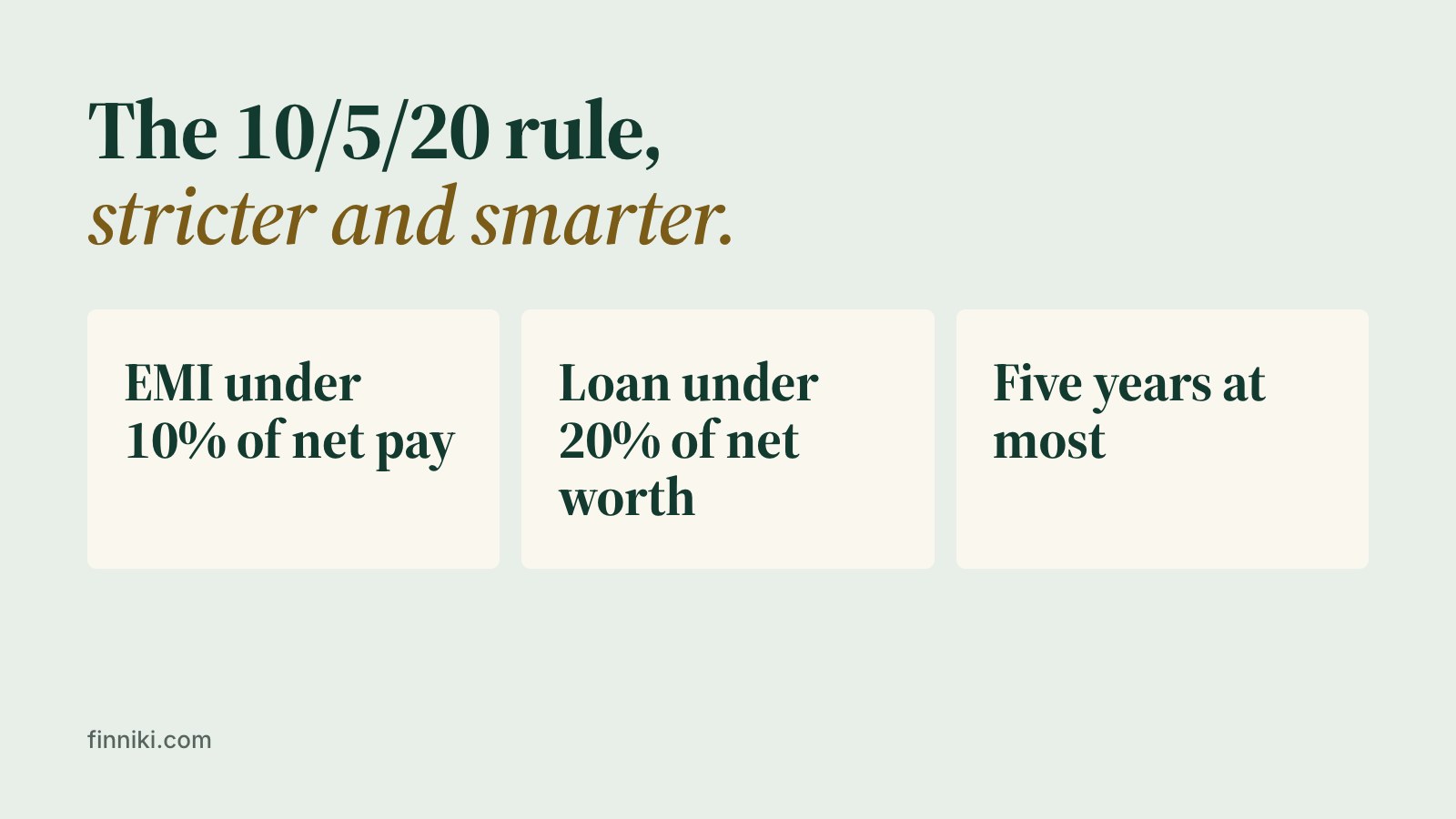
A stricter rule, and the one Nikhil follows, because it brings in net worth as well as income. Three conditions:
- EMI no more than 10% of your net (take-home) monthly salary.
- Loan no more than 20% of your net worth.
- Tenure no more than 5 years.
The net-worth test is the point. Wealthy people measure big purchases against what they own, not against their monthly pay. At 9% over five years:
- Take-home ₹1,20,000: EMI up to ₹12,000, which supports a loan of about ₹5.8 lakh, but only if your net worth is about ₹29 lakh. With a net worth of ₹15 lakh, the ceiling drops to a ₹3 lakh loan.
- Take-home ₹1,80,000: EMI up to ₹18,000, a loan of about ₹8.7 lakh, and a net worth of about ₹43 lakh to support it.
Most people do not yet have a net worth of ₹29 or ₹43 lakh, which means that, by this rule, most people are buying cars they cannot afford. A ₹20 lakh car on an ₹80,000 salary has become normal. Every oversized EMI quietly eats into retirement, children's education and future security: you are not living large, you are borrowing from your future self.
How much car loan can I afford on my EMI?
Roughly ₹48,000 of loan for every ₹1,000 of EMI over five years at 9% (about ₹40,000 over four years). So:
- An ₹8,000 EMI ceiling supports a loan of about ₹3.9 lakh over five years.
- A ₹15,000 EMI ceiling supports a loan of about ₹7.2 lakh.
That is the loan, not the on-road price: add your down payment to get the car budget. Work out your number before you walk into a showroom, not after.
What is the SWP strategy for a car loan?
It is a way to use a lump sum you already have to cover part of the EMI, instead of spending it on the car. You know a SIP: a fixed amount goes into a fund every month. An SWP (systematic withdrawal plan) is the reverse: you invest a lump sum once, and a fixed amount flows from it into your bank account every month while the rest stays invested.
Priya earns ₹1 lakh a month and wants a ₹12 lakh car.
- The usual way: ₹2.4 lakh down, a ₹9.6 lakh loan at 9% for 4 years. EMI about ₹23,900; total interest about ₹1.87 lakh.
- With an SWP: Priya has ₹3 lakh sitting in a fixed deposit. She invests it in a balanced (hybrid) fund instead. At 12% a year, it can support an SWP of about ₹2,900 a month, which she points at the EMI. Her out-of-pocket EMI falls to about ₹21,000. With ₹5 to 6 lakh invested, the SWP covers ₹5,000 to ₹6,000 a month.
Should you pay cash for a car or take a loan and invest?
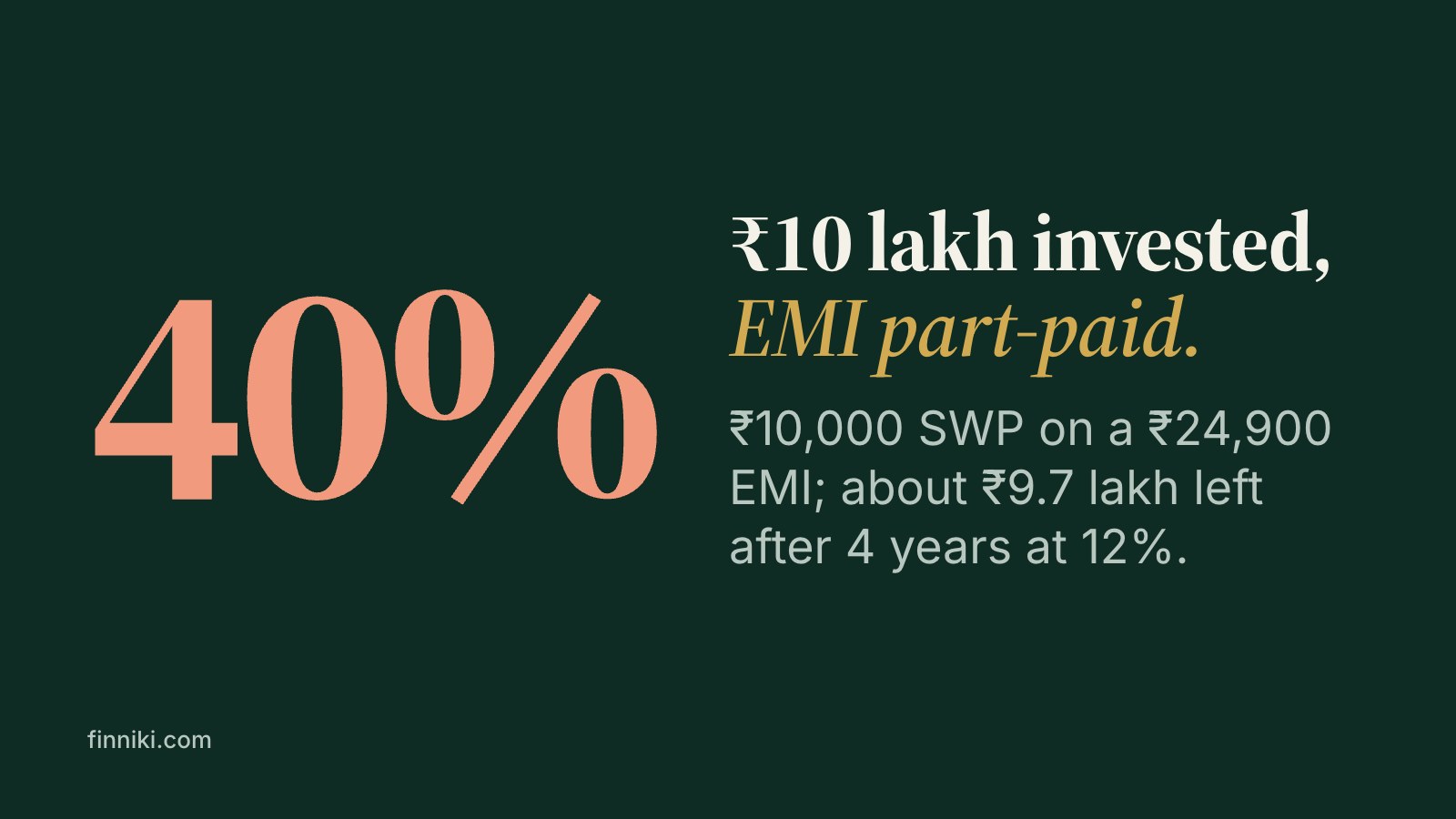
Only take the loan if your investments can reliably beat the loan's interest rate after tax. Say you have ₹10 lakh in savings. Instinct says pay cash. The alternative: invest the ₹10 lakh in a mutual fund and take a ₹10 lakh loan at 9% for 4 years.
- EMI: about ₹24,900 a month.
- SWP: at 12% a year, ₹10 lakh supports about ₹10,000 a month, covering about 40% of the EMI. Your out-of-pocket EMI drops to about ₹14,900.
- Over 4 years: you pay about ₹1.94 lakh in interest; the SWP pays ₹4.8 lakh towards your EMIs.
- At the end: the loan is gone and the fund still holds about ₹9.7 lakh.
That looks like magic, so be clear about what happened. The SWP is your own money; it does not make the loan cheaper. The fair comparison is with paying cash and then investing the ₹24,900 you would have paid as EMI every month. Before tax, over 4 years:
- At 12% returns, the loan-and-invest route ends about ₹70,000 ahead.
- At 9%, the two are roughly even.
- At 6%, the loan route ends about ₹80,000 behind.
So the strategy is a bet that your fund will beat the loan rate. It can pay off, and it keeps a cushion of cash available, but it is not free money.
What should you know before trying the SWP car-loan strategy?
Four things:
- Returns are not guaranteed. 12% is a long-term historical figure for equity-heavy funds; some years give 18%, some 5%, some a loss. A bad first year, with withdrawals running, can leave you behind.
- Pick the right kind of fund. Balanced advantage or hybrid funds suit an SWP. Pure debt funds will not earn enough to beat a 9% loan.
- Count the tax. Each SWP withdrawal is partly a capital gain. In an equity-oriented fund, gains within a year are taxed at 20%; after a year, at 12.5% above ₹1.25 lakh of gains a year. Interest on a personal car loan is not tax-deductible.
- You need a lump sum and an emergency fund first. If your savings are at zero, build the emergency fund before thinking about an SWP, and speak to an adviser to match this to your income, risk appetite and goals.
FAQs
What is the 20/4/10 rule for car loans?
Put at least 20% down, borrow for no more than 4 years, and keep EMI plus insurance under 10% of your gross monthly income.
What is the 10/5/20 rule?
EMI under 10% of take-home pay, a car loan no bigger than 20% of your net worth, and a tenure of no more than 5 years.
How much car loan can I get with a ₹10,000 EMI?
About ₹4.8 lakh over five years at 9%, or about ₹4 lakh over four years.
What is the EMI on a ₹10 lakh car loan?
About ₹24,900 a month over 4 years at 9%, with about ₹1.94 lakh of total interest.
Is a 7-year car loan a good idea?
Usually not. A ₹10 lakh loan at 9% over 7 years costs about ₹3.5 lakh in interest, against about ₹1.94 lakh over 4 years.
Can an SWP pay my car EMI?
It can cover part of it: ₹10 lakh at 12% supports about ₹10,000 a month. But it only beats paying cash if your fund earns more than the loan rate after tax.
Should I pay cash for a car or take a loan?
Pay cash unless you have a lump sum you can invest for at least the loan's term in a fund you expect to beat the loan rate, and an emergency fund besides.
Buy the car your plan can afford
Work out your EMI ceiling with both rules before you visit a showroom. To decide between cash, a loan or an SWP for your own numbers, book a session, or find more episodes on FinNiki videos. Before you negotiate, read car buying tips that saved ₹2.7 lakh and how an SWP works.
General information, not advice for your situation. Rules change; check your own numbers with a CA before you act.