FCNR 25% Trick for NRIs: Real or a Trap? (2026)
The viral 25% FCNR return depends on 9x leverage and a 2% spread. How it works, the real 11-13% ceiling, the risks, and the RBI window that has now closed.

Nikhil Varghese, CA · 8 min read

Quick answer: The viral "25% FCNR trick" is real arithmetic on a spreadsheet but not a realistic return. It relies on leverage: borrowing a large multiple of your deposit, pledging it back to the lender and earning the gap between the FCNR rate and your borrowing cost. With a 1% spread and 5 to 6 times leverage, the episode estimates roughly 11 to 13% at the very best, before the standby letter of credit (SBLC) cost and tax. The 25% needs 9 times leverage and a roughly 2% spread that barely exists. The RBI window that made the high FCNR rates possible has closed, and the leveraged version can lose money if rates move against you.
Updated October 2026. The script describes the RBI swap window as open until 30 September. On 14 August 2026 the RBI brought the deadline for raising eligible deposits forward to 31 August 2026, so the subsidised rates are no longer available for new deposits. Check each bank's current FCNR rate before you decide.
 Watch the 15-minute episode: The 25% FCNR trap explained for NRIs
What did the RBI actually do for FCNR deposits?
It paid the hedging cost. On 5 June 2026 the RBI announced a special swap facility under which it absorbs the entire currency-hedging cost on fresh 3 to 5 year FCNR(B) deposits raised in a set window, and exempted these deposits from certain reserve requirements, which made them cheaper for banks to hold. The window was first set from 8 June to 30 September 2026, and then cut short: deposits had to be raised by 31 August 2026, with banks able to execute swaps until 11 September. Banks passed the benefit on quickly. SBI raised its FCNR rates by close to 295 basis points and HDFC raised its rates too.
An FCNR deposit is a foreign-currency deposit that an NRI opens with an Indian bank in dollars, pounds or euros. You put in foreign currency and get principal plus interest back in the same currency at maturity, so there is no rupee depreciation risk inside the deposit. Dollars go in and dollars come out.
Why were FCNR rates so low before the RBI move?
Because of hedging cost. When a bank deploys your dollars in India it has to hedge the currency risk, and that cost had run at about 2 to 3.5% a year. It came straight out of what the bank could pay you, which kept FCNR rates stuck in a dull 3 to 4% range and inflows weak. With the RBI absorbing the cost, rates jumped to about 6 to 7%, tax-free in India, with no rupee risk. That is a strong number on its own, and nowhere near 25%. The RBI's swap covers the principal, not the interest component, so a weakening deposit currency can still affect the interest you receive.
Where does the 25% number come from?
From leverage, which means earning interest on a much bigger pool than you put in, while paying interest only on the borrowed part. The gap between the two is the extra return. Take an NRI with US$100,000:
- No leverage: US$100,000 in a 7% FCNR deposit earns US$7,000 a year. It is tax-free in India with no rupee risk, and for most NRIs that is where the story should end.
- With leverage: the NRI puts in US$100,000, a bank lends another US$500,000, and the full US$600,000 goes into the same 7% deposit, pledged to the lender through an SBLC, a standby letter of credit that lets the lender take the deposit if the borrower does not repay. The overall borrowing rate is 6%, one point below the deposit rate, with a hard-negotiated SBLC cost already baked in.
- The maths: US$600,000 at 7% earns US$42,000. Interest on the US$500,000 borrowed at 6% is US$30,000. The profit is US$12,000 a year, a 12% return on the original US$100,000, against US$7,000 without leverage.
To reach the viral 25% you would have to push leverage to 9 times your capital and secure a spread close to 2%. On a spreadsheet the number touches 25. But a 2% spread is the fantasy: at today's lending rates in the US, Australia, Canada or Singapore, where the best realistic borrowing rate is around 5 to 6%, a 1% gap is far closer to reality. The episode's view is that with a 1% spread and 5 to 6 times leverage you are looking at about 11 to 13% at the very most. The 25% is a theoretical ceiling balanced on assumptions that barely exist today.

What are the risks of the leveraged FCNR play?
Leverage multiplies risk as much as returns. The attraction is real: a double-digit dollar return anchored by a fixed deposit, not equity or anything market-linked. The costs and risks are real too:
- The SBLC fee. The 12% example assumes the SBLC cost was negotiated down hard. Left alone, an SBLC can run upward of 1% a year, which on a thin spread can wipe out the edge. So 12% is close to a best case, not a floor.
- Tax. US and UK residents are taxed on interest, so the take-home shrinks again.
- Floating borrowing costs. The spread is a market rate, not fixed by law. If your borrowing cost is floating and rates rise during the loan, the spread shrinks or flips. If your floating rate rises above your fixed deposit rate, you lose money on every leveraged dollar, and at five to ten times your capital that is a real hit to principal.
- The lender. The structure needs a bank willing to lend that much against an SBLC on workable terms, and regulatory comfort with this kind of leverage has shifted before. Maths that works on paper does not guarantee a cooperative bank.
Who is the leveraged FCNR play for?
Only NRIs with spare dollars and a genuine appetite for risk. If you are in your late 40s or early 50s and planning retirement, take the plain FCNR rate with no leverage or a small amount. The honest summary is that the 6 to 7% FCNR rate was real, RBI-backed and one of the better risk-free dollar opportunities NRIs had seen in years, while the 25% is theoretical. If you want an alternative, GIFT City has been widening NRI access to equity and other instruments with separate, market-linked tax treatment: read GIFT City for NRIs.
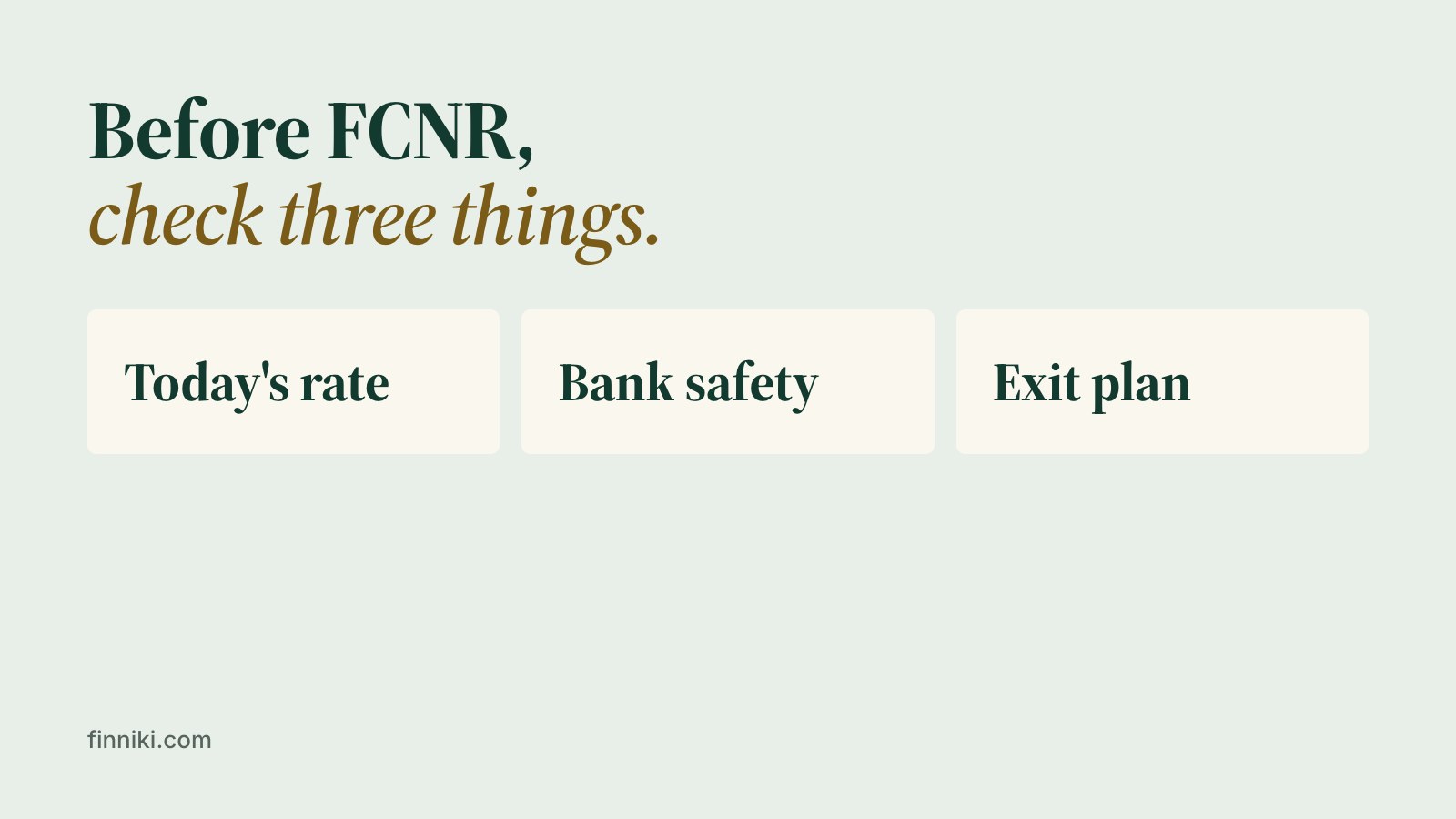
What should you check before putting money in FCNR?
- The current rate. The episode's bank table (SBI near 5.75%, HDFC 5 to 6%, ICICI and Axis around 6%, smaller banks such as AU Small Finance Bank, Karur Vysya Bank and DCB at about 7% and above) was a snapshot from the window. Rates have moved since the window closed, so check your bank's current FCNR rate. Compare with the NRE vs FCNR tool.
- Safety. Deposits in India are insured by the DICGC only up to ₹5 lakh per depositor per bank, principal and interest combined, a tiny slice of a dollar deposit. A smaller bank with an eye-catching rate is often pricing in its own higher risk. For a large amount, split it: a PSU bank for safety, a larger private bank for rate and service. Check the bank's credit rating and NPA figures in its annual report.
- Loan limits, if you are leveraging. SBI, for example, lets you borrow against an FCNR deposit depending on remaining tenure: up to 3 years residual with a 10% margin lets you borrow up to 90%, and more than 3 and up to 5 years with a 15% margin lets you borrow up to 85%. Limits vary, so verify the loan-to-value and margin before you proceed.
- Flexibility. If you exit before the tenor ends, the bank typically cuts your rate by at least 1%, and if you held it only briefly you may earn no interest. There is no partial withdrawal, so you break the whole deposit. Do not treat FCNR as an emergency fund: for money you might need in 3 to 6 months, use an NRE savings account, a liquid fund or an overseas account. Ladder your FCNR across maturities, for example one, two and three years, so some money is always coming free. In a crunch, a loan against the deposit, often up to 85 or 90% of its value, is almost always better than breaking the FD.
FAQs
Can an NRI really earn 25% on an FCNR deposit?
Only on paper. It needs about 9 times leverage and a spread of close to 2%, which barely exists. The episode's realistic estimate with a 1% spread and 5 to 6 times leverage is about 11 to 13% at best, before SBLC costs and tax.
Is the RBI's FCNR swap window still open?
No. The RBI brought the deadline for raising eligible deposits forward to 31 August 2026, with banks executing swaps until 11 September. Check your bank for the rate it offers now.
What is an SBLC and why does the leveraged FCNR play need it?
A standby letter of credit is a bank guarantee that lets the lender take the pledged deposit if the borrower does not repay. It acts as collateral, and its fee can run above 1% a year.
What FCNR rate can an NRI expect now?
Rates peaked at about 6 to 7% in the window, with some small banks at around 7% and above. They change often, so check your bank's FCNR rate page on the day you book.
Is an FCNR deposit safe?
Deposits are insured by the DICGC up to ₹5 lakh per depositor per bank, so most of a dollar deposit sits outside that cover and depends on the bank's own strength.
Can I withdraw an FCNR deposit early?
You can break it, but the bank typically cuts the rate by at least 1%, you may earn no interest if you held it briefly, and there is no partial withdrawal.
Is FCNR interest taxable?
It is tax-free in India while you are an NRI. US and UK residents are taxed on the interest in their country of residence.
Should I leverage my FCNR deposit?
Only if you have spare dollars and a real appetite for risk. If you are close to retirement, take the plain FCNR rate with no leverage or a small amount.
Put your dollars where they fit your plan
Where your dollars sit depends on your currency, your tax residency and your timeline. Book a one-to-one session to work through yours, or browse more explainers on our video page.
General information, not advice for your situation. Rules change; check your own numbers with a CA before you act.