How NRIs Invest in India in 2026: Accounts & Tax
Before you pick a fund, fix the account: NRE, NRO or FCNR. How NRIs invest in India in 2026, the repatriation caps, property TDS and the new AIS rule.

Nikhil Varghese, CA · 11 min read

Quick answer: Before you pick a fund, get the account structure right, because it decides how your money moves, how it is taxed and whether you can bring it back out. Use an NRE account for money you earn abroad, an NRO account for income generated in India, and an FCNR deposit if you will spend the money abroad. Under FEMA, your resident savings account must be redesignated as an NRO account as soon as you become an NRI, and holding funds you are not permitted to hold can bring a penalty of up to three times the amount involved. For most NRIs mutual funds should be the core, and every return should be judged after tax in the country where you live.
Updated October 2026. India moved to a new Income-tax Act from April 2026: the rules are broadly the same, but section numbers and form numbers changed (for example Form 13 for a lower-deduction certificate is now Form 128). Rates, limits and form numbers can change, so confirm them with your bank or adviser before you act.
 Watch the 18-minute episode: How NRIs invest in India to turn ₹1 lakh into ₹1 crore
What should an NRI do before investing in India?
Fix the foundation first: where your money sits before you invest it. Two NRIs can invest the same amount in the same mutual funds for ten years with almost identical returns, and still end up in completely different places. The one who invested through an NRE account can move his money back abroad in about three weeks. The one who kept using his resident savings account and never told the bank he had moved cannot.
The mistake is rarely a bad fund. It is investing before understanding the rules that decide whether the money can ever come home.
Why invest in India at all as an NRI?
Because diversification means owning different economies, not only different stocks. If your portfolio sits in one market, and that market was carried by a handful of technology companies, it is less diversified than it looks. India offers manufacturing, banking, IT, pharma, consumer, infrastructure and energy, a young population, rising incomes, urbanisation and infrastructure spending, which are decade-long trends and not one-year trades.
You also understand India: the brands people trust, festive spending, and the business that is becoming part of everyday life long before it shows up in a research report. Keep investing where you live, and give India a place. This post is about doing it correctly. It does not decide how much of your portfolio belongs in India.
Which account should an NRI use: NRE, NRO or FCNR?
- NRE account: for money earned outside India, such as a Dubai salary in dirhams sent to India. The money is fully repatriable, with no cap and no certificate.
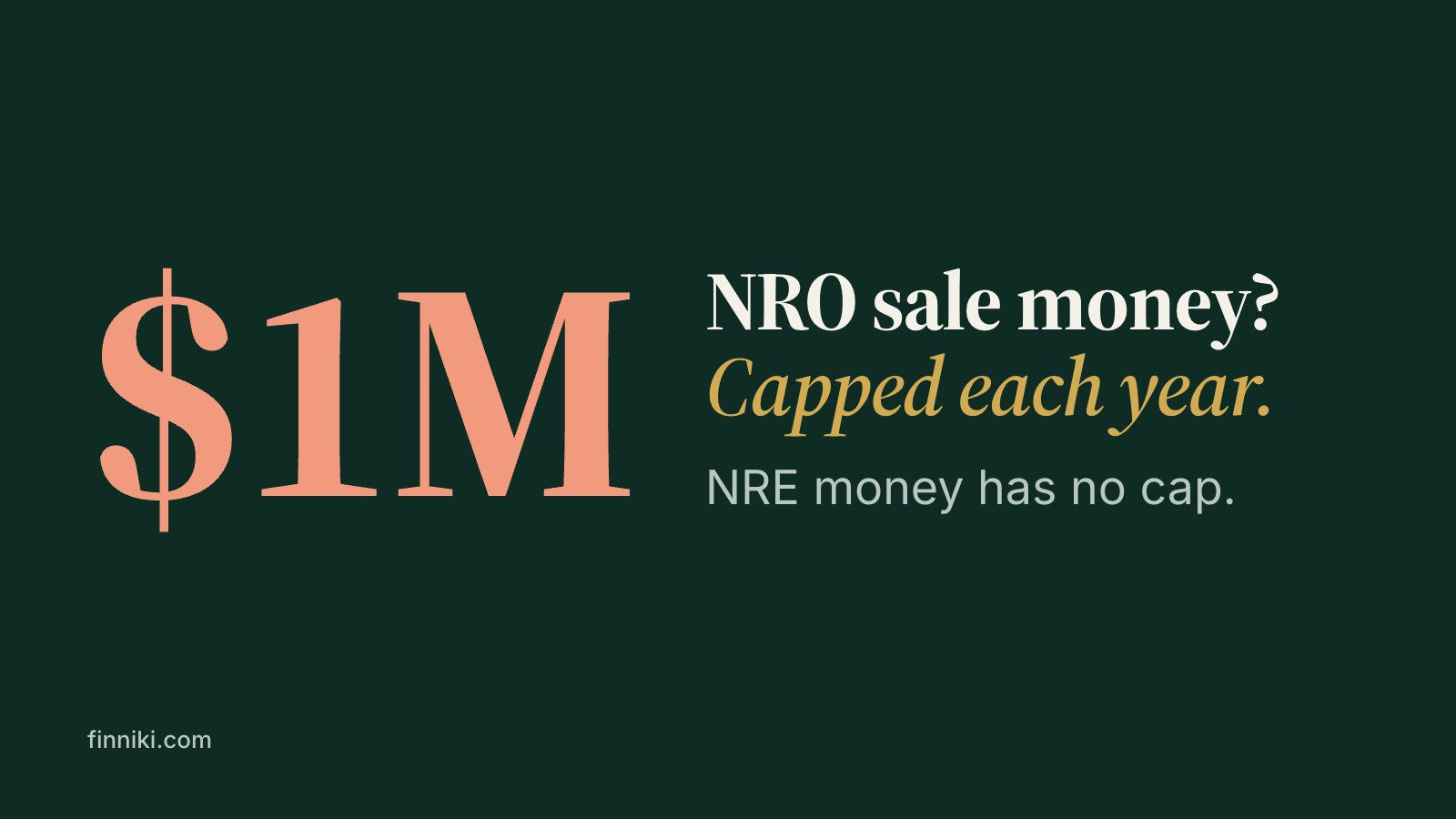
- NRO account: for money generated inside India: rent from a Bengaluru flat, a pension, or dividends. From an NRO account you can repatriate US$1 million per financial year. The cap applies to capital transactions such as sale proceeds and capital gains. Current items such as rent, interest and dividends are not subject to the cap. Above the cap you need RBI approval, which is very rare. Before money leaves, you need Form 145 and Form 146 (formerly 15CA and 15CB), the certificate from a Chartered Accountant that Indian tax is paid.
- FCNR deposit: a fixed deposit in foreign currency (dollars, pounds, euros) with no exchange-rate risk.
What happens if an NRI keeps using a resident savings account?
The money can get stuck. Under FEMA, the day you become an NRI you are not permitted to hold a resident savings account. It has to be redesignated as an NRO account, immediately and not eventually. In the example, the NRI never did it. For eleven years every rupee flowed through an account he was not allowed to hold. When he tried to move money abroad, the bank had to unwind it all: where each credit came from, Indian or foreign income, which year and which tax was paid. He had no clean answer, so the money could not leave.
The penalty under FEMA for holding funds you were not permitted to hold can go up to three times the amount involved. The fix is free: inform your banks that you have moved abroad. Almost nobody does.
NRE FD or FCNR: which one should you pick?
Pick by where you will spend the money. An NRE fixed deposit converts your money into rupees first, so a weaker rupee can quietly eat part of the return when you convert back. An FCNR deposit stays in foreign currency, so there is no exchange-rate risk.
- Spending the money in India: NRE FD.
- Spending it abroad: FCNR.
NRE FDs maximise rupee returns and FCNR protects your currency. Rates vary by bank and tenure: large banks' NRE FD rates in 2026 are mostly in the 6 to 7% range, with a few banks paying more, so check the day you book. Use the NRE vs FCNR tool to compare. For a deeper look at the rupee risk, read GIFT City for NRIs.

Can NRE money be repatriated after buying property in India?
Not fully. If you invest NRE money in stocks or mutual funds and sell years later, the proceeds come back fully repatriable. But if you use NRE money to buy a house and sell it later, the sale proceeds are generally credited to your NRO account. The money went in fully repatriable and came out under a cap.
The buyer also has to deduct TDS before paying you. When a resident sells a property, the buyer deducts 1%. When an NRI sells a long-term property (held more than two years), the effective deduction can reach 14.95% including surcharge and cess, and it is deducted on the entire sale value, not on your profit.
Sell a flat for ₹1.5 crore with an actual gain of ₹40 lakh: your real tax is about ₹5 lakh, but the buyer deducts over ₹22 lakh. More than ₹17 lakh then sits with the Income Tax Department, and getting it back can take a year.
The fix is a lower-deduction certificate, applied for before the sale, so the buyer deducts on your actual gain. After the sale it is too late. India has run on a new Income-tax Act since April 2026: the lower-deduction certificate is now applied for on Form 128 (it was Form 13), and the buyer's deduction sits under a new section number (Section 393 replaces Section 195). If your broker or adviser still quotes the old section and form, they are working from the old law, and paperwork can be rejected.

What can an NRI invest in, and who is each option for?
There is no best investment, only what is right for you:
- Fixed deposits: predictable, with no market swings. Use them for an emergency fund, short-term goals and the debt part of a portfolio. If you will spend the money abroad, a weakening rupee can eat a high return, which is where FCNR wins. For retirement twenty years away, FDs are unlikely to beat inflation.
- Mutual funds: for most NRIs, the core. They give diversification and professional management in one product, and you can run a SIP every month. US residents should understand the PFIC rules: many Indian mutual funds are treated very differently under US tax law, with heavy reporting and unfavourable treatment. That does not mean avoid India, but structure it properly first. Similar rules exist in the UK.
- Direct stocks: if you enjoy analysing businesses. Do not confuse familiarity with expertise: great businesses bought at bad prices still deliver bad returns. Unless you enjoy the work and can sit through volatility, a fund is the better answer.
- GIFT City: lets eligible investors invest in foreign currency directly, with attractive tax treatment on certain structures. It is still evolving, so whether it fits depends on your goals. Read GIFT City for NRIs.
- Gold: a hedge against uncertainty, not a wealth engine. Skip physical jewellery (making charges, storage, insurance, purity) and use gold ETFs or bars. The episode suggests no more than about 10% of a portfolio.
- Real estate: most NRIs who buy property in India do it because a parent asked, a cousin bought, or it feels like letting go of India otherwise. That is a real feeling but not an investment thesis. Rental yields are low, tenants are managed across time zones, and exit brings the TDS and repatriation rules above. If it will be your home when you return, buy it. If you are buying to build wealth, run the numbers first.
- Startups and AIFs: exceptional returns and exceptional risk. Most startups fail, money is locked for years and minimums are high. This is the icing, not the cake: build the core first.
Does India tax an NRI's investments, and how are they taxed where you live?
Yes. The biggest myth is that living abroad means India does not tax your investments. Depending on the asset you may face capital gains tax, dividend tax or TDS. Many countries also tax your worldwide income, so your Indian investments may have to be disclosed where you live.
Interest on an NRO account is taxed at 30% TDS plus cess. Under the India-US and India-UK treaties, that drops to 15% if you furnish a Tax Residency Certificate and Form 10F (Form 41 under the new Act). That is half the tax for two documents most NRIs have never heard of. India has Double Taxation Avoidance Agreements with most countries, so you should not be taxed twice on the same income, but claiming relief needs documentation. Never decide on pre-tax returns: decide on what you keep.
What changed in July 2026 for foreign accounts and Indian tax?
On 8 July 2026, the CBDT issued an order authorising the tax department to upload financial information it receives from foreign tax authorities into your AIS and Form 26AS. India has received data on foreign accounts and investments from more than a hundred countries for years, but it sat inside the department. Now it appears in your own tax statement, going back to 2022.
If you are a genuine non-resident, this is not aimed at you: the data is exchanged based on the tax residency you declared to your foreign bank. It becomes your problem in two situations:
- You move back to India. Once you are resident and ordinarily resident, every foreign account must be disclosed, and the department now has the data before you file.
- Your residency declaration to the foreign bank is wrong or out of date. That happens more often than you would think.
If you plan to come home in the next few years, fix your foreign accounts now, not after you land. Check your status with the NRI status calculator and the RNOR calculator.
What is the one framework to run before investing in India?
Do not start by asking which mutual fund to buy. Start by asking whether your structure is right, because every decision touches your banking, taxes, currency, repatriation and long-term plans at the same time:
- Account: is the money in the right account (NRE, NRO or FCNR), and have you told your banks you are an NRI?
- Currency: will you spend it in India or abroad?
- Tax: what will you keep after tax in India and where you live?
- Exit: can you bring the money out, and under which cap and certificate?
FAQs
Which account should an NRI use to invest in India?
An NRE account for money earned abroad, an NRO account for income generated in India, and an FCNR deposit if you will spend the money abroad.
Is NRE money always freely repatriable?
Money in an NRE account moves out without a cap or certificate. But sale proceeds of a property bought with NRE money are generally credited to the NRO account and come out under the US$1 million annual cap.
How much can an NRI send abroad from an NRO account?
US$1 million per financial year on capital transactions such as sale proceeds and capital gains, with a CA certificate and Form 145 and Form 146. Rent, interest and dividends are not subject to the cap.
Do I have to close my resident savings account when I become an NRI?
It has to be redesignated as an NRO account, immediately. Holding funds you are not permitted to hold can bring a FEMA penalty of up to three times the amount involved.
How much TDS does a buyer deduct when an NRI sells property?
For long-term property it can reach 14.95% including surcharge and cess, on the entire sale value. A lower-deduction certificate, applied for before the sale, limits it to the tax on your actual gain.
Are Indian mutual funds a problem for US-based NRIs?
Many are treated as PFICs under US tax law, with heavy reporting and unfavourable treatment. It does not mean avoiding India: structure the investment properly first.
Does the July 2026 AIS order affect every NRI?
Not a genuine non-resident whose foreign bank holds the right residency declaration. It matters if you move back to India or if your declaration to the foreign bank is wrong.
Should an NRI buy property in India as an investment?
Only after running the numbers. Rental yields are low, tenants are managed remotely, and exit brings TDS and repatriation rules. If it will be your home when you return, buying is a good life decision.
Get your structure right before you send a rupee
India is one of the best long-term opportunities, and the people who benefit are the ones who understood the rules before putting money to work. Book a one-to-one session to check your accounts and tax set-up, or browse more explainers on our video page.
General information, not advice for your situation. Rules change; check your own numbers with a CA before you act.