Why NRIs Regret Moving Back to India: 3 Costly Mistakes
The ₹40 lakh gap, the property trap and the Vacation India Illusion. What a family of four needs a month, and two questions before you move back.

Nikhil Varghese, CA · 10 min read

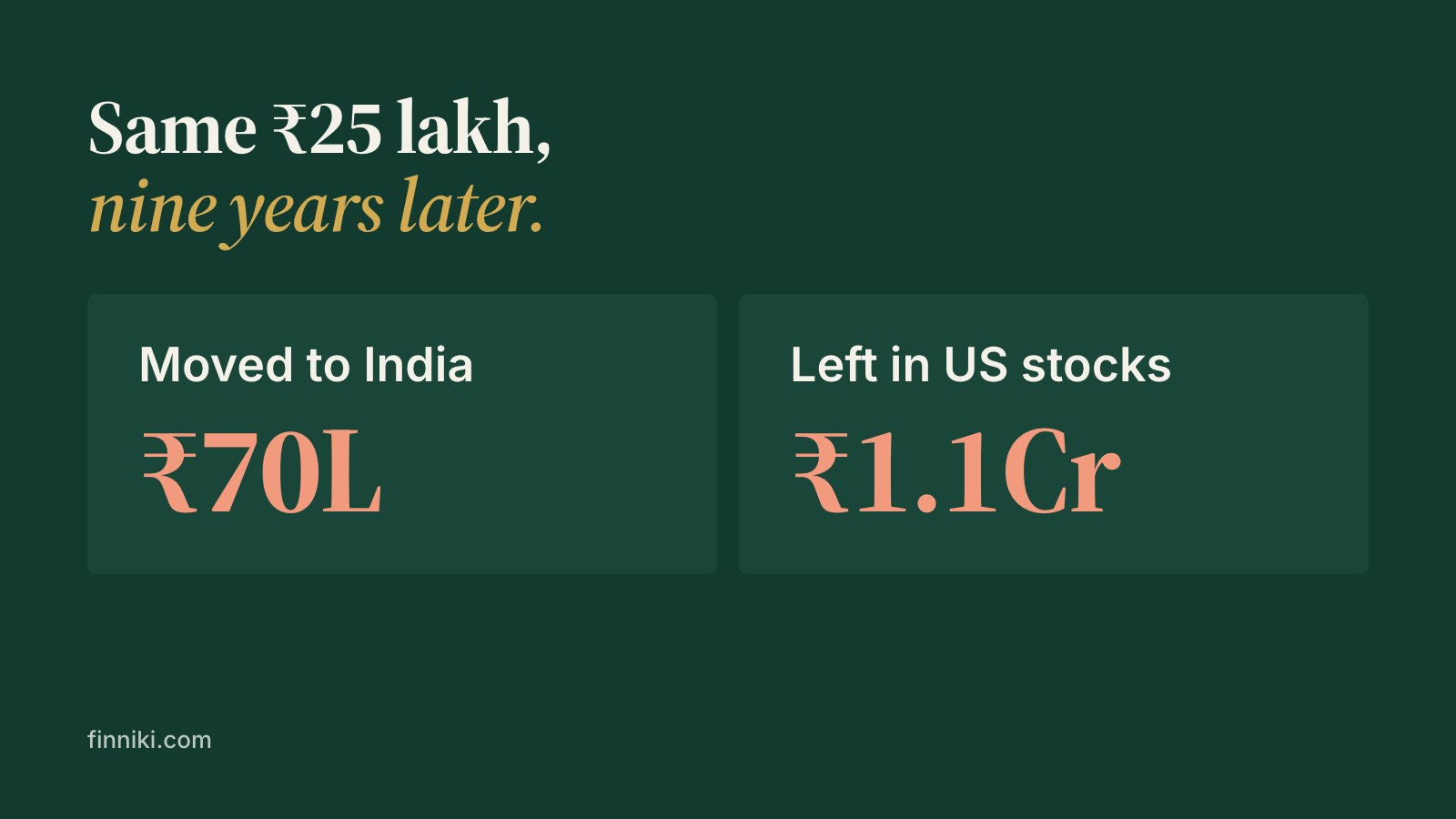
Quick answer: Most NRIs who regret moving back to India did not choose the wrong fund. They made three decisions before they landed: they moved too much money at once, they bought a flat in India before living in the city, and they budgeted for the India of a three-week holiday instead of a normal Tuesday. In the episode's example, the same ₹25 lakh moved to India in 2017 grew to about ₹70 lakh, while left in the US it would be worth about ₹1.1 crore, a gap of roughly ₹40 lakh. A comfortable family life in a tier-one city costs about ₹2 to ₹3 lakh a month. Rent for a year, move only what year one needs, and decide on the numbers: or, if the move is really about your parents or your kids, move with your eyes open.
Updated October 2026. The example is illustrative and uses the episode's index levels: the Nifty 50 closed at about 22,700 on 28 October 2026, which keeps the gain near 2.8 times from early 2017. US stocks have traded higher than the episode's 7,400 figure for the S&P 500, which would widen the gap a little. Rates, rents and school fees move, so run your own numbers.
 Watch the 15-minute episode: The ₹40 lakh mistake NRIs make before they move back
Why do some NRIs regret moving back to India?
Because the money decisions happen before they land, and the India they expect is not the India they get. Think of Rohit: 44, fifteen years in the US, a senior engineer, married with two children in middle school who are, honestly, more American than Indian. His parents are in their seventies and the calls about doctor visits are more frequent. Between his 401(k), some Indian mutual funds and savings on both sides, he has about ₹4 crore.
₹4 crore sounds large in India, and it is a strong number, but Rohit is not 65. That money has to cover his children's education, his parents' healthcare and his own retirement, and survive inflation for the next 35 to 40 years. Each of the three mistakes below was a sensible decision made under a deadline he did not choose, which is why they are worth slowing down on.
Mistake 1: How much does moving your savings to India early cost?
The mistake is the currency bet, and it starts when you send savings home and never think about the exchange rate again. Take two paths for the same money in 2017:
- Moved to India: ₹25 lakh, about US$36,000 at roughly ₹68 to the dollar, invested in the Nifty 50. The Nifty was around 8,180 in early 2017 and is about 22,700 now, roughly 2.8 times. The ₹25 lakh becomes about ₹70 lakh.
- Stayed in the US: the same US$36,000 in the S&P 500, around 2,271 in early 2017 and about 7,400 in the episode, roughly 3.2 times. It becomes about US$115,000, which is about ₹1.1 crore at today's rate.
The gap is about ₹40 lakh, and it has nothing to do with the Indian market doing badly: the Nifty gave a healthy 2.8 times. When you move money to India you make two bets at once: one on the market, and one against the rupee. The rupee has given up roughly 2 to 3% a year against the dollar for a long time, so every rupee you convert starts the race behind.
The fair criticism is that this window favours US stocks. Run the same comparison from 2003 and the Nifty wins, sometimes comfortably. But the rupee drag does not vanish in other periods. A strong Indian market can cover it up, and it cannot remove it.
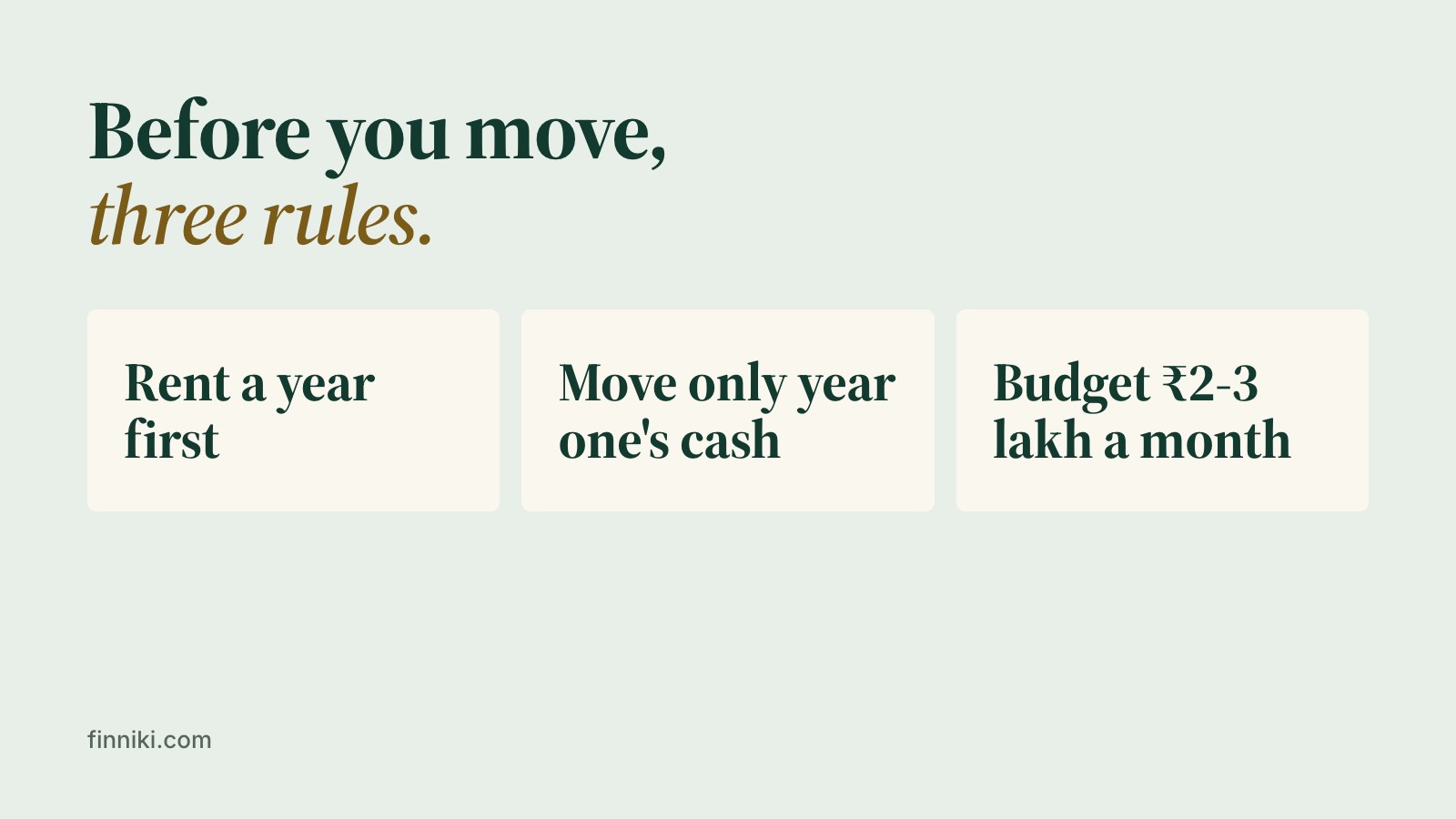
Fix: move only what year one actually needs, such as rent, school admission, a car and an emergency fund. Keep everything else invested where it is, and move more once life in India has settled. Going slowly costs nothing. Going all at once costs years of dollar compounding you never get back. For the rupee side of this decision, read GIFT City for NRIs.
Why is this question arriving earlier than people planned?
Because tech layoffs have come in waves, and on an H-1B, losing the job puts your visa, your children's school and your whole India timeline on a clock of about six months. Wage structures have also shifted towards higher bands, so people in the middle who used to feel safest are now the most exposed. Someday is arriving years early, so the decisions you still have time to get right matter more than ever.
Mistake 2: Should you buy a house in India before you move back?
No. Buying a flat while you still live in the US looks obvious on paper: lock in the price, beat the rise and have something waiting when you land. Then reality arrives: construction delays that run into years, builders who vanish and court cases with no end date. Property in India involves a lot that never reaches a PDF, and you cannot see it from a laptop in New Jersey.
You are also making a permanent decision about a city you have visited only on holiday. You do not know the commute at 9am on a Tuesday, whether the school is twenty minutes away or an hour in traffic, or whether you will still want that neighbourhood in two years.
Fix: rent first and let the city tell you whether it fits before you sign anything you cannot walk away from. Keep the money that would have gone into the flat liquid and invested, because residential real estate in India yields around 2 to 3%. That is not the number that should decide where your family lives for twenty years. A year of rent costs a fraction of one wrong flat held for a decade.
What does a month in Bangalore really cost an NRI family of four?
About ₹2.6 lakh for a comfortable life on the IB school track, or ₹1.9 to ₹2.3 lakh trimmed. City choice matters almost as much as salary: Kochi, Chennai, Gurgaon and Bangalore cost very different amounts, and even within one city the school you pick can swing the monthly number by ₹30,000 or more. Rohit picks Bangalore for the tech jobs, the hospitals and the direct flight to the US.
- Housing: 3BHK in a safe society, good but not ultra-premium area: ₹65,000 (range ₹50,000 to 75,000).
- Schooling for two children: IB or IGCSE school, with transport, books and activities: ₹80,000 (range ₹70,000 to 90,000).
- Household: utilities and groceries: ₹40,000.
- Transport: daily commute: ₹10,000.
- Healthcare: insurance and check-ups for ageing parents, with a buffer: ₹25,000.
- Lifestyle: dining and leisure: ₹40,000.
- Total, comfortable: ₹2,60,000 a month.
- Trimmed: a moderate lifestyle with CBSE or ICSE schooling (about ₹35,000 to 50,000 for both children): ₹1,90,000 to 2,30,000 a month.
The honest range for a family like Rohit's in a tier-one city is about ₹2 lakh a month for stable and no-frills, to ₹3 lakh for genuinely comfortable with room to breathe. Below ₹1.9 lakh the compromises start to show in ways your family feels, and above ₹3 lakh most of the extra buys convenience and status. This is the episode's own estimate, so run your own version for your city and school choice.
Mistake 3: What is the Vacation India Illusion?
It is the gap between the India you visit for three weeks a year and the India you live in, and being financially prepared does not protect you from it. On holiday the family is thrilled to see you, the food is as you remember it and every weekend is a wedding or a trip. That is not a Tuesday. A Tuesday is traffic on the school run, a broadband technician two hours late and paperwork that always needs one more document.
Life back home also did not pause while you were away: your friends have their own careers and packed weekends, and nobody has been waiting. For someone who left fifteen years ago, moving back is closer to moving to a new country that speaks the same language and shares your last name.
Fix: do not test it from inside a two-week Diwali trip. Rent for a year, sit through an ordinary Tuesday, then decide whether it is home or somewhere you visit with jet lag. A year of renting costs almost nothing next to a move across continents that you then have to unwind.
Is moving back to India only a money decision?
No, and pretending it is would be dishonest. Everything above assumes the goal is the largest number, and for many NRIs it is not. If Rohit's parents are in their seventies, no spreadsheet prices being there for the next ten years instead of flying in twice a year. If something happens to one of them while he stays in the US, the ₹40 lakh he protected will feel like nothing.
Some parents want their children to grow up near grandparents, inside the language and knowing where they are from. Others see two teenagers pulled out of the only country they have known. Both are reasonable. If you have decided to move back for your parents or for the life you want your children to have, the money questions do not change that decision, they change how you carry it out: move back with your eyes open on the currency, the property and the monthly number, instead of finding out the hard way in year two.
So should you move back? Two questions decide it
- Have you lived in the city for a year, not just visited it?
- Can your income and corpus carry ₹2 to ₹3 lakh a month without eating into the ₹4 crore that still has to last 35 years?
At ₹2.5 lakh a month Rohit draws about 7.5% of his corpus every year just to live. At ₹1.5 lakh, that is about 4.5%. That difference separates a corpus that lasts from one that does not.
If both answers are yes, the move works, and the property, the currency and the timing are execution. If either is no, that is not a reason to cancel anything: it is a reason to rent for a year and run the numbers again before you sign something permanent. If you are only a couple of years from retirement and your corpus is already tight against that range, this is not the year to test the Vacation India Illusion in person. Fix the number first, then move. Check your tax status with the NRI status calculator and the RNOR calculator.
FAQs
Is it a mistake to move all my savings to India when I return?
Often. You make a market bet and a bet against the rupee at once. Move what year one needs and leave the rest invested where it is.
How much does a family of four need per month in Bangalore?
About ₹2 lakh for a stable, no-frills life and up to ₹3 lakh for comfortable, with housing near ₹65,000 and schooling for two children from ₹35,000 to ₹90,000 a month depending on the board.
Should I buy a flat in India before moving back?
Rent first. Buying from abroad exposes you to delays, disputes and a city you may not like, and residential yields are only about 2 to 3%.
What is the Vacation India Illusion?
The mismatch between holiday India and everyday India. A three-week visit does not show you traffic, paperwork and a normal Tuesday.
How much of my corpus can I safely spend each year?
In the episode's example, ₹2.5 lakh a month is about 7.5% of a ₹4 crore corpus a year, against about 4.5% at ₹1.5 lakh a month. The lower figure is far more sustainable over 35 years.
Does the ₹25 lakh example always favour the US?
No. It uses a period when US stocks did especially well. From 2003 the Nifty wins, sometimes comfortably. The rupee drag is there in every period, though.
Is moving back for my parents a bad financial decision?
Not if you have decided it knowingly. The money questions change how you execute the move, not whether you make it.
How long should I rent before deciding to move back for good?
About a year, long enough to live through ordinary days and not only holidays and festivals.
Run your numbers before you pack a single box
What decides whether a move back works is whether your finances, your family's expectations and your daily life line up. Book a one-to-one session to work through your own city, corpus and timing, or browse more explainers on our video page.
General information, not advice for your situation. Rules change; check your own numbers with a CA before you act.