OCI Returning to India: NRE, NRO & FCNR Rules 2026
Moving back on an OCI? Your card does not set your banking: FEMA does. What happens to NRE, NRO and FCNR accounts, and the RFC option many miss.

Nikhil Varghese, CA · 8 min read

Quick answer: Your OCI card has no bearing on your bank accounts. Banking follows FEMA residency, which turns on your intention to settle in India, not on a day count or on the card. The moment you become a FEMA resident you must tell your bank and redesignate your NRE and NRO accounts. An existing FCNR deposit can run to maturity, but it cannot be renewed: at maturity you choose a resident rupee deposit, an RFC account or repatriation. The costliest mistakes are staying silent, which can bring a FEMA penalty of up to three times the amount involved, and picking the rupee option by default without knowing the RFC exists.
Updated October 2026. Remittance forms 15CA and 15CB are now numbered Form 145 and Form 146 under the Income-tax Act, 2025, from 1 April 2026. Banks apply the rules slightly differently, so confirm each step with your own bank before you act.
 Watch the 14-minute episode: Returning to India with an OCI? Don't touch your bank accounts until you watch this
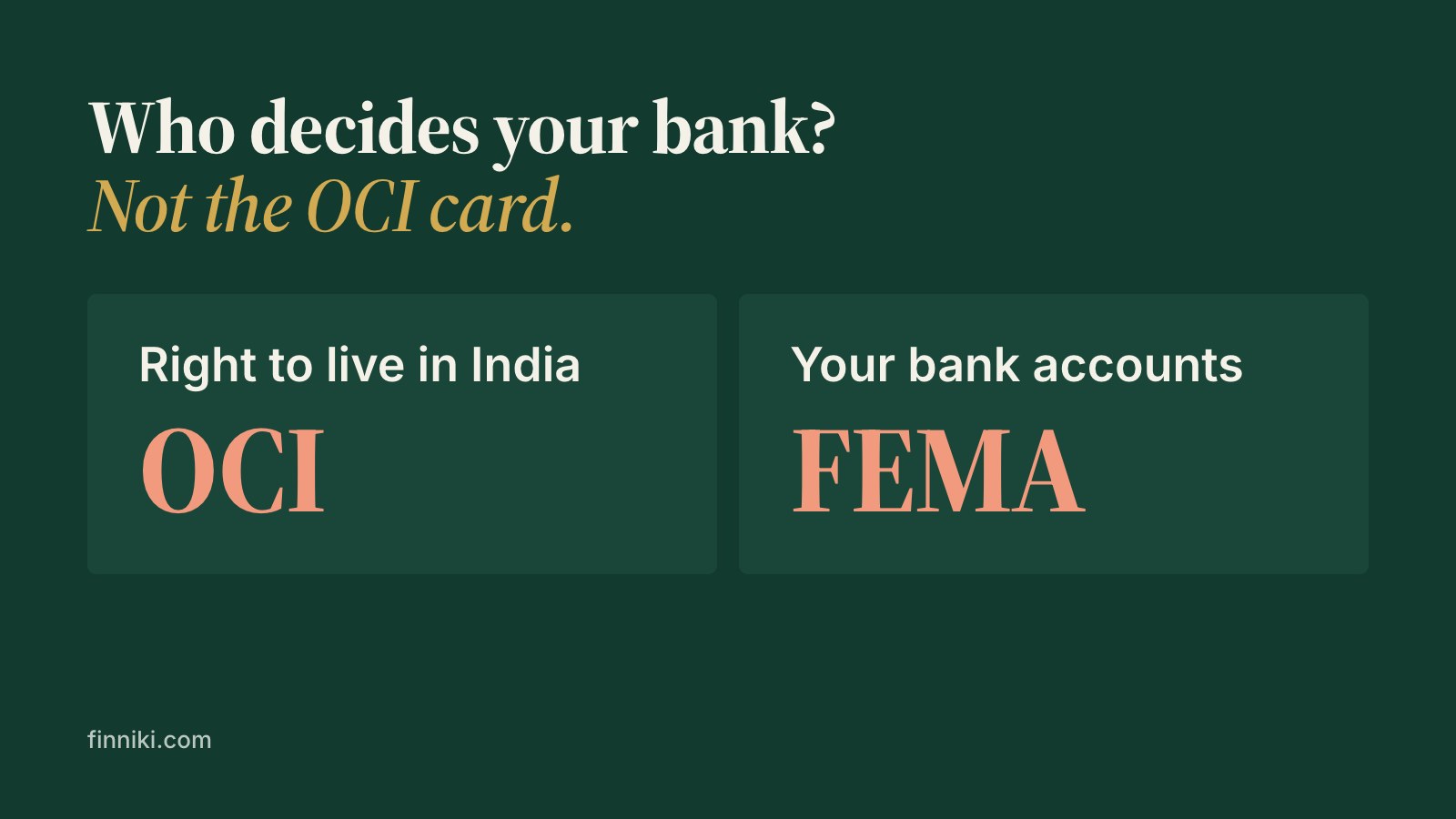
Does an OCI card decide which bank accounts you can hold?
No. An OCI card is an immigration document, not a banking one. Your right to live in India and your right to hold a particular bank account run on two different rulebooks. Your banking eligibility is set by FEMA, the Foreign Exchange Management Act, which asks one question: are you a Person Resident Outside India?
While you live and work abroad with no plan to return for an indefinite stay, FEMA treats you like any NRI, whether your label is NRI, PIO or OCI. The label does not drive the banking. Your FEMA status does.
Which accounts can an OCI cardholder hold while living abroad?
- NRE account: for foreign earnings converted into rupees. Principal and interest are fully repatriable, and the interest is tax-free in India while you hold NRI status.
- NRO account: for income earned in India, such as rent, dividends or a pension. Repatriation is possible but capped at US$1 million per financial year, and needs a chartered accountant's certificate with Form 15CA and Form 15CB (now Form 145 and Form 146).
- FCNR(B) deposit: a fixed deposit held in dollars, pounds or euros and never converted to rupees. It is shielded from currency swings and fully repatriable. Its interest stays tax-free while you are an NRI, and can stay exempt after you become an RNOR.
You cannot hold resident and NRI accounts side by side. The point at which you become a FEMA resident is the trigger to redesignate, and it is the turning point of the whole process. To compare the two deposits, use the NRE vs FCNR tool.
When do you become a FEMA resident after returning?
When you come back for good with the intention to stay for an indefinite period, not on the day you buy a one-way ticket. Returning does not flip a switch, and it is not an overnight change either.
FEMA defines a Person Resident in India as someone here for more than 182 days in the preceding financial year, but it excludes anyone who went abroad for employment, business or another purpose that signals an intention to stay outside India. On the way back, FEMA applies the same lens in reverse: have you returned to stay?
This is where FEMA and the Income Tax Act part ways. The Income Tax Act runs on a day count. FEMA runs on intention. So you can become a FEMA resident before you reach 182 days, and a string of short visits can leave you a non-resident despite a lot of time in India. Days set the threshold, and intention sets the direction. Through all of it your OCI status stays the same. Use the NRI status calculator to see where your tax status stands.
What happens to your NRE and NRO accounts when you become a resident?
They have to be redesignated. Do nothing and you hold accounts you are no longer eligible for.
- NRE account: it cannot continue indefinitely. It is redesignated into a domestic resident account or an RFC account. Once it becomes an ordinary resident account, the tax-free interest ends, because resident interest is taxable in India.
- NRO account: it is also redesignated, but the funds stay where they are and only the classification changes. The impact is smaller because NRO interest was already taxable, with TDS.
Does your FCNR deposit close when you become a resident?
No. This is the point that trips up most returning OCIs. Your existing FCNR can run to maturity, with interest accruing at the contracted rate and no forced early closure.
Some banks describe this differently, and a few allow redesignation to an RFC account earlier. Ask your bank before you act.
Does RNOR status let you delay changing your accounts?
No. RNOR (Resident but Not Ordinarily Resident) is a tax status you may qualify for in your first year or two back. It generally means your foreign income is not taxed in India during that window. People assume it buys them time on the accounts. It does not.
Your account structure follows FEMA, and your tax treatment follows the Income Tax Act. FEMA does not care that you are an RNOR. Once you are a FEMA resident, your NRE and FCNR accounts must be redesignated whatever your tax status is. The tax treatment of the interest does differ:
- NRE interest stops being exempt the moment you stop being a non-resident, RNOR or not.
- FCNR and RFC interest can stay exempt while you are an RNOR, and turns taxable only when you become ordinarily resident.
So redesignate on time, and take the RNOR exemption on your FCNR and RFC for as long as you qualify. The RNOR calculator shows how long that window lasts.
What are your options when your FCNR deposit matures?
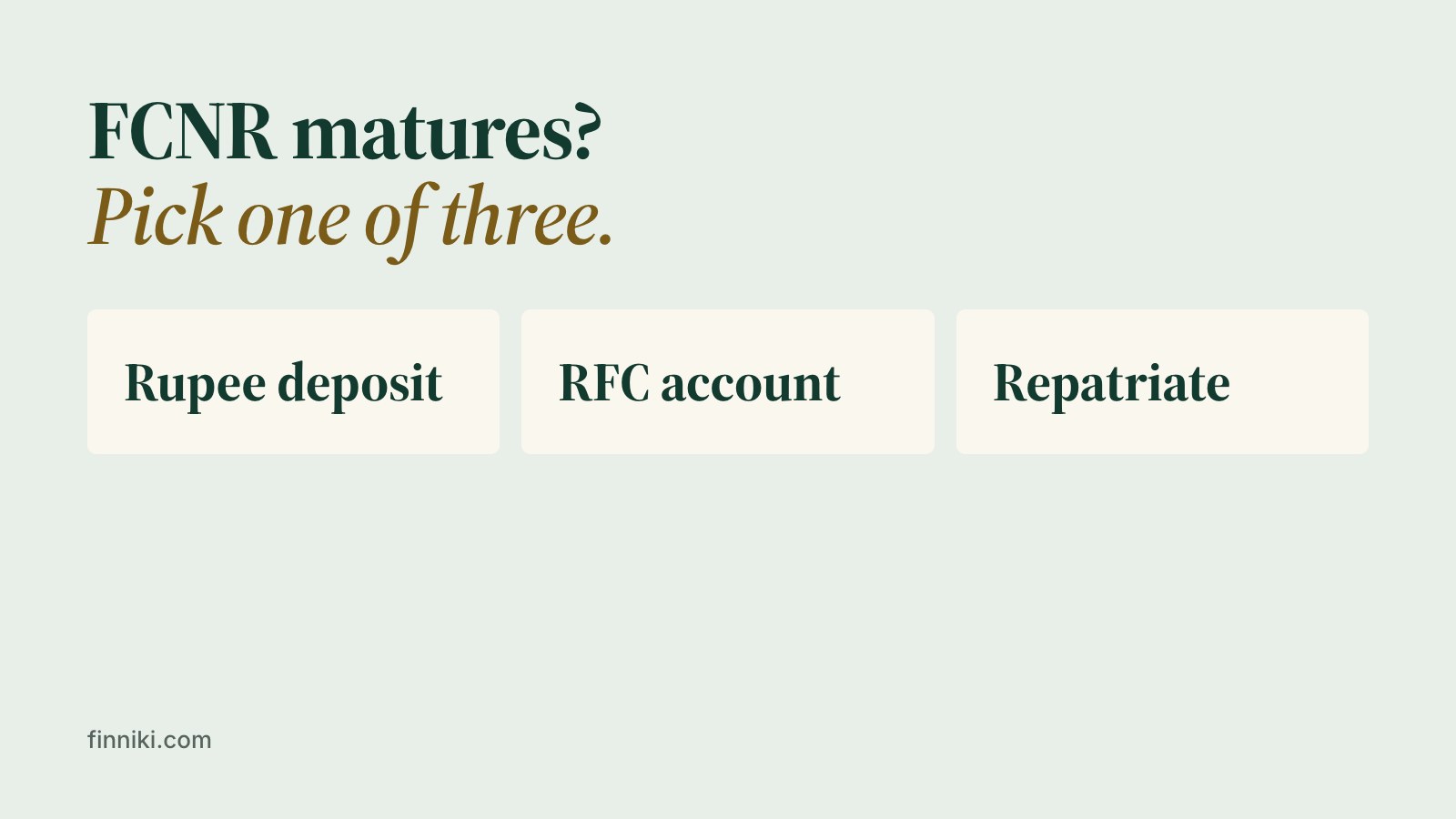
You cannot renew it. An FCNR is built only for non-residents, so a FEMA resident cannot open or renew one. Under RBI's rule, a matured FCNR held by a resident converts into either a resident rupee deposit or an RFC deposit. You have three practical choices.
- A resident rupee fixed deposit: the simplest. The deposit converts at the prevailing rate, with interest taxable once you are ordinarily resident. From then on you carry the full rupee risk.
- An RFC (Resident Foreign Currency) account: built for returning Indians who want to keep holding foreign currency. Your dollars stay dollars and earn interest in that currency, and you can use them when you need them. Interest turns taxable once you are ordinarily resident but stays exempt while you are RNOR. If you still earn income overseas, hold investments abroad or are not sure India is permanent, the RFC gives real flexibility.
- Repatriate the money: FCNR proceeds are fully repatriable, principal and interest, with no limit. The funds usually route through your resident or RFC account first. If you still carry a mortgage or commitments abroad, this is often the most practical route.
There is no single right answer. Will you keep needing foreign currency? Could you move abroad again? Or would you rather consolidate everything in India? Decide before the FCNR matures, not after.
What mistakes cost returning OCIs the most?
- Sending all overseas income to the NRO account because it is the one already open. When you later try to send a large sum abroad, you hit the US$1 million annual cap and the CA certificate with Form 145 and Form 146 (formerly 15CA and 15CB). NRE money would have moved freely.
- Staying silent. Your bank does not track your FEMA status or your return date. If you skip the notification and keep running NRI accounts you are not entitled to, you breach FEMA. Under Section 13 the penalty can run to three times the amount involved, where the amount is quantifiable, plus daily penalties while it continues. Tell your bank first.
- Converting to rupees by reflex at FCNR maturity. The bank asks what you want, and "convert to rupees" feels like the obvious answer. Nobody mentions the RFC, so you give up flexibility without knowing it was on offer.
Do the 2026 OCI rule changes affect your banking?
No. The 2025 and 2026 OCI changes (tighter grounds for cancellation, e-OCI, online applications and the digital arrival requirement) do not touch your banking. But paperwork errors can hold you up at the airport before you reach a bank. The companion post, OCI card rules 2026, covers them.
FAQs
Can an OCI cardholder keep an NRE account after moving back to India?
Not once you become a FEMA resident. The NRE account has to be redesignated into a resident account or an RFC account, and the interest stops being tax-free.
When does an OCI cardholder become a FEMA resident?
When you return with the intention to stay for an indefinite period. FEMA looks at your intention, with 182 days in the preceding financial year as the threshold, not at your OCI card.
Does my FCNR deposit have to be closed when I return?
No. An existing FCNR can run to maturity at the contracted rate. Some banks treat early redesignation differently, so ask yours.
Can I renew my FCNR deposit after becoming a resident?
No. At maturity it converts into a resident rupee deposit or an RFC deposit, or you can repatriate the money.
What is an RFC account?
A Resident Foreign Currency account lets a returning Indian keep holding foreign currency. The interest stays exempt while you are an RNOR and turns taxable once you are ordinarily resident.
Does RNOR status delay changing my bank accounts?
No. Accounts follow FEMA and tax follows the Income Tax Act. Redesignate once you are a FEMA resident, and keep the RNOR exemption on FCNR and RFC interest while you qualify.
How much can I send abroad from an NRO account?
Up to US$1 million per financial year, with a chartered accountant's certificate and Form 145 and Form 146 (formerly Form 15CA and 15CB).
What is the penalty for not telling my bank I have moved back?
Under FEMA Section 13, the penalty can run to three times the amount involved where it is quantifiable, plus daily penalties while the breach continues.
Plan your move back before you land
Your accounts, your tax status and your OCI each run on their own rules. Book a one-to-one session to work through the order of steps for your own move, or watch more NRI explainers on our video page.
General information, not advice for your situation. Rules change; check your own numbers with a CA before you act.