PIS vs Non-PIS for NRIs: Which Account Costs Less?
NRO Non-PIS vs PIS for NRI trading: brokerage, F&O and intraday, repatriation limits, the 2026 holding caps, joint accounts, and which route fits you.

Nikhil Varghese, CA · 9 min read

Quick answer: A Non-PIS account is simply your NRO account linked to a demat and trading account, used to trade Indian shares without the bank's Portfolio Investment Scheme (PIS) layer. It is regulated, needs no RBI approval and is usually cheaper: at one leading discount broker, Non-PIS brokerage is ₹50 an order against ₹200 on PIS, with no per-trade PIS reporting charge, and it is the route for F&O and, at brokers that offer it, equity intraday. The trade-off is that Non-PIS investments are non-repatriable, so money comes out under the NRO cap of US$1 million a year. Choose NRE-PIS if you need fully repatriable equity, NRO Non-PIS for active, cheaper trading, and neither for mutual funds.
Updated October 2026. From 12 June 2026 the FEMA rules raised the limits for individual investors outside India in a listed Indian company to under 10% each and 24% in aggregate (previously 5% and 10%). Forms 15CA and 15CB are now Forms 145 and 146. The joint-account rules below have been corrected: an NRE account can have a resident close relative as joint holder.
 Watch the episode: NRI trading mistake costing ₹1 lakh or more? PIS vs Non-PIS explained
How much does a PIS account cost an active NRI trader?
More than most NRIs realise. Take Rajat, a US-based software engineer with two young children, who has spent four years investing in Indian shares through the PIS account his bank recommended when he became an NRI. Every trade runs through his PIS-designated account, the bank reports it to the RBI, he pays a reporting charge, his brokerage is ₹200 an order, and money has to move from his NRO account into the PIS account before trades go through, sometimes with a lag.
Then his cousin, also an NRI, mentioned he pays ₹50 an order with the same broker, for the same shares, because he uses NRO Non-PIS. At today's prices, the arithmetic for Rajat, who makes about 120 trades a year:
- Brokerage: 120 trades × (₹200 − ₹50) = ₹18,000 a year, or ₹72,000 over four years.
- PIS reporting charges: about ₹100 per trading day, or roughly ₹40,000 to ₹50,000 over four years.
- Total: about ₹1.2 lakh, before counting the F&O and intraday trades his cousin could place and he could not.
His bank, his broker and his tax adviser all assumed PIS was the default, because for most NRIs walking into a bank it is. Rajat is an active trader: if you trade less, your saving is smaller, but the structure is the same.

What is a Non-PIS account for NRIs?
It is your regular NRO account linked to a demat and trading account, used to invest in Indian markets without going through the PIS framework. It is not a new product or a loophole: you are using a different, permitted route that works much more like a resident's trading set-up. There is no separate PIS ledger, no bank reporting of each trade to the RBI and no per-trade PIS charge.
Because it sits on an NRO account, it also handles your other Indian money: rent from a flat back home, dividends and pension payments flow into the same account. No RBI approval is needed: complete the NRO account KYC with your bank, link your demat and trading account, and you are set up.
Is Non-PIS cheaper than PIS?
Usually, yes. Under PIS your money sits in a designated account, every trade flows through that ledger and is reported by the bank, each trade carries a reporting charge, and moving money between NRE or NRO and the PIS account adds delay. Under Non-PIS that whole layer disappears.
The gap shows up in brokerage. From September 2025 one leading discount broker cut its Non-PIS brokerage to ₹50 an order (or 0.5%, whichever is lower), while PIS brokerage stayed at ₹200: a 75% difference on every trade. PIS trades do execute in real time on the exchange, and the bank is not approving each one; it is everything around the trade that is heavier, and that has a price.

Can NRIs trade F&O and intraday through Non-PIS?
F&O, yes; intraday, depending on your broker. PIS is built for delivery trades in shares: intraday trading and short selling are not done through it, and F&O does not run through PIS either. Through NRO Non-PIS you can trade futures and options, and in July 2025 SEBI removed the requirement for NRIs to trade F&O through a separate custodial participant code, which made this simpler. Since 2025 some brokers have also enabled equity intraday on Non-PIS accounts, but not all do, so check with yours.
This is not a recommendation to trade F&O or intraday. But if that is your style, Non-PIS is structurally the more capable route.
Do the NRI shareholding limits still apply on Non-PIS?
Yes. Non-PIS removes the bank's daily monitoring of your holdings, but not the company-level limits under FEMA, which apply whether you use PIS or Non-PIS. Since 12 June 2026, an individual investor resident outside India must hold less than 10% of a listed Indian company's paid-up equity capital, and all such individuals together up to 24% (the limits were 5% and 10% before). For almost every individual NRI these caps are irrelevant in practice, but "fewer reporting steps" does not mean "no ceilings anywhere".
Can you repatriate money from a Non-PIS account?
Yes, within the NRO limit. Investments through NRO Non-PIS are made on a non-repatriation basis, so money comes out of India under the general NRO rule: up to US$1 million per financial year, after applicable tax and with Form 145 and Form 146 (formerly 15CA and 15CB). That cap is a FEMA rule for every NRO account, not a Non-PIS rule.
If you want to move everything back abroad freely, with no cap, NRE-PIS remains the cleaner route. For most individual NRIs, US$1 million a year is ample, and within it repatriation is simpler because nothing is shuttled through a separate PIS ledger. More in NRI repatriation.
Can one NRO Non-PIS account handle all your Indian income?
Yes, and that is one of its quieter advantages. Because it is an NRO account, rent, dividends, pension, trading flows and remittances from abroad (converted to rupees on credit) all land in one place, with one statement. Tax time and tracking both get simpler. Rajat's cousin had run everything through his NRO Non-PIS set-up for two years; when Rajat asked how he kept track of it all, the answer was that there was nothing to track.
Which account should an NRI use: NRE, NRO, PIS or Non-PIS?
Match the account to the money and the job:
- NRE: foreign income. Interest is tax-free in India, and the money is fully and freely repatriable.
- NRO: Indian income such as rent, dividends, pension and sale proceeds. Interest is taxable with TDS, and repatriation is capped at US$1 million a year.
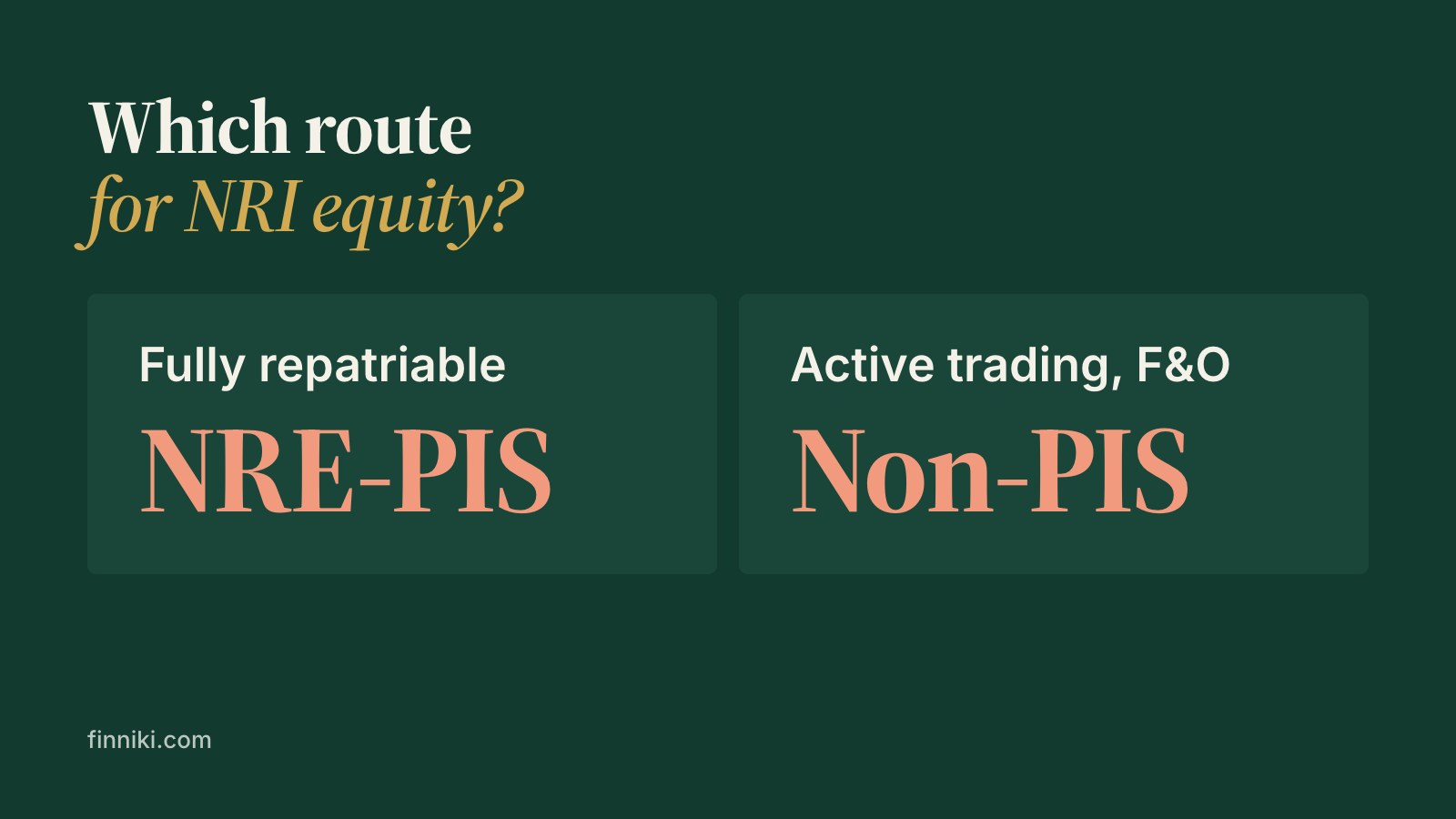
- NRE-PIS: fully repatriable equity investing.
- NRO Non-PIS: active, cheaper trading: delivery, F&O and, where your broker allows it, intraday. NRI-specific rules still apply: short selling is generally not permitted and leverage can differ, so confirm with your broker.
- Mutual funds: need neither PIS nor Non-PIS. NRIs invest directly from an NRE or NRO account, folio by folio, with NRI KYC and FATCA.
Is a Non-PIS account safe and legal?
Yes. The three common myths:
- "Non-PIS isn't safe." The NRO account underneath is regulated by the RBI under FEMA, with strict KYC. It is not a grey area.
- "You can't invest in much through Non-PIS." You can buy shares for delivery, trade F&O, apply for IPOs and invest in bonds, convertible debentures and warrants.
- "Tax is more complicated with Non-PIS." NRI tax rules apply the same way whichever route you use. NRO interest has TDS, but that is true of every NRO account.
Who should open an NRO Non-PIS account?
It suits you if you:
- Trade actively and want a leaner, cheaper set-up.
- Want F&O, or intraday where your broker offers it.
- Have several streams of Indian income to consolidate.
- Have been kept out of Indian markets by PIS paperwork.
It is not for you if you need fully repatriable equity (use NRE-PIS), invest only in mutual funds (a regular NRE or NRO account is enough), or are running business transactions, which need a different FEMA structure.
Can an NRE or NRO account be held jointly with a resident?
Yes, both can, on a "former or survivor" basis with the NRI as the first holder. Many guides say an NRE account can be joint only with another NRI; that is not right. Since 2011 the RBI has allowed an NRE account to be held jointly with a resident close relative, who can operate it only as a power-of-attorney holder while the NRI is alive. NRO accounts can also be held jointly with residents. Banks and brokers set their own policies for the linked trading and demat accounts, so confirm the details, but the banking-level flexibility can make family money management and estate planning much easier.
What should you know before opening a Non-PIS account?
Four practical points:
- NRE and NRO accounts are in rupees. They do not hold foreign currency, but they can receive remittances from abroad, which are converted to rupees on credit.
- Minimum balances vary by bank. Check before you open.
- You can have both. Hold a PIS account and an NRO Non-PIS trading set-up at the same time, keeping repatriable and non-repatriable investments apart. If you still run a resident demat, fix that first: see NRI demat account.
- Non-PIS is optional. It is not mandatory, but for active traders and anyone wanting a simpler set-up it is becoming the default, because it gets out of your way.
FAQs
What is the difference between PIS and Non-PIS for NRIs?
PIS routes trades through a designated bank account that tracks and reports them, and suits fully repatriable investing. Non-PIS uses an ordinary NRO account linked to your demat, with no PIS layer, and its investments are non-repatriable.
Is a Non-PIS account legal for NRIs?
Yes. It is an NRO account regulated by the RBI under FEMA, and no RBI approval is needed to use it for trading.
Can NRIs trade F&O in India?
Yes, through an NRO Non-PIS route. Since July 2025 SEBI no longer requires a separate custodial participant code for NRI F&O.
Can NRIs do intraday trading in India?
Some brokers now allow equity intraday on NRO Non-PIS accounts, but not all. It is not done through PIS.
Can money in a Non-PIS account be sent abroad?
Yes, up to US$1 million per financial year after tax, with Forms 145 and 146, because it is an NRO account.
Do NRIs need PIS to invest in mutual funds?
No. Mutual funds are bought directly from an NRE or NRO account with NRI KYC, without PIS or Non-PIS.
How much of a listed company can an NRI own?
Since 12 June 2026, an individual investor outside India must hold less than 10% of a listed company, and all such individuals together up to 24%.
Can a resident parent be a joint holder on an NRI's NRE account?
Yes, if they are a close relative, on a "former or survivor" basis; the resident can operate it only as a power-of-attorney holder during the NRI's lifetime.
Check your set-up before your next trade
Ask your bank about NRO Non-PIS by name, compare the fees, and be clear on the non-repatriation trade-off for your situation. Book a session to review your NRI accounts and trading set-up, or find more episodes on FinNiki videos.
General information, not advice for your situation. Rules change; check your own numbers with a CA before you act.