Is ₹1 Crore Enough? What It Really Does for You
₹1 crore gives you stability, not freedom. Why it is not a retirement number, how wealth speeds up after it, and the trap that undoes it.

Nikhil Varghese, CA · 7 min read

Quick answer: ₹1 crore in liquid savings gives you stability, not freedom: it turns emergencies like a car replacement, a wedding or a hospital bill into planned expenses, and it takes panic out of your decisions. It is not enough to retire on in India: withdrawing ₹80,000 a month, rising with 6% inflation, it lasts about 12 to 16 years depending on returns. At 12%, ₹1 crore earns about ₹12 lakh a year and doubles in about six years, so the next crores come faster. The biggest risk at this stage is the "play money" trap: gambling part of the corpus on high-risk bets and then chasing the losses.
Updated October 2026. The episode cited SEBI's first estimate of FY25 derivatives losses (over ₹1 lakh crore); SEBI's 2026 study revised it to ₹1.12 lakh crore. Some of the episode's projections have been recalculated below, with the assumptions stated.
 Watch the episode: What ₹1 crore really does for your financial life in India
What does ₹1 crore actually do for you?
It removes panic from your decisions. People make their worst financial choices with their backs to the wall: rent overdue, an EMI they cannot meet, a medical bill out of nowhere. Most Indian families, even high earners, live close enough to the edge that panic is always a few expenses away.
Now look at the big costs of a middle to upper-middle-class life in India today, as typical figures:
- Replacing a car: ₹15 to 20 lakh.
- A child's degree at a good private institution: ₹25 to 30 lakh.
- A mid-scale family wedding: ₹20 to 25 lakh.
- A medical emergency beyond your insurance: ₹10 to 15 lakh.
With about ₹1 crore you can actually reach, these stop being crises and become expenses you plan for. That shift, from crisis mode to planning mode, improves every other decision: you negotiate better at work, invest more patiently and make cleaner career choices. That is the first real power of ₹1 crore: not wealth, but stability.
Is ₹1 crore enough to retire in India?
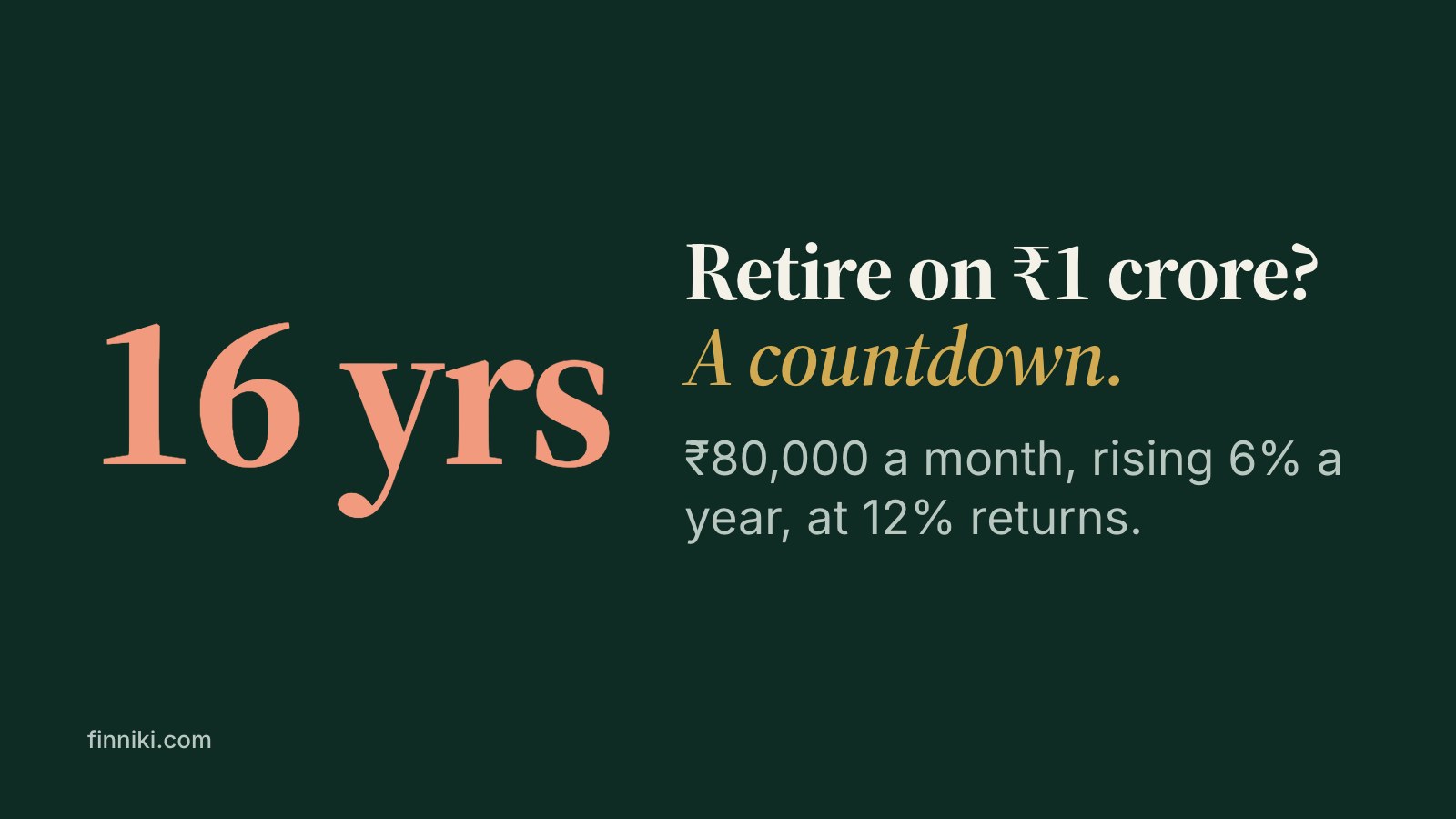
No. ₹1 crore is not a retirement number in India today. Take a real scenario: you are 45, you have just reached ₹1 crore, and your household spends ₹80,000 a month (₹9.6 lakh a year), which is not extravagant in a big city.
Your expenses do not stay still. At 6% inflation, that same lifestyle costs about ₹1.43 lakh a month in 10 years and about ₹2.57 lakh a month in 20 years.
If you retire and withdraw ₹80,000 a month, raising the withdrawal with inflation each year, the ₹1 crore runs out in:
- about 16 years if it earns a steady 12% a year;
- about 14 years at 10%;
- about 12 years at 8%.
Retire at 45 and the money is gone somewhere between 57 and 61, with perhaps 20 or 25 years of life still ahead. That is not a retirement plan; it is a countdown.
How much do you need to retire in India?
Far more than ₹1 crore. Financial planners often use the 4% rule: your yearly spending should be no more than 4% of your corpus. At ₹9.6 lakh a year, that means at least ₹2.4 crore at today's costs, and more once you allow for inflation over a 25-year retirement. For most Indian households aiming for a comfortable retirement, Nikhil's working range is ₹5 to 8 crore, depending on age, city, lifestyle and healthcare needs.
So ₹1 crore is not the destination; it is the starting line of real compounding. The investors who understand this protect the corpus instead of slowly drawing it down.
Why does wealth grow faster after ₹1 crore?
Because returns are a percentage of the base, and the base is now large. At 12% a year, ₹1 crore earns about ₹12 lakh in a year, roughly ₹1 lakh a month, without you adding a rupee. At ₹5 crore, the same 12% produces ₹60 lakh a year, about ₹5 lakh a month.
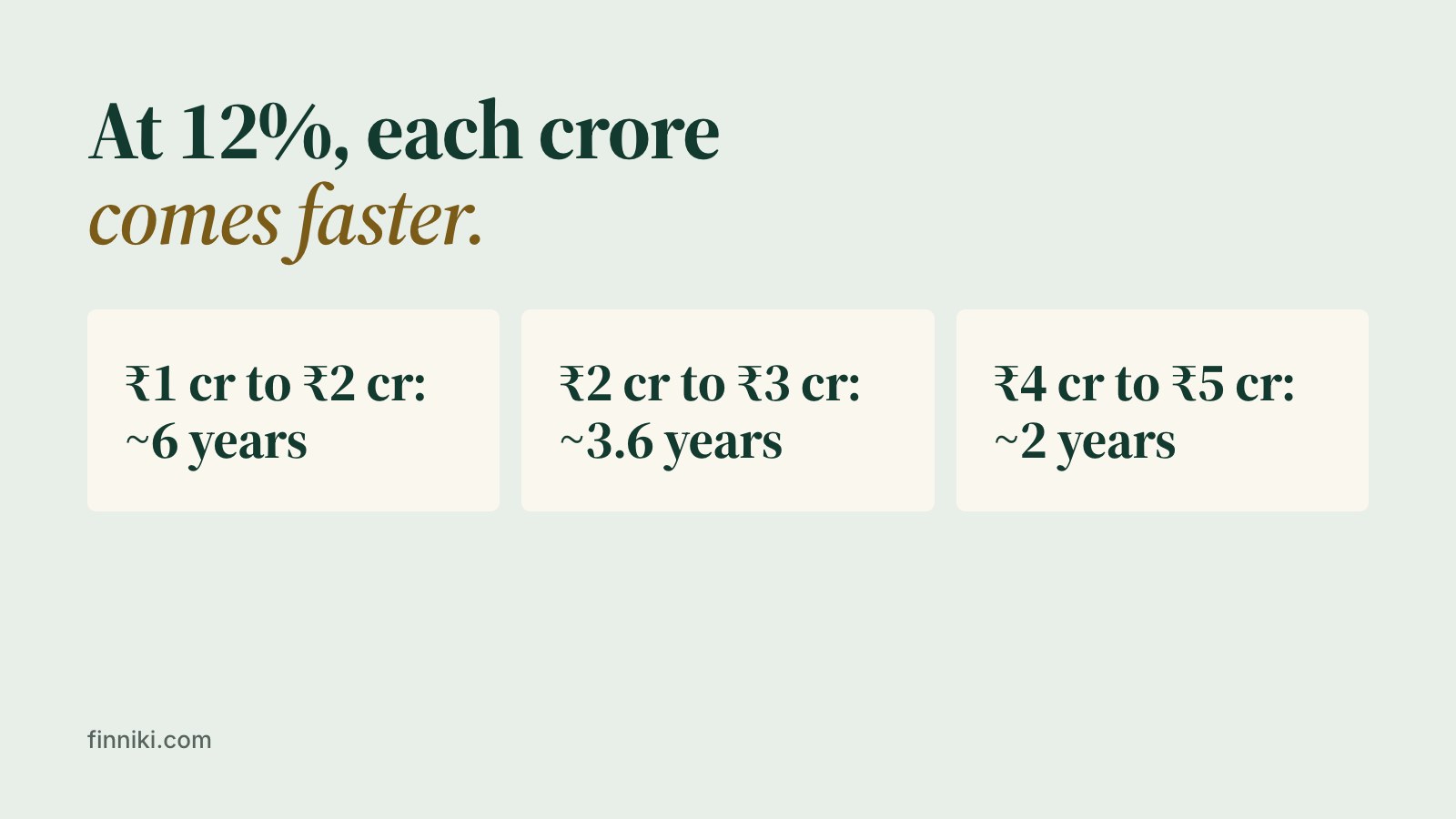
Each crore also takes less time than the one before. At 12%, with no new money:
- ₹1 crore to ₹2 crore: about 6.1 years.
- ₹2 crore to ₹3 crore: about 3.6 years.
- ₹3 crore to ₹4 crore: about 2.5 years.
- ₹4 crore to ₹5 crore: about 2 years.
Same return, same market; only the base changed. Building the first crore takes discipline; growing the ones after it takes patience, a very different skill. (For the full working, see why wealth grows faster after your first ₹1 crore.)
What is the "play money" trap?
It is the mistake that undoes everything, and it strikes at exactly this stage. An investor crosses ₹1 crore after years of discipline, and that confidence turns into an appetite for bigger, faster returns. "I can afford to experiment with ₹10 or ₹20 lakh. If it works, great; if not, I can absorb it." The reasoning feels sound. It is not, for two reasons.
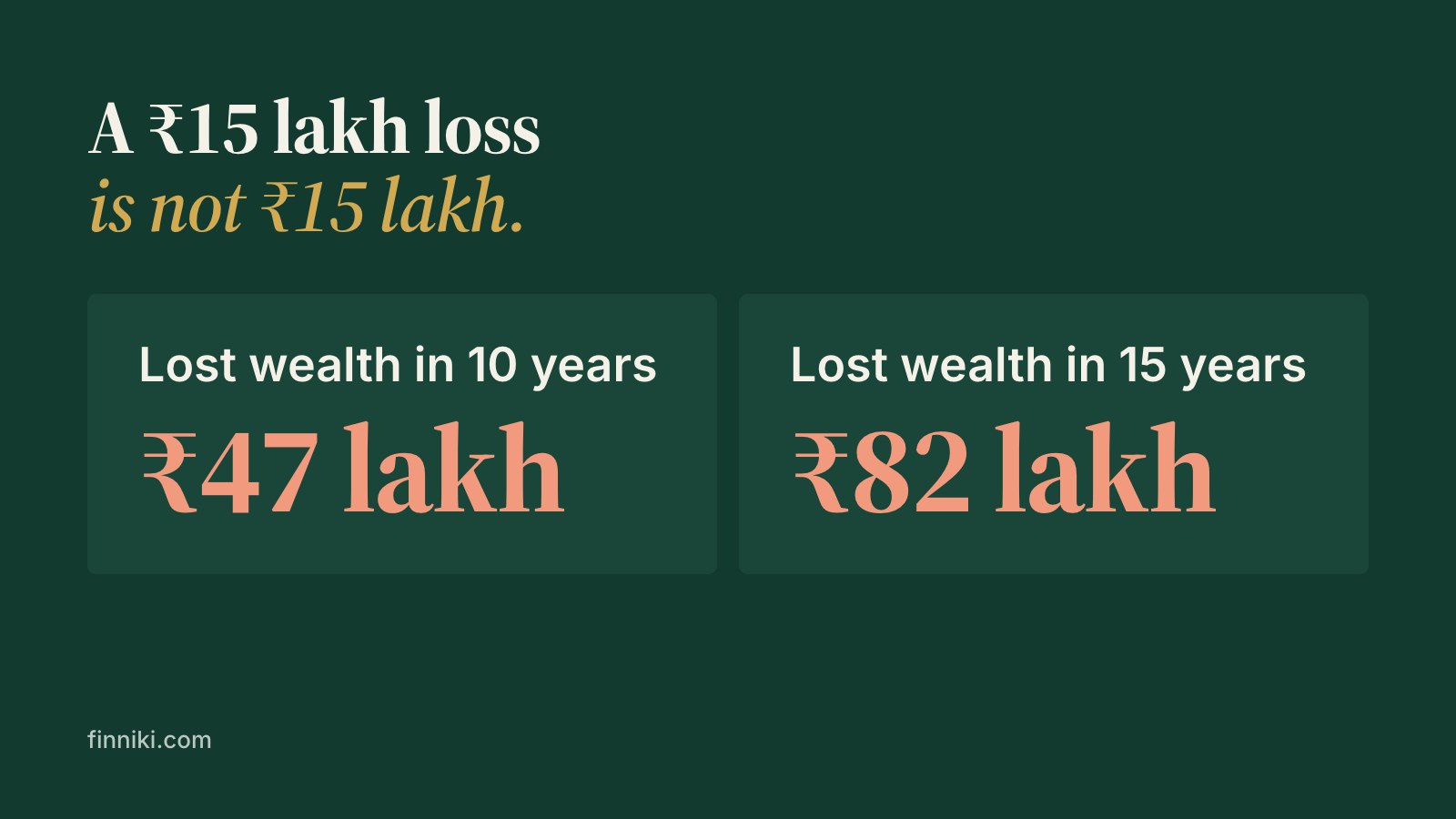
First, no loss is "affordable" when it comes out of a compounding base. A ₹15 lakh loss is not just ₹15 lakh. At 12%, that money would have grown to about ₹47 lakh in 10 years and ₹82 lakh in 15. You are surrendering decades of compounding.
Second, few people take a loss and move on. They switch to recovery mode: bigger positions, higher risks, emotional decisions. A ₹10 lakh experiment slowly becomes a ₹35 to 40 lakh hole, not through one bad call but through a series of emotional ones.
The data bear this out. In SEBI's study of equity derivatives (futures and options), about 91% of individual traders lost money in FY25, with net losses of about ₹1.12 lakh crore; in FY26, 88% lost a combined ₹91,685 crore. Many of them believed they were putting a manageable slice of their portfolio into higher-return bets.
The market has no memory of how long it took you to reach ₹1 crore. A 15% fall at this size is ₹15 lakh, perhaps two or three years of savings, gone in weeks.
How rich is ₹1 crore in India?
Rich enough to be rare, not rich enough to stop. Only a small minority of Indian households have ₹1 crore in liquid financial assets: not property values or net worth, but money they can actually reach. Getting there takes years of correct behaviour in a country where financial literacy is still developing, and that deserves to be acknowledged.
But ₹1 crore is not wealth. Confusing stability with freedom at this stage leads people to make decisions they are not yet in a position to make: their salary or business income still matters. For comparison, the Hurun India Wealth Report 2025 counts a household as a "millionaire" household at a net worth of ₹8.5 crore or more, which only about 0.31% of Indian households have reached.
The encouraging part: protected and left to compound at 12%, ₹1 crore becomes ₹5 crore in about 14 years, without a single extra rupee. Protect the base, do not interrupt the compounding, and the destination takes care of itself.
How should you manage money after ₹1 crore?
Change your role from engine to protector. In practice:
- Keep an emergency buffer in safe, liquid assets, so a bad month never forces you to sell investments.
- Do not treat any part of the corpus as "play money". If you want to learn trading, cap it at an amount whose loss would not change your plans, and never top it up to win losses back.
- Watch lifestyle creep. Let spending rise more slowly than the portfolio.
- Do not retire on ₹1 crore. Keep earning and investing until your corpus covers your expenses many times over.
- Review the plan once a year, not every time the market moves.
FAQs
Is ₹1 crore enough to retire in India?
No. Withdrawing ₹80,000 a month that rises with 6% inflation, ₹1 crore lasts only about 12 to 16 years, depending on returns.
How long will ₹1 crore last?
At ₹80,000 a month rising 6% a year, about 16 years at a steady 12% return, 14 years at 10% and 12 years at 8%.
How much does ₹1 crore earn in a year?
About ₹12 lakh at a 12% annual return, roughly ₹1 lakh a month, though equity returns vary from year to year.
How long does it take ₹1 crore to become ₹5 crore?
About 14 years at 12% a year, without adding any money.
What is the 4% rule?
A guideline that your yearly spending should be no more than 4% of your corpus; for ₹9.6 lakh a year, that means at least ₹2.4 crore.
How much do you need to retire comfortably in India?
For many households, ₹5 to 8 crore, depending on age, city, lifestyle and healthcare needs.
Should I trade F&O after reaching ₹1 crore?
It is risky: SEBI found about 91% of individual derivatives traders lost money in FY25, and losses taken from a compounding base cost far more than their face value.
Protect the engine
₹1 crore is not the finish line; it is the first moment the finish line becomes visible. To turn it into a real retirement plan, book a session, or find more episodes on FinNiki videos.
General information, not advice for your situation. Rules change; check your own numbers with a CA before you act.