Is a 401(k) Worth It If You're Moving Back to India?
Moving back to India? Why the 401(k) match still wins, how the 59½ penalty, RNOR and Form 40 fit, Roth or Traditional, and the two-date test.

Nikhil Varghese, CA · 10 min read

Quick answer: Yes, for most NRIs a 401(k) is still worth it even if moving back to India is the plan. If your employer offers a vested match, take it: a 50% match is an immediate 50% gain, while the early-withdrawal penalty is 10% plus US tax, so the match usually comes out ahead. The catch is the Two Clocks Problem: the 401(k) runs on a US clock built around age 59½, and your life runs on an India clock. Write your India date and your 59½ date side by side today; if India comes first, build a bridge fund outside the 401(k) so the move never forces a penalised withdrawal.
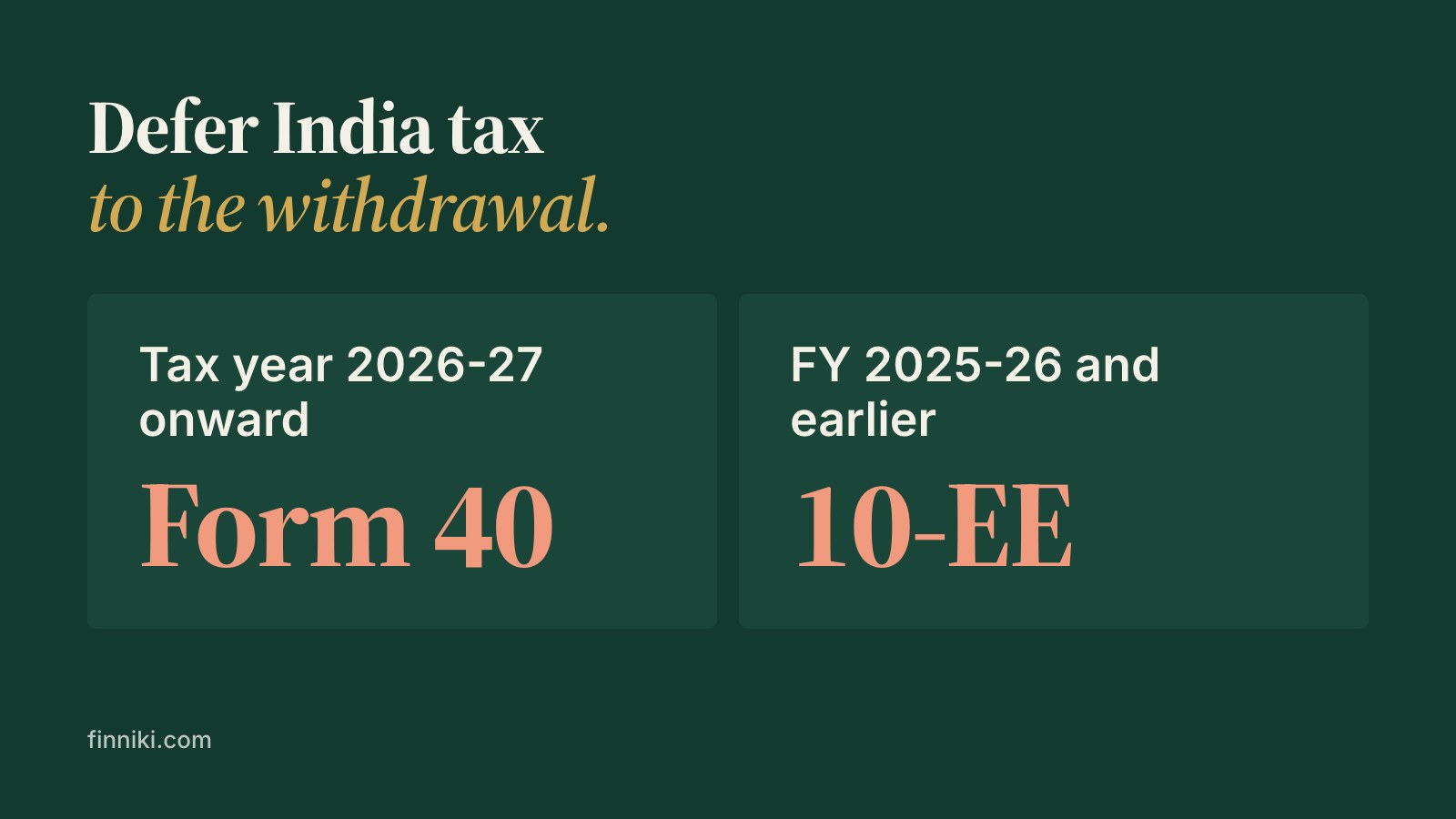
Updated for the 2026 US contribution limits and India's Income-tax Act, 2025: the election that defers India tax on a foreign retirement account is now Section 158 with Form 40 from tax year 2026-27 (it was Section 89A with Form 10-EE).
 Watch the 19-minute episode: Is your 401(k) still worth it if you're moving back to India?
What is the Two Clocks Problem?
It is the mismatch between two timelines that most NRIs read separately:
- Clock one, the US retirement clock, counts your age. It is built around 59½: withdraw before that and the IRS charges a 10% penalty on top of regular income tax.
- Clock two, your India clock, counts your own plan: five years, ten years, tied to your parents' health, your child's school stage, or simply the year you decide to go back.
A 401(k) works well when both clocks roughly agree. Most of the confusion about "should I invest if I'm leaving" comes from never checking one against the other.
Why is a 401(k) a good deal before you think about India?
Because of three things: the match, tax-deferred growth and high limits.
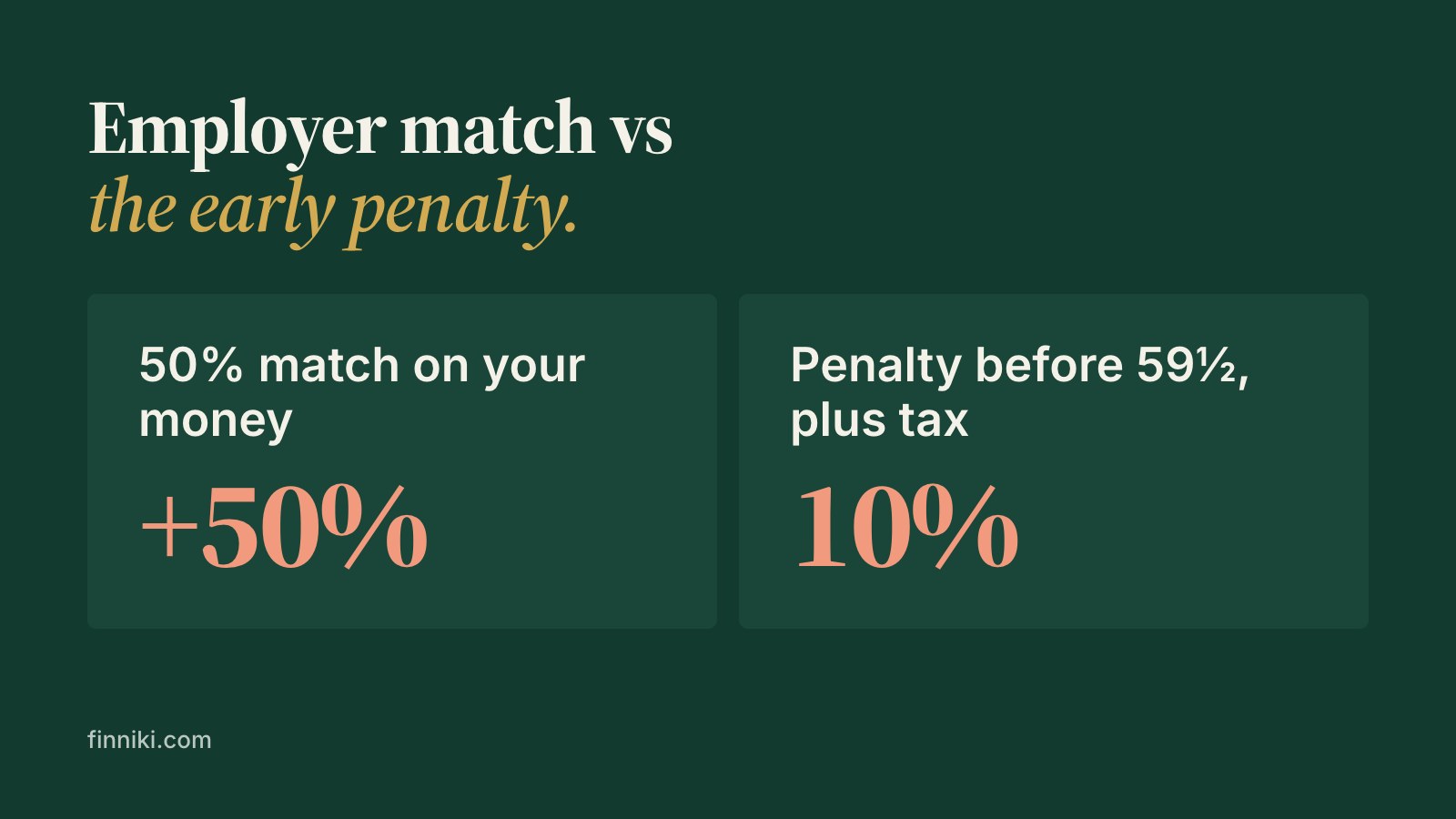
The employer match. Say your employer matches 50% of what you contribute, up to 6% of salary (formulas vary, so check yours). On a $120,000 salary, 6% is $7,200 of your money and your employer adds $3,600: an immediate 50% before the market does anything. One catch: some plans make you stay a set number of years before the match is fully yours, so if your India date is close, check your plan's vesting schedule.
Tax-deferred growth. Money in a traditional 401(k) compounds without a yearly IRS cut. Deferred is not free: traditional withdrawals are generally taxed as ordinary US income. Over 10 to 20 years, the deferral still makes an enormous difference.
High limits. The 2026 limits (2025 in brackets):
- Employee elective deferral: $24,500 ($23,500).
- Catch-up, age 50 to 59 and 64+: $8,000 ($7,500).
- "Super" catch-up, age 60 to 63: $11,250 ($11,250).
- Combined employee + employer, excluding catch-up: $72,000 ($70,000).
- Annual compensation cap: $360,000 ($350,000).
Two rows matter for a returning NRI. Between 60 and 63, the super catch-up lets you save $11,250 extra, which is useful if your India date falls around then. And from 2026, if your FICA wages from that employer (Box 3 of your W-2) crossed $150,000 last year, any catch-up must go in as Roth, after tax. Plan type matters too: Safe Harbor plans vest employer money immediately, and a Solo 401(k) lets a self-employed person put in far more.
For most people the rule is simple: contribute at least up to the full match.
Is the match still worth it if you move back in a few years?
Yes. This is the part that stays true whatever your timeline. Even if you are moving back in two years, contributing up to the match is close to a no-brainer: you are not locking the money away forever, only choosing when and how you access it. Take Divya, 32, a software engineer in Seattle with about $150,000 in her 401(k), contributing 8% with a 4% match, and planning to move back in about five years. Her match is still worth taking. What gets complicated is not the match but everything after you stop contributing and start thinking about withdrawal.
What does an early withdrawal actually cost?
The 10% penalty plus ordinary US income tax, wherever you live. Living in Bangalore instead of Seattle does not take your 401(k) outside US tax rules. On the example above:
- You put in $7,200; the employer adds $3,600; total $10,800.
- The 10% penalty on $10,800 is $1,080, about 30% of the $3,600 match, before ordinary US tax.
This is a sense of scale, not a full cost: the real number depends on your bracket, whether the match has vested, investment growth and timing. It does not mean early withdrawal is fine.
Do you have to withdraw your 401(k) when you move to India?
No. Moving back does not force a withdrawal. You can generally:
- Leave it in your old employer's plan (its rules set your investment options and fees).
- Roll it into an IRA.
- Roll it into a new employer's plan, if that plan allows it.
The exception: plans can force out small vested balances, generally up to $7,000, by cashing them out or moving them to an automatic-rollover IRA. For everything else, nothing breaks when you land. The account keeps working, and nobody warns you that a different clock has started: your RNOR window. For what to do with the account after you move, see what happens to your 401(k) when you move back to India.
How does India tax your 401(k) after you return?
It depends on your residency status:
- Still in the US, working: US rules apply, with tax-deferred growth. Generally no Indian income-tax exposure while non-resident, subject to treaty and reporting rules.
- Back in India as RNOR (typically 2 to 3 years): withdrawals received outside India are often not taxed in India; withdrawals received in India can be. It depends on your facts.
- Back in India as a full Resident (ROR): 401(k) withdrawals become taxable in India as well.
- Any withdrawal before 59½: the 10% IRS penalty plus ordinary US tax, wherever you live.
RNOR (Resident but Not Ordinarily Resident) is a planning window, not a blanket exemption: where the money is received matters, so a withdrawal credited to an Indian bank account may be taxed. Once RNOR ends, India can tax the same account you thought was safely parked in the US. Check your own window with the RNOR calculator.
Which filing stops India taxing your 401(k) growth every year?
Once you are a full resident, an election lets India tax your 401(k) growth only when you withdraw, not every year. The safety net, new Act (tax year 2026-27 onward) first, old Act (FY 2025-26 and earlier) in brackets:
- Defer India tax: Section 158, Form 40 (Section 89A, Form 10-EE). Taxes the actual withdrawal, not the annual growth.
- Treaty relief: Section 159, with Article 20 for pensions (Section 90). A pension may be taxed only in your country of residence, depending on the distribution.
- Foreign tax credit: Form 44 (Form 67). Credit in India for US tax already paid.
Which column applies depends on the income year, not the date you file. Do not assume Article 20 of the India–US treaty settles a lump-sum withdrawal: whether a given distribution fits depends on its type and your facts. If both countries tax the same withdrawal, a foreign tax credit may be available in India. For treaty relief more broadly, see DTAA for NRIs.
What goes wrong when the two clocks don't line up?
A gap nobody checked. Sagar and Sunita (composites, like Divya) are in their mid-50s after 22 years in New Jersey, planning to move back in about three years once their younger child finishes college. Sagar is 56. Part of their early India cash was meant to come from his 401(k), but his 59½ is three and a half years away, past the move date. Withdrawing early to fund the move means the 10% penalty plus US tax, and India may tax it too once RNOR ends.
The gap is only six months. Small gaps are cheap to bridge; the expensive ones are the gaps nobody looked for.
How do you bridge a gap before 59½?
Check your India date against your 59½ date today, not the week before you book tickets. If there is a gap:
- Bridge it with other savings, and leave the 401(k) growing untouched.
- Delay the withdrawal until after 59½.
- 72(t) plan (substantially equal periodic payments): lets you access the money early without the 10% penalty, but it generally must continue for five years or until 59½, whichever is longer. A long commitment, not a quick fix.
- Rule of 55: if you leave an employer in or after the year you turn 55, you can generally withdraw from that employer's plan without the 10% penalty, if the plan allows it.
None of these work if you only discover the gap after you have landed.
Roth or Traditional 401(k) if you're moving back to India?
Start with the usual question, your tax bracket now versus at withdrawal, then add your India timeline:
- Your bracket: higher now than later leans Traditional; lower now, or a higher India-adjusted bracket later, leans Roth.
- Withdrawing during RNOR: the choice matters less, since either can be untaxed in India if received outside India.
- Withdrawing after RNOR ends: Traditional withdrawals are taxable in India (Form 40 defers tax on growth until withdrawal); Roth is possibly more favourable, though India's treatment is still evolving.
- Certainty on today's rate, or early career on a lower income: leans Roth, which locks the rate in now.
A high US bracket now and lower later favours Traditional; a lower bracket today favours Roth. If you are fairly confident about moving back and your withdrawals will fall in or after your RNOR period, Roth deserves serious consideration. It is a lean, not a rule: in a very high bracket with decades to go, Traditional's upfront deduction can still be worth more. And remember that higher earners may be pushed into Roth catch-ups anyway.
So, how much should you put in your 401(k)?
It depends on how close your move is:
- Early to mid career, flexible India date (like Divya): contribute at least to the full match, and keep going beyond it. Compounding works whether you are in Seattle or Bangalore when you touch the money.
- Moving within a few years (like Sagar and Sunita): check the penalty maths against your withdrawal date now. If you might need the money before 59½ and have little saved outside the 401(k), take the match first, then build a bridge fund before adding more.
- Unsure if or when you are moving: contribute as normal. The account stays flexible until 59½, wherever you live.
- Ten years out, but the date keeps moving: contribute fully and recheck the two clocks once a year.
What is the two-date test?
A one-minute check that turns a surprise into a known number:
- Write the years until your India date.
- Write the years until you turn 59½.
- Subtract the first from the second. If the answer is above zero, you land in India before you can withdraw without penalty, and that is the gap to bridge.
Divya's numbers are 5 and 27½: a long gap, years away, which she can plan around. Sagar's are 3 and 3½: a six-month gap, close enough that it needs a plan now.

FAQs
Should I max out my 401(k) if I'm moving back to India?
Contribute at least up to the employer match. Beyond that, keep contributing if your timeline is flexible, but build a separate bridge fund if you may need money before 59½.
Is the 401(k) match worth it if I leave the US in two years?
Usually yes, if it vests: a 50% match beats the 10% early-withdrawal penalty plus tax. Check your plan's vesting schedule first.
Do I have to cash out my 401(k) when I move to India?
No. You can leave it in your old plan or roll it into an IRA; only small vested balances, generally up to $7,000, can be forced out.
Is my 401(k) taxed in India?
Withdrawals received outside India during RNOR are often not taxed in India; once you are a full resident, withdrawals become taxable in India as well.
What is Form 40 for a 401(k)?
Under the Income-tax Act, 2025, Form 40 (Section 158) lets a resident defer India tax on 401(k) growth until withdrawal. For FY 2025-26 and earlier it was Form 10-EE (Section 89A).
How can I withdraw from a 401(k) before 59½ without the penalty?
Through a 72(t) plan of equal periodic payments, or the Rule of 55 if you leave that employer in or after the year you turn 55 and the plan allows it.
Roth or Traditional 401(k) for an NRI moving back?
If you are confident about moving back and will withdraw in or after your RNOR period, Roth deserves serious consideration; in a very high US bracket, Traditional can still win.
Check both clocks before you need to
A 401(k) is a good account for someone moving back to India; you just manage two clocks instead of one. Book a session to line up your 59½ date, RNOR window and withdrawal plan, or work out your window with the RNOR calculator.
General information, not advice for your situation. Rules change; check your own numbers with a CA before you act.