DTAA for NRIs 2026: Cut TDS on NRO Interest Legally
NRO interest TDS of 31.2% can fall to 10-15% under a tax treaty. Country-by-country rates, the TRC and Form 41 you need, and what a DTAA does not cover.

Nikhil Varghese, CA · 11 min read

Quick answer: A DTAA (Double Taxation Avoidance Agreement) is a tax treaty that decides which country taxes your income and caps the tax India deducts. For most NRIs the quickest win is NRO interest: banks deduct about 31.2% by default, but treaties cut it to 10% to 15%, depending on where you live. The treaty rate is not applied automatically: you must give your bank a Tax Residency Certificate (TRC) from your country and Form 41 (formerly Form 10F). Always compare the treaty rate with India's own rate and use the lower one; for some dividends, India's rate wins.
Updated October 2026. India's new Income-tax Act 2025 and Income-tax Rules 2026 apply from 1 April 2026: Form 10F is now Form 41, and the lower-deduction certificate (Form 13) is now Form 128. The treaty rates below are unchanged. Corrected from the episode: the India–UK treaty caps dividends at 10%, not 15%, and the US treaty rate on an individual's interest is 15% (10% applies only to interest paid to banks).
 Watch the episode: Double tax for NRIs? DTAA explained
What is a DTAA and how does it help NRIs?
It is an agreement between India and another country that stops the same income being taxed in full twice. When you live abroad and earn money in India, both countries can claim the right to tax it: India because the income arises here, and your country of residence because you live there. A DTAA decides who taxes, and how much.
Treaty relief works in three ways:
- Exemption: the income is taxed in only one country.
- Tax credit: both countries tax it, but your country of residence gives you credit for the Indian tax.
- Reduced withholding: India deducts tax at source (TDS) at a lower treaty rate.
Two rules apply to everything below. First, Indian law lets you use the treaty rate or India's domestic rate, whichever is lower: always compare. Second, the treaty is not applied automatically. Without the right documents, your bank keeps deducting at the full rate, every year.
How much does a DTAA save on NRO interest?
Often more than half the tax. Banks deduct TDS on NRO interest at 30% plus 4% cess, about 31.2% (more with surcharge on very large incomes). Treaty rates on NRO interest and on dividends are far lower:
- UAE: interest 12.5%, dividends 10%.
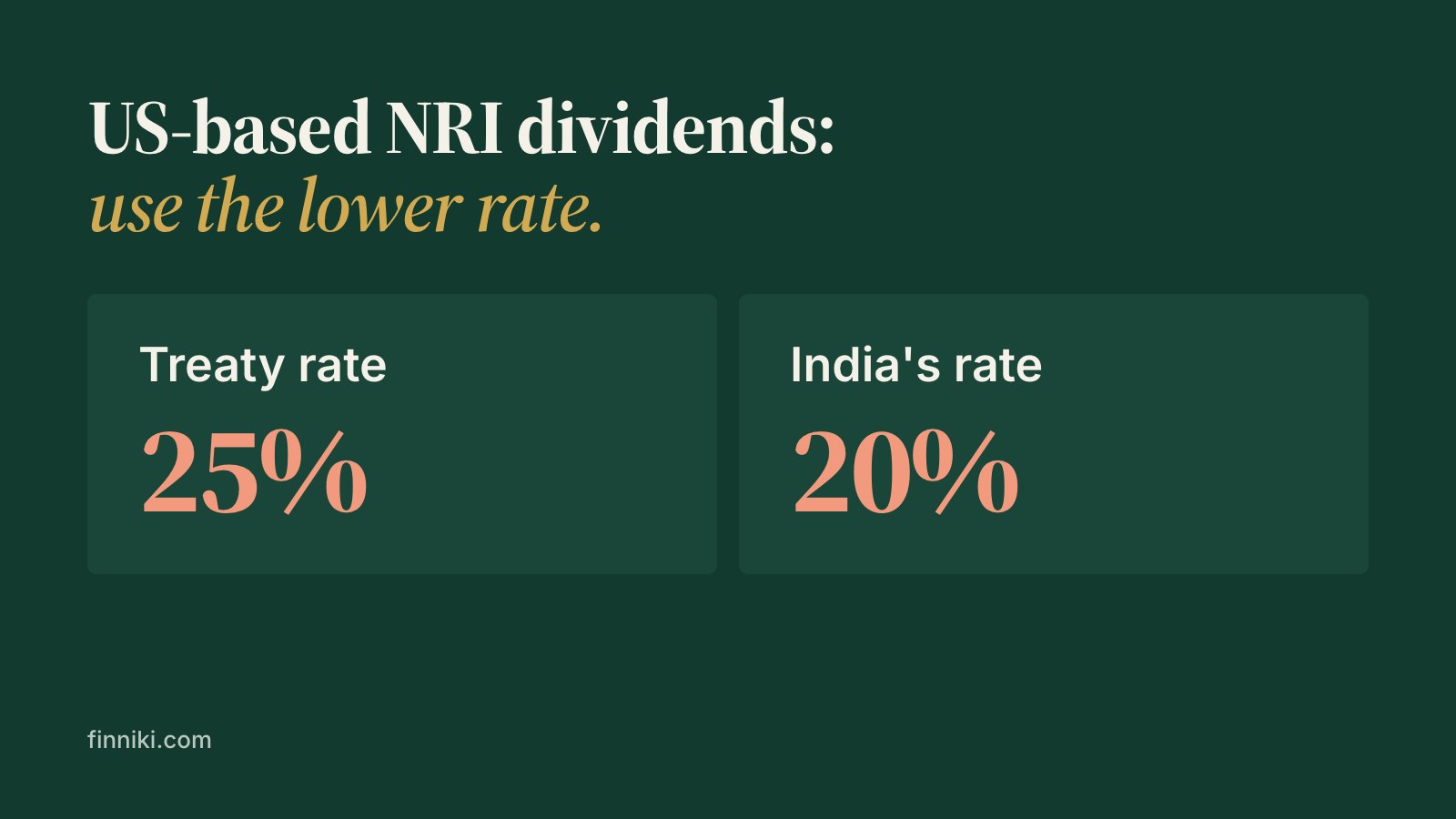
- US: interest 15%, dividends 25% (so India's 20% applies).
- UK: interest 15%, dividends 10%.
- Singapore: interest 15%, dividends 15%.
- Canada: interest 15%, dividends 25% (so India's 20% applies).
- Australia: interest 15%, dividends 15%.
- Germany: interest 10%, dividends 10%.
Dividend rates are for individual shareholders with small holdings. India's own rate on an NRI's dividends is 20% plus surcharge and cess.
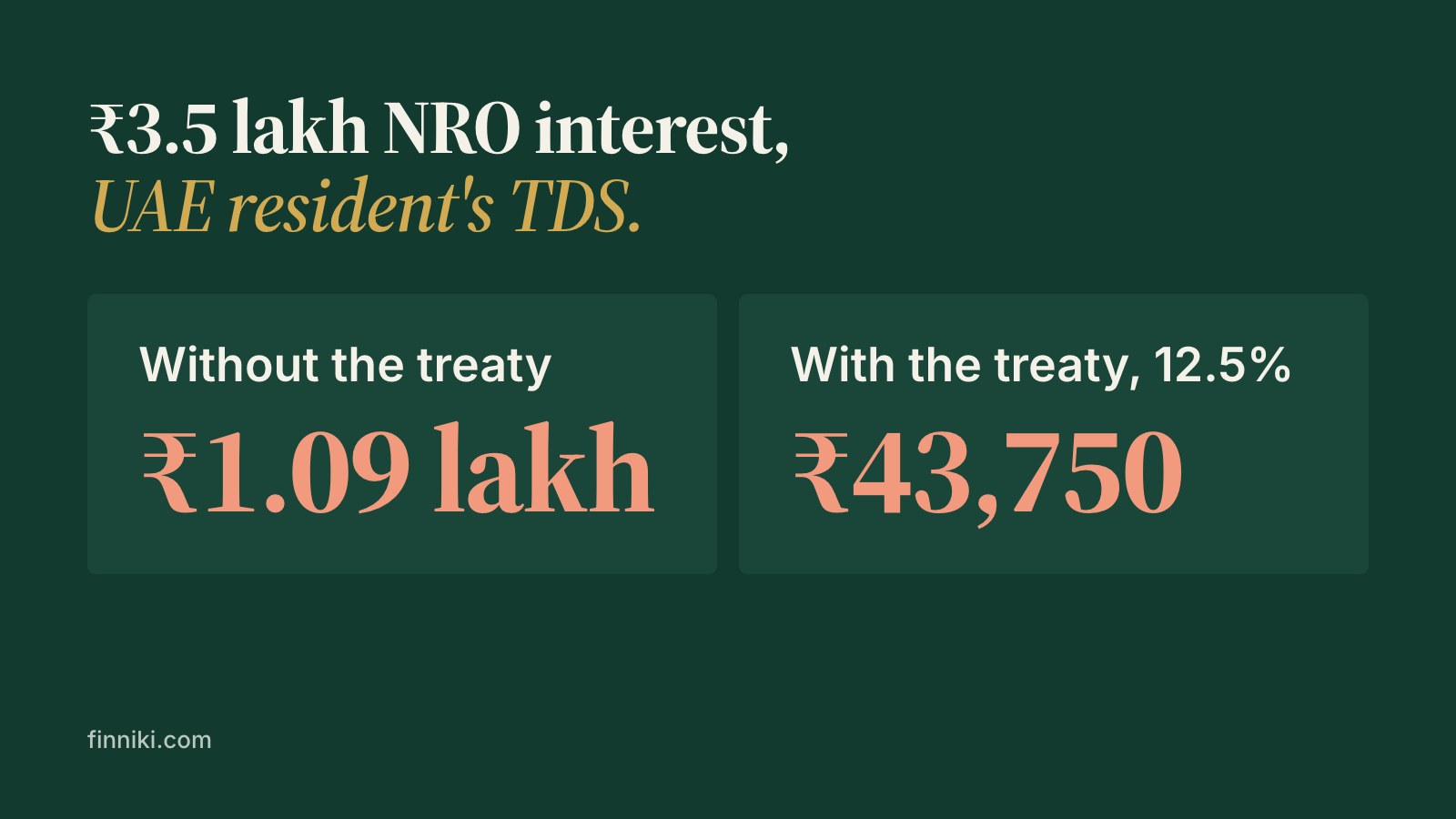
Take an NRI in Dubai with ₹50 lakh in an NRO fixed deposit at 7%: ₹3.5 lakh of interest a year. Without the treaty, TDS is about ₹1,09,200. At the UAE treaty rate of 12.5%, it is ₹43,750: about ₹65,000 saved every year, from one deposit and two documents.
If you hold an NRE or FCNR deposit instead, the interest is already tax-free in India for NRIs, so the treaty question arises mainly on NRO accounts. See NRE vs FCNR.
Why is the India–UAE DTAA so valuable for NRIs?
Because the UAE has no personal income tax, so every rupee India gives up is a real saving. Under the treaty:
- NRO interest: capped at 12.5%, against about 31.2%.
- Dividends from Indian companies: capped at 10%, half India's 20%.
- Indian shares: gains on shares of Indian companies remain taxable in India.
- Mutual fund units: tribunal rulings have held that units of Indian mutual funds are not "shares" under such treaties, so gains fall under the treaty's residuary clause and are taxable only in the country of residence. For a UAE resident, that can mean no tax on mutual fund gains. This is a tribunal position the tax department can still contest, so take advice and keep your TRC and papers in order before relying on it for large sales.
To use the treaty you must be a UAE tax resident, usually by spending at least 183 days there in the year or meeting its alternative tests, and hold a TRC from the UAE Federal Tax Authority. Apply well before you need it.
What does the DTAA mean for US-based NRIs?
Less than you might hope, because the US taxes its citizens and green card holders on worldwide income wherever they live. The treaty's saving clause lets the US keep taxing them as if the treaty did not exist; the treaty's job is to stop you paying twice, through the Foreign Tax Credit.
- NRO interest: capped at 15%. On ₹10 lakh of interest, TDS drops from about ₹3.12 lakh to ₹1.5 lakh: ₹1.62 lakh saved a year.
- Dividends: the treaty rate is 25%, higher than India's 20%, so India's rate applies and the treaty gives no extra benefit. That is why you always compare.
- Capital gains: both countries can tax them. India taxes long-term gains on listed shares and equity funds at 12.5% above ₹1.25 lakh a year, and short-term gains at 20%. The US taxes long-term gains at 0%, 15% or 20% depending on income, and short-term gains at ordinary rates. You pay India first and claim a credit in the US.
US citizens and green card holders also file Form 1040 every year, report foreign accounts on an FBAR if they total over $10,000 at any point, and report foreign financial assets on Form 8938 above its thresholds. The penalties for missing these are heavy. Your TRC is IRS Form 6166; the IRS asks for at least 45 days, so apply early.
How does the India–Singapore DTAA treat mutual fund gains?
Possibly tax-free in India, on current tribunal rulings. On interest, the treaty caps NRO TDS at 15%; on dividends it caps tax at 15%, below India's 20%, so it helps.
On capital gains, shares of Indian companies are taxable in India. But in Anushka Sanjay Shah (Mumbai tax tribunal, March 2025), a Singapore resident's short-term gains of about ₹1.35 crore on Indian equity and debt fund units were held taxable only in Singapore, because mutual fund units are not shares and fall under the residuary clause. Singapore does not generally tax capital gains, so the effective tax can be nil. It is a tribunal decision, not the last word, so take advice before large redemptions.
The treaty's limitation of benefits clause targets shell companies; for individuals, what matters is genuine Singapore tax residence. Your TRC comes from IRAS, Singapore's tax authority.
How do the UK, Canada and Australia treaties compare?
Identical on interest, different on dividends.
- Interest: all three cap NRO TDS at 15%. A UK-based NRI with ₹2 lakh of NRO interest pays about ₹30,000 instead of ₹62,400: ₹32,400 saved a year.
- Dividends: the UK treaty caps them at 10% and Australia's at 15%, both below India's 20%, so claim the treaty. Canada's 15% applies only to companies holding at least 10% of the voting power; for everyone else it is 25%, so Canadian retail investors are better off with India's 20%.
- Capital gains on Indian shares: both countries can tax; you pay in India and claim a foreign tax credit at home.
Do not assume you stopped being a tax resident when you boarded the plane. Canada can treat you as resident if you keep strong ties such as a home, a spouse or dependent children there. Australia applies detailed residency tests, and the UK uses its Statutory Residence Test, based on days and ties. If both countries treat you as resident, the treaty's tie-breaker rules decide (see below).
Why is the India–Germany DTAA worth claiming?
It has some of the lowest rates of any major treaty: 10% on NRO interest and 10% on dividends. On the same ₹50 lakh NRO deposit earning ₹3.5 lakh a year, TDS falls from about ₹1.09 lakh to ₹35,000: about ₹74,000 saved a year. Capital gains, including on property in India, can be taxed in India first, with a credit in Germany; given Germany's high tax rates, claiming that credit matters.
What happens if you are a tax resident of two countries?
The treaty's tie-breaker decides. Take someone who leaves the US for India in August. The US tax year runs January to December, India's April to March. By August they have spent over 183 days in the US, enough to be resident there, and from August to March they will spend over 182 days in India, enough to be resident here. Both countries claim them for overlapping periods.
Article 4 of most of India's treaties settles this by walking down four steps until one gives an answer:
- Permanent home: where you have one available.
- Centre of vital interests: where your family, business and strongest personal and economic ties are.
- Habitual abode: where you actually spend most of your time.
- Nationality.
The tie-breaker only helps if you can prove your side of the line: keep day counts, passport stamps, rental agreements and records of where your family and bank accounts are. For US citizens and green card holders, the saving clause means the US keeps its right to tax, so the foreign tax credit does the work. If you are planning a move, talk to a cross-border adviser a year ahead. If you are moving back to India, check whether you will be RNOR, which keeps most foreign income out of Indian tax for your first years back: see the RNOR calculator.
Which documents do you need to claim DTAA benefits?
Two, given to whoever pays you, such as your bank.
- Tax Residency Certificate (TRC) from the tax authority of your country of residence, confirming you are tax resident there for a stated period. No TRC, no treaty rate. Renew it every year, and allow anything from a few days to about eight weeks depending on the country.
- Form 41 (formerly Form 10F), a self-declaration filed online on the Indian income tax e-filing portal, with your name, PAN, your foreign tax identification number, the period and the treaty country. Non-residents who do not need a PAN can still register and file it.
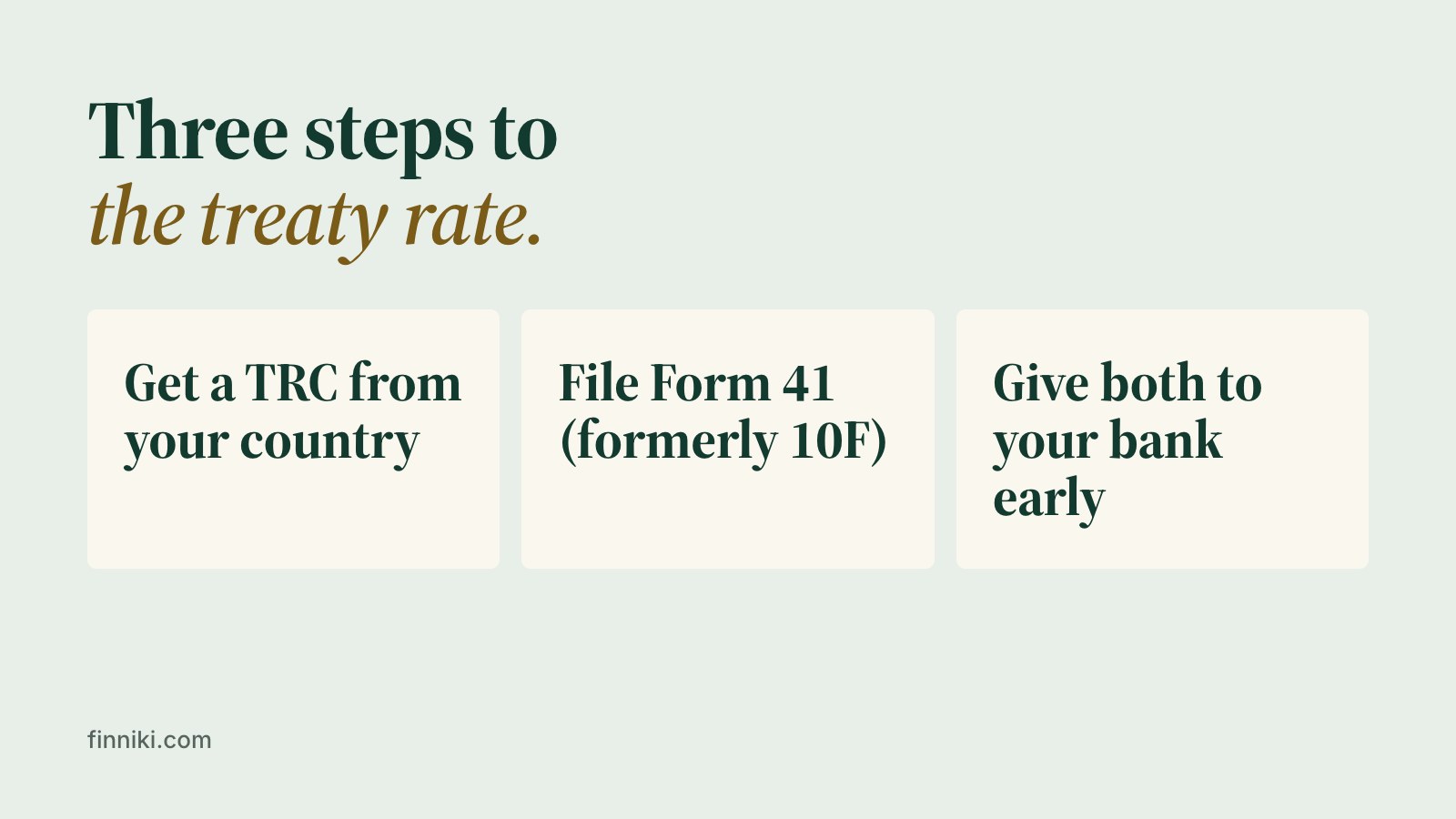
Get both to your bank before the interest or dividend is paid. If they are accepted in time, TDS is deducted at the treaty rate. If you are late, the extra TDS has already gone, and you can only recover it as a refund through your Indian tax return, which can take months.
What does a DTAA not cover?
- Rental income from property in India is taxed in India whichever treaty applies. You can claim a credit at home, but India keeps the first right to tax.
- Property sales: India taxes gains on Indian property. NRIs pay 12.5% without indexation on long-term gains for sales from 23 July 2024.
- Interest and penalties for late or missed tax are not covered by any treaty.
- Zero tax overall. A treaty prevents double taxation; it does not promise no taxation. If you earn meaningful income from India, expect to pay tax somewhere.
- Automatic use. It is optional: compare and pick the lower rate. Canadian retail investors' dividends are the classic case where India's rate is better.
Can you get a lower or nil TDS certificate instead?
Yes. If your real Indian tax for the year is lower than the TDS being deducted, because your income is within the basic exemption (₹4 lakh under the new regime), or you have losses or deductions, you can apply to the Income Tax Department for a lower or nil deduction certificate, now on Form 128 (formerly Form 13). Once granted, it tells the payer to deduct at a lower rate, or not at all. It suits NRIs whose Indian income is modest but still hit by high default TDS.
FAQs
What is DTAA for NRIs?
A tax treaty between India and your country of residence that stops the same income being taxed twice and caps the tax India deducts on interest, dividends and some other income.
What is the DTAA rate on NRO interest?
It depends on the country: 12.5% for the UAE, 10% for Germany, and 15% for the US, UK, Singapore, Canada and Australia, against about 31.2% without the treaty.
Is DTAA applied automatically?
No. Your bank deducts the full rate until you give it a Tax Residency Certificate and Form 41 (formerly Form 10F).
What is Form 41?
The self-declaration that replaced Form 10F from 1 April 2026. Non-residents file it online on the e-filing portal to claim treaty benefits.
Are mutual fund gains tax-free for NRIs in the UAE or Singapore?
Possibly. Tribunal rulings treat mutual fund units as falling under the treaty's residuary clause, taxable only where you live, but the position can still be contested.
Does the DTAA reduce tax on selling property in India?
No. India taxes gains on Indian property; you can claim a credit for that tax in your country of residence.
Should I always use the DTAA rate?
No. Use whichever is lower, the treaty rate or India's rate. For US and Canadian retail investors, India's 20% on dividends beats the treaty's 25%.
Can I get back TDS deducted before I submitted my TRC?
Yes, by filing an Indian tax return and claiming the refund, which can take months.
Stop overpaying on your Indian income
Most NRIs do not lose money because they earn less; they lose it because nobody told them to claim. If you have NRO interest, dividends or a sale coming up, book a session to set up your treaty claim, or read how NRIs invest in India and why NRIs get tax notices.
Moving back? Read how RNOR status can keep your foreign income tax-free for up to three years.
General information, not advice for your situation. Rules change; check your own numbers with a CA before you act.