RNOR Status: How Returning NRIs Save Tax
RNOR keeps foreign income out of Indian tax for your first years back. Who qualifies, how to stretch it to three years, and the mistake that costs lakhs.

Nikhil Varghese, CA · 10 min read

Quick answer: RNOR (Resident but Not Ordinarily Resident) is a transition status for Indians who come back after years abroad. You are a tax resident of India, but your foreign income is generally not taxed in India unless it is received in India, and you generally do not have to list your foreign assets in your return. You qualify if you were a non-resident in 9 of the 10 previous years, or spent 729 days or fewer in India in the previous 7 years. Most long-term NRIs get two RNOR years automatically and can plan a third by counting days. The costly mistake is having foreign sale proceeds paid straight into India: keep them abroad and remit later.
Updated October 2026. India's new Income-tax Act 2025 applies from 1 April 2026 and uses "tax year" instead of "financial year". The residence and RNOR tests carry over unchanged, so the examples below use tax years from 2026–27.
 Watch the episode: RNOR explained, how returning NRIs avoid paying lakhs in tax
What is RNOR status?
RNOR is a halfway status between NRI and full resident. While you live abroad as an NRI, India taxes only your Indian income: your salary in Dubai, rent from a flat in the US or gains on shares in Singapore are outside the Indian tax net. Once you come back and become a Resident and Ordinarily Resident (ROR), India taxes your global income: every rupee, earned anywhere.
RNOR sits in between. You are resident for most everyday purposes, but your foreign income generally stays outside Indian tax as long as it is earned and received outside India. Think of it as a grace period that gives you time to restructure your money before the full rules apply.
Why does RNOR matter when you move back to India?
Because without it, the income and gains on a decade of overseas savings would come into the Indian tax net overnight. Take Rajesh (not his real name), who spent twelve years in the US and built a share portfolio, retirement savings and a rental property. He moved back without talking to a tax adviser. A year later, a tax notice put his bill on foreign investments at more than ₹25 lakh, most of which planning before the move could have avoided.
Most of that cost comes from timing: selling, receiving or restructuring at the wrong moment. RNOR gives you a window to do those things while your foreign income is still outside Indian tax.
Who qualifies for RNOR status?
First, you must be a resident for the year. For most returning NRIs that means spending 182 days or more in India in the tax year (April to March). Once you are resident, you are RNOR if you pass either of two tests:
- The 9-out-of-10 test: you were a non-resident in at least 9 of the 10 tax years before this one. Returning in 2026–27, you look back at 2016–17 to 2025–26.
- The 729-day test: you spent 729 days or fewer in India in the 7 tax years before this one. Returning in 2026–27, you add up your days from 2019–20 to 2025–26.
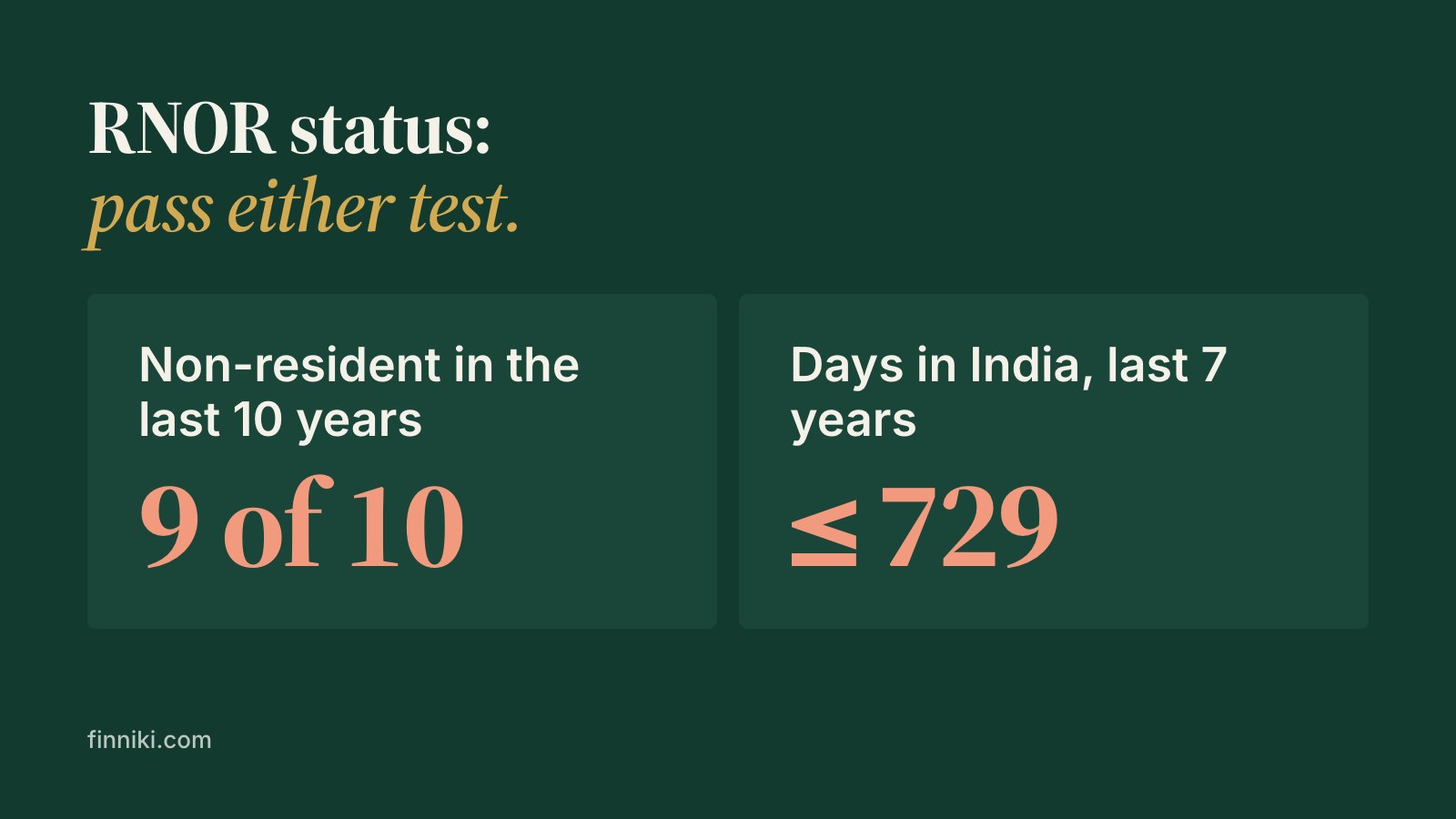
One test checks how long you were an NRI; the other checks how long you were physically in India. Pass either and the year is an RNOR year.
Two other routes lead to RNOR. An Indian citizen or person of Indian origin whose Indian income exceeds ₹15 lakh becomes resident after 120 days in India (if they also spent 365 days here in the previous four years), and is then treated as RNOR. An Indian citizen with Indian income above ₹15 lakh who is not liable to tax in any other country is deemed resident, and also treated as RNOR.
One trap for people returning for good: the 182-day threshold is a relaxation for Indians visiting India. If you come back permanently and spent 365 days or more in India over the previous four years, you can become resident after just 60 days. Check this before you assume your first year is an NRI year.
How long does RNOR status last?
Usually two years, and sometimes three. If you were abroad for ten years or more, you pass the 9-out-of-10 test in your first and second years back automatically, whatever your day count. By the third year you have two resident years in the look-back, so the 9-out-of-10 test fails, and only the 729-day test can keep you RNOR.
That third year turns on your day count. If you spend every day of your first two years in India, the look-back reaches about 730 days, one or two over the limit, and the third RNOR year is lost. A few weeks abroad in those first two years can keep it. Check your own years with the RNOR calculator.
How can you stretch RNOR to three years?
By planning your days in India for the first two years. Take someone who has not visited India for seven years and returns permanently in April 2026:
- Year 1, 2026–27: 200 days in India. Resident, because it is over 182. The 7-year look-back is 0 days, so RNOR.
- Year 2, 2027–28: 250 days. The look-back (2020–21 to 2026–27) is 200 days, and they also still pass the 9-out-of-10 test, so RNOR.
- Year 3, 2028–29: 365 days. The 9-out-of-10 test now fails, but the look-back is 200 + 250 = 450 days, under 729, so RNOR again.
- Year 4, 2029–30: the look-back is 200 + 250 + 365 = 815 days, over 729. RNOR ends and they become ordinarily resident.

This only works if your day count is airtight. The day you arrive and the day you leave usually both count as days in India, which is where many people slip. Keep a spreadsheet, and back it with passport stamps, boarding passes and travel history. Arriving in April, at the start of the tax year, gives you the most room to plan. In any year you spend fewer than 182 days in India (and no other test applies), you are simply an NRI again.
What are the benefits of RNOR status?
Three, and the first is the biggest.
- Foreign income is generally not taxed in India. Income earned and received outside India stays outside Indian tax during your RNOR years (unless it comes from a business controlled from India or a profession set up here). Say you sell US shares and book a $30,000 gain on shares held for over two years. As an ordinary resident, India would tax it at 12.5% plus cess: about $3,900, roughly ₹3.7 lakh at ₹95 to the dollar, and more if the gain is short-term, which is taxed at your slab rate. Book the same gain while RNOR and keep the proceeds abroad, and India does not tax it.
- Lighter disclosure. An ordinary resident must list every foreign bank account, share, fund and property in the return's foreign assets schedule (Schedule FA), with balances, peak values and dates. As an RNOR, you are generally not required to.
- A planning window. You can sell appreciated foreign investments, rebalance your portfolio and time your transfers to India while foreign gains are outside Indian tax. Check the tax in your old country of residence too: it may still apply depending on your residency there.
What should you do with your investments during RNOR?
Use the window deliberately:
- Book foreign capital gains on investments that have grown a lot, and park the proceeds in an overseas account. When you later bring the money to India, you are moving capital, not income, so the original gain is not taxed again. Only new income after that point, such as interest or dividends in India, is taxable.
- Rebalance from tax-inefficient holdings into the ones that suit an Indian resident, before every gain becomes taxable here.
- Consider GIFT City if you want to keep money in dollars inside India. How its products are taxed depends on the product and your residential status, so check before assuming it saves tax. See our guide to GIFT City for NRIs.
- Keep your FCNR deposits and RFC account in mind: their interest can stay exempt while you are RNOR, though your NRE and FCNR accounts still have to be redesignated under FEMA when you return. See OCI and NRI banking when you return to India.
What is the most expensive RNOR mistake?
Bringing foreign proceeds straight into India. Take Priya (not her real name), eight years in Singapore. She understood RNOR and hired a CA. In October of her first RNOR year she sold her Singapore shares and booked a gain of about ₹40 lakh, which should have been outside Indian tax. But excited about a flat in Mumbai, she had the whole sale proceeds paid into India. Income received in India is taxable in India, even for an RNOR, and she paid over ₹5 lakh in tax.

The rule: let the sale proceeds land in your overseas account first, and transfer them to India later, ideally only when you actually need the money. What matters is where the income is first received, not how soon you want to spend it.
Common RNOR mistakes returning NRIs make
- Not tracking days. Map your travel for the next two or three years before you move: family events, work trips, long holidays.
- Assuming RNOR is automatic. It is not. You claim it by choosing the right residential status in your return, so your CA needs to know from day one.
- Not documenting foreign income. Undisclosed does not mean undocumented. Keep clean records of overseas income and sales: you will need to explain the source when you remit.
- Believing RNOR means zero tax. Indian income, such as salary, rent and interest earned in India, is fully taxable.
- Doing it alone. A CA who understands NRI taxation will often cost far less than one avoidable tax bill.
Your RNOR checklist
Before you return:
- Talk to a CA who specialises in NRI tax, ideally six months or more before you move.
- Check whether you qualify under the 9-out-of-10 test or the 729-day test, and whether the 60-day rule could catch you.
- Review your foreign investments and decide which gains to book during RNOR.
- Plan your days in India for the next three tax years, and start a day-count spreadsheet.
During your RNOR years:
- File your return claiming RNOR status.
- Book gains as planned, with proceeds paid into your overseas account.
- Do not have foreign income paid into India.
- Keep records of all foreign income and assets.
FAQs
What is RNOR status in India?
Resident but Not Ordinarily Resident: a transition status for returning Indians in which foreign income is generally not taxed in India unless it is received in India.
How do I qualify for RNOR?
Be a resident for the year, and either have been a non-resident in 9 of the previous 10 tax years or have spent 729 days or fewer in India in the previous 7 tax years.
How many years can I be RNOR?
Usually two years for someone abroad ten years or more, and a third year if your days in India over the previous seven years stay at 729 or fewer.
Is foreign income taxable for an RNOR?
Generally no, if it is earned and received outside India. It becomes taxable if it is received in India, or comes from a business controlled or a profession set up in India.
Can I bring money to India while I am RNOR?
Yes. Money already received in your overseas account can be transferred later as capital. The mistake is having sale proceeds or other foreign income paid straight into India.
Does an RNOR have to report foreign assets in the ITR?
Generally no. The foreign assets schedule applies to ordinary residents; it starts once your RNOR years end.
Do the arrival and departure days count?
Usually yes: both days are generally counted as days in India, so keep exact travel records.
Is RNOR status automatic?
No. You claim it by selecting the right residential status in your return each year.
Plan your return before you book the flight
The NRIs who keep their savings are not the cleverest ones; they get the right advice before they move. Work out your RNOR years with the RNOR calculator, check your current status with the NRI status calculator, or book a session to plan your return.
Before you move, also read DTAA for NRIs and the returning-to-India money checklist.
General information, not advice for your situation. Rules change; check your own numbers with a CA before you act.