e-OCI Card 2026: How to Download It & OCI FAQs
The e-OCI is a free digital copy of your OCI card. How to generate it, the passport update rules, and answers to eight common OCI questions.

Nikhil Varghese, CA · 8 min read
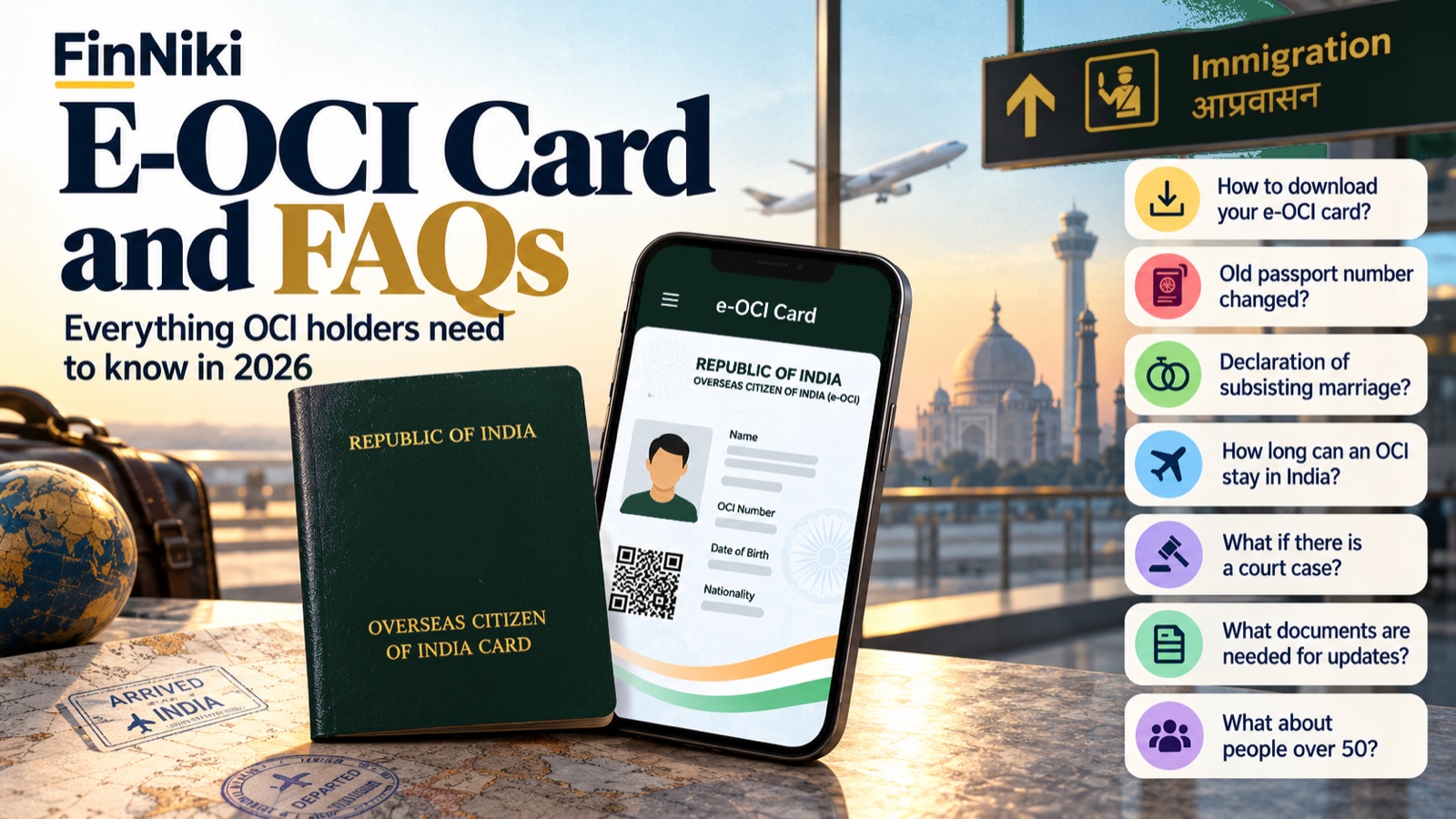
Quick answer: The e-OCI is a digital copy of your OCI card. If you already hold an OCI card you do not apply again or pay a fee: log in to the OCI portal, open the e-OCI tab, generate the card and save it on your phone. Your physical booklet stays valid, and a new applicant now receives the card digitally only. Updating your passport details and generating an e-OCI are two separate things, and neither changes your OCI status, your FEMA residency or your bank accounts.
Updated October 2026. The e-OCI launched on 30 June 2026 under the Citizenship (Amendment) Rules 2026. Details such as the daily download limit and the passport-update rules by age have changed more than once, so confirm them on the OCI portal or with your Indian mission before you act.
 Watch the 14-minute episode: e-OCI card explained and OCI passport update rules 2026
What is the e-OCI card?
It is a digital version of your existing OCI card that you generate from the OCI portal and keep on your phone. The Government of India launched it on 30 June 2026 for both new applicants and existing cardholders.
- If you already have an OCI: you do not need a fresh OCI to get an e-OCI. You generate it from your existing record.
- If you are applying for a new OCI: the government has moved to digital issuance, so you receive the e-OCI only.
- Your physical booklet continues to be valid and is still accepted for immigration and related services. Do not throw it away.
- At the airport: you can show the e-OCI digitally at immigration and, where required, to airlines, so you do not necessarily have to carry the physical booklet every time you travel.
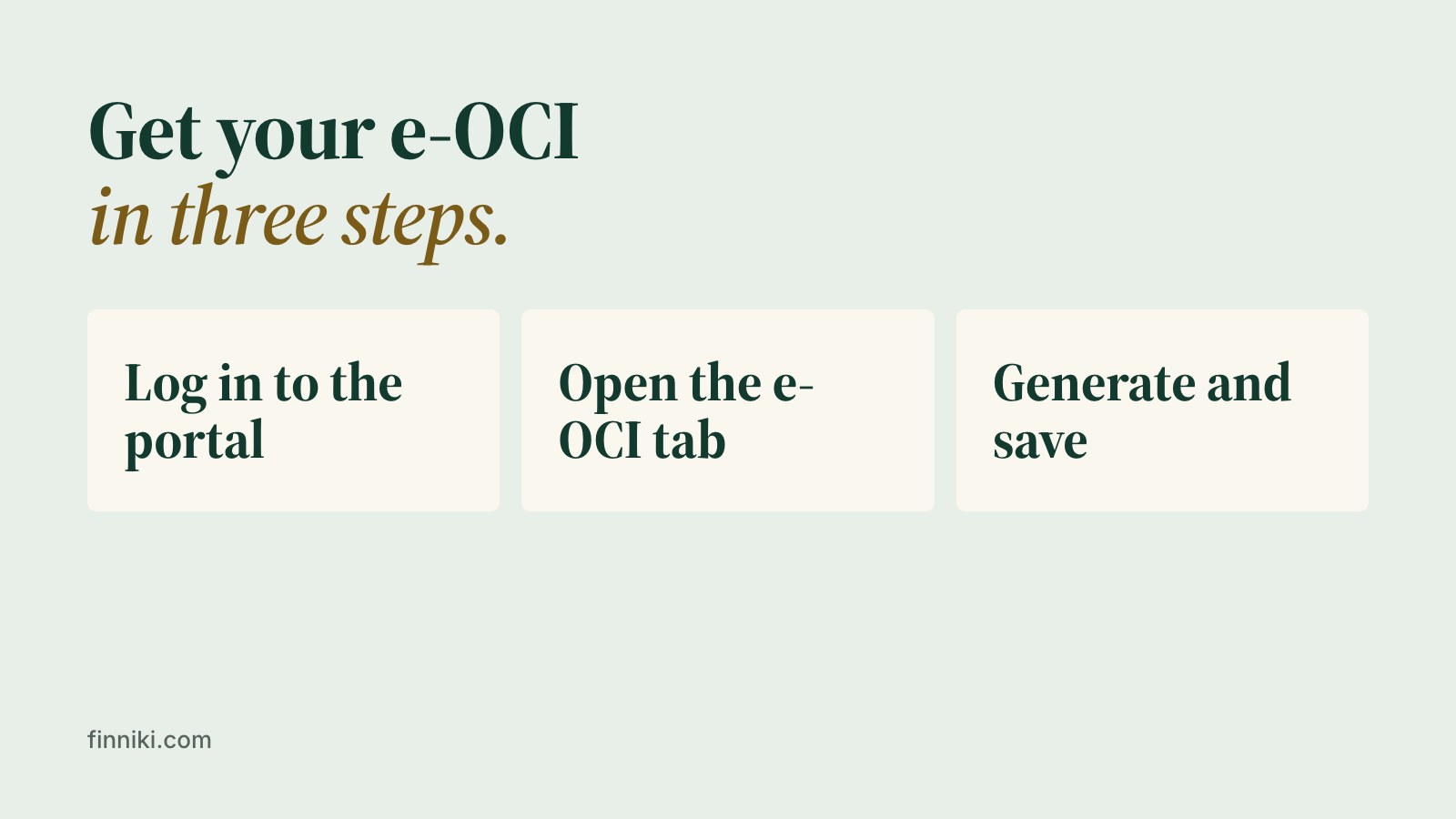
How do you download your e-OCI card?
- Log in to the OCI Services Portal with your registered email and password.
- Go to your dashboard and open the e-OCI tab. Your OCI details appear there.
- Click Generate e-OCI Card, then download it and save it securely on your phone or another device.
There is no separate fee. The episode notes that you can download the e-OCI up to five times in a day, and if you reach the limit you wait until the next day. Downloading it does not change your OCI status or give you any new rights: it is a digital representation of what the system already holds.
Do you need a new OCI if your passport number changed?
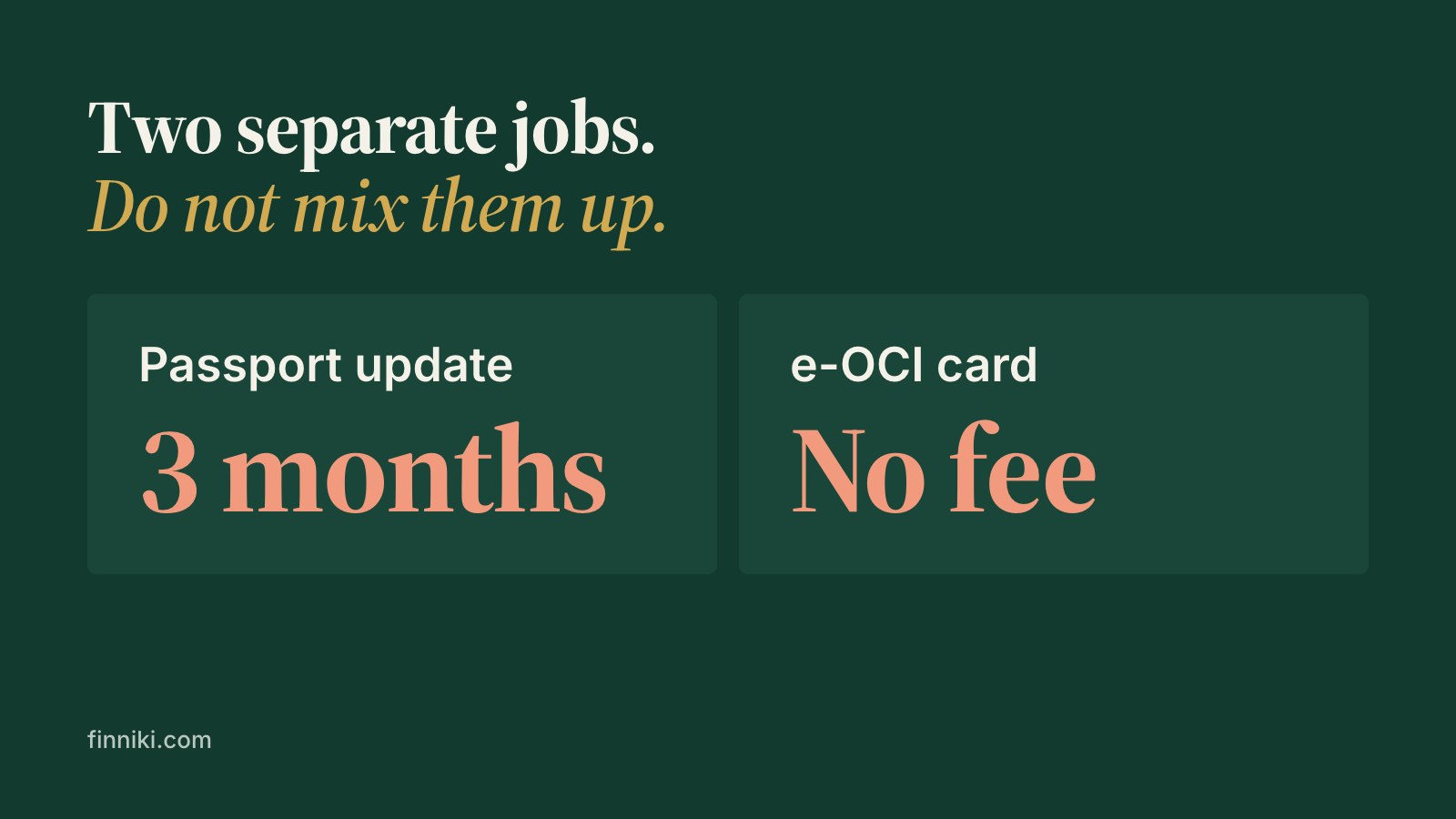
No. A new foreign passport number does not mean a fresh OCI application. You update your passport particulars through the OCI Miscellaneous Services on the portal. It is free if you do it within three months of getting the new passport, and otherwise a US$25 penalty applies. Once the update is complete, your e-OCI reflects the new details.
Do not confuse the two jobs. Updating your passport information and generating your e-OCI are different steps: you can generate the e-OCI separately even if you hold a physical booklet. The update for a late passport change is also covered in the companion post, OCI card rules 2026.
What does the "subsisting marriage" declaration mean?
It applies only to people who got their OCI as the foreign spouse of an Indian citizen or an OCI cardholder. When such a person updates a passport, the guidelines require extra documents, including a declaration that the marriage is still subsisting. If the spouse is an Indian citizen, their passport is also required. If the spouse is an OCI cardholder, their passport and OCI card are required.
That requirement maintains the spouse-based OCI status. It does not make your inheritance rights disappear. Property and inheritance are separate legal questions governed by the applicable property and succession laws. If your OCI is based on your Indian origin rather than your marriage, this declaration is not a rule you need to worry about.
How long can an OCI holder stay in India before NRE and NRO accounts are affected?
An OCI has no limit on how long you can stay in India, and your OCI does not change because you spent more time there. What can change is your residential status, and that affects accounts such as NRE and NRO. These are two separate questions:
- OCI status: a lifelong immigration status.
- FEMA residency: decides how your bank accounts are treated.
The episode states the FEMA test as being a non-resident if you were outside India for more than 182 days in the preceding financial year. RBI guidance says that when residency changes from non-resident to resident, an NRE account is redesignated as a resident account, or the funds move to an eligible RFC account. An NRO account is redesignated when you return with the intention to stay for an uncertain period. Look at your FEMA residency and your tax residency separately, using the NRI status calculator. For the full banking rules after a return, read OCI returning to India: NRE, NRO and FCNR rules.
Can an Indian court case cancel your OCI?
Not automatically. An OCI can be cancelled by the Central Government only on specified grounds under Section 7D of the Citizenship Act. Examples include obtaining the OCI through fraud, certain specified violations of law, circumstances involving national security, and, for a spouse-based OCI, a separation. Courts have examined cancellations and confirmed that cancellation is a specific statutory process, not an automatic result of any case.
A court order can still affect the underlying matter. For a property or inheritance dispute, read the order and the law involved. Being an OCI holder gives you no immunity from Indian law.
Why does the passport update form ask about family members?
To check for duplicate records. It does not ask you to submit anyone's application, only a reference number from their old paperwork. If you do not have that old number, use their OCI card number, which is what most people do. If the system asks for information you are unsure about, do not enter something at random to get through: check with the relevant Indian mission or the OCI helpdesk.
Do you have to update your passport after 50, or reissue at 20?
There are two different things, and the answers have changed over time:
- Reissue means a new physical card printed with your new passport number. Under the 2021 rules, a cardholder who registered before 20 needed a one-time reissue with the first new passport after turning 20, and nothing further after that. A mission notice dated 23 July 2026 says the government has now dispensed with reissue at that point, and holders update passport details online and give biometrics at the mission, the FRRO or their next entry or exit. Check which applies to you with your Indian mission.
- Updating your passport details online does not give you a new card. You upload your new passport and a recent photo. The episode says that after 50, you need to do this only the first time you renew after turning 50, and not for later passports. It still recommends updating whenever you renew, because it is simple and keeps your records current.
Turning 50 does not start any clock by itself. The update is triggered only when you actually receive a new passport. If your current passport is valid until 2028, there is nothing to do now.
Can you travel while your passport update is "under process"?
Yes. If you have already submitted the update, you do not have to wait for approval. The Ministry of Home Affairs says there is no restriction on an OCI cardholder travelling to or from India from the date the new passport is issued until the updated documents receive final acknowledgement in the OCI system. Travel with your valid new passport and your OCI card.
The three-month period is the deadline for submitting the update, not a deadline for the government to finish processing it. If you submitted within three months and it is still under process, you have done your part, and you do not need to file again. Take screenshots of the acknowledgements as proof.
Does your spouse's passport also need updating?
Not necessarily. If your OCI was issued on the basis of marriage, your spouse's details can form part of the supporting documents. Whether his or her passport needs a separate update depends on why that information appears in your record and whether the spouse-based requirements have changed. Do not file a random miscellaneous application to change a spouse's passport number. Check the current spouse-based documentation requirements with your Indian mission or the OCI helpdesk first.
What are the five separate things people confuse?
Your OCI status, your passport update, your e-OCI card, your FEMA residential status and your bank accounts are five different things. A change in one does not automatically mean a change in the others.
FAQs
Do I have to apply for a new OCI to get an e-OCI?
No. If you already hold an OCI card, you generate the e-OCI from the OCI portal using your registered login. There is no separate fee.
Is my physical OCI booklet still valid?
Yes. The physical booklet continues to be valid and is still accepted for immigration and related services.
Can I show the e-OCI at immigration instead of the physical card?
Yes. You can present it digitally at immigration and, where required, to airlines. Keep your physical booklet as well.
Does generating an e-OCI change my OCI status or rights?
No. It only represents the information already in the system.
Is there a deadline to update my passport details on my OCI?
Yes, three months from the date the new passport is issued. It is free inside that window, and a US$25 penalty applies after it.
Can I travel if my passport update is still under process?
Yes, with your valid new passport and your OCI card, once the update has been submitted. Keep screenshots of the acknowledgement.
Does a court case in India cancel my OCI?
No. Cancellation is possible only on the specified grounds under Section 7D of the Citizenship Act, through a formal process.
Does staying longer in India affect my OCI?
No. It can affect your FEMA residency, which decides how your NRE and NRO accounts are treated.
Keep your OCI paperwork and your money matters separate
If you are planning to move back to India, your OCI is the easy part: tax residency and bank accounts need their own plan. Book a one-to-one session to work through yours, or browse more explainers on our video page.
General information, not advice for your situation. Rules change; check your own numbers with a CA before you act.