Returning to India: How Much Money to Keep Abroad
Moving back to India? Why not to bring all your money home, how much to keep abroad, and the RNOR, FEMA and Schedule FA steps to take before you fly.

Nikhil Varghese, CA · 10 min read

Quick answer: Moving back to India does not mean moving all your money back. Selling everything abroad and transferring it home in one go can trigger foreign taxes and early-withdrawal penalties, puts a lump sum into the market at a single moment, and leaves your whole future in one currency. Many cross-border advisers suggest keeping 30 to 60% of your net worth outside India, towards the higher end if you already own Indian property or investments. Keep global growth assets and, usually, retirement accounts; bring back idle cash and scattered small holdings. Before you fly: work out your RNOR window, tell your bank and redesignate NRI accounts once you are a FEMA resident, and build a foreign-asset inventory for Schedule FA.
Updated October 2026. India's Income-tax Act, 2025 applies from 1 April 2026; the RNOR tests are unchanged in substance. Penalties for leaving foreign assets out of your return now exclude non-property assets worth up to ₹20 lakh, and a one-time disclosure scheme for missed reporting is open until 31 December 2026. The script's line that some holdings need RBI approval to keep is corrected below.
 Watch the episode: Returning to India? You could lose 30% instantly
What is the biggest money mistake returning NRIs make?
Treating where you live and where your money lives as one decision. Smart, financially aware people land in India, feel ready to close the chapter abroad, and close it financially too: they sell their overseas portfolios, shut foreign accounts and transfer the whole corpus home at once. It feels clean. But the decision is usually driven by a wish for emotional closure, not by tax, investment or portfolio logic, and it does three kinds of damage:
- Taxes and penalties abroad. Selling investments or property can trigger capital gains tax, and cashing in a retirement account early can bring income tax plus a penalty on top. Much of this can be reduced or deferred with the right sequence.
- A single entry point. The whole sum goes into Indian markets at whatever level they happen to be that month, with no phasing.
- Concentration. One economy, one currency, one market, one regulator. That is not diversification.
And returns are not always permanent. Some people move abroad again within two or three years, for work, lifestyle or air quality. If everything has been wound up, they start again from zero. Flexible, portable assets keep your options open.
How much of your money should stay outside India after you return?
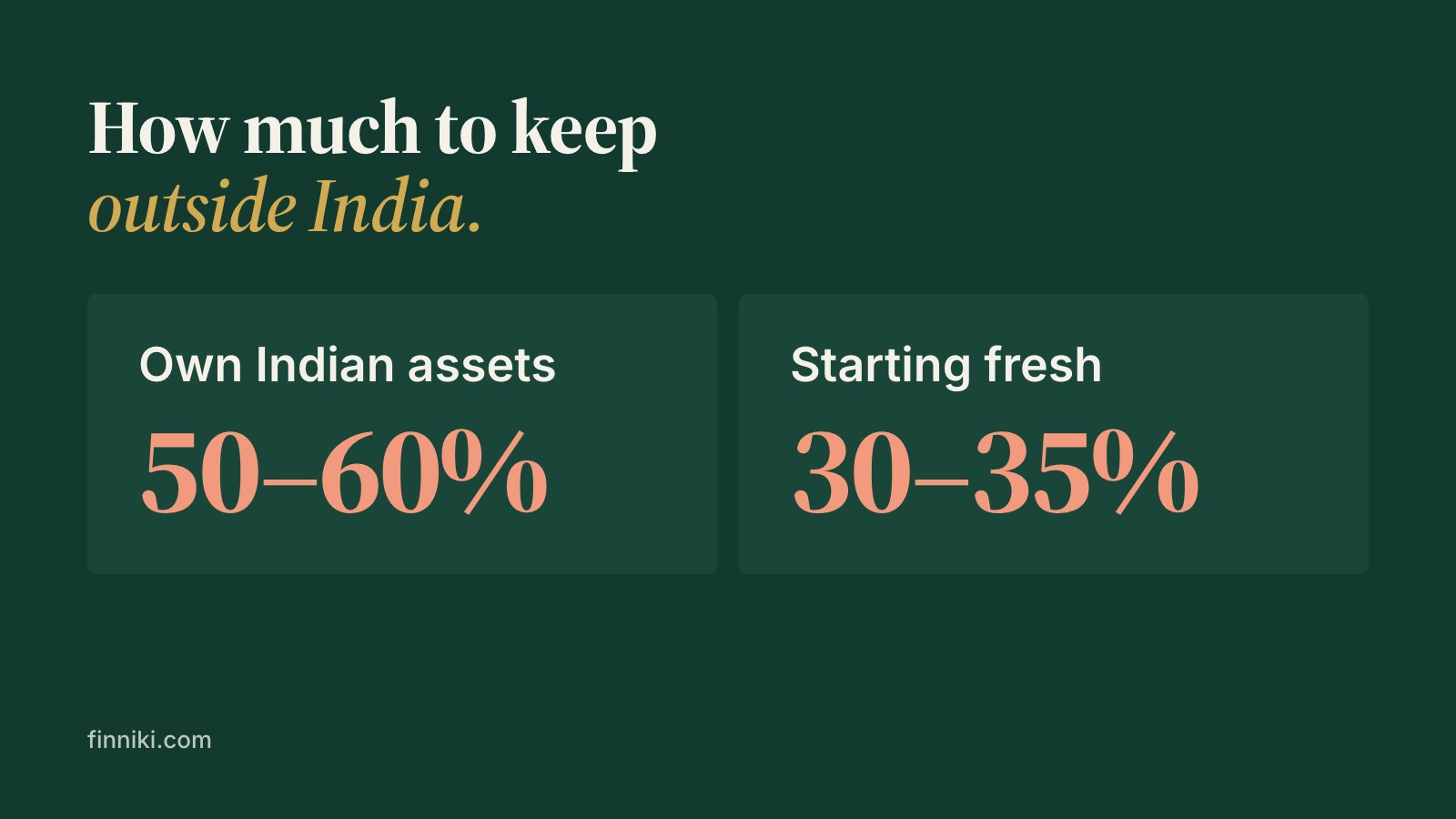
There is no universal rule, but many cross-border advisers find that 30 to 60% of net worth outside India strikes a good balance for globally mobile professionals, even after returning. Where you sit in that range depends on what you already own in India:
- 50 to 60% abroad if you already have Indian property, an Indian equity portfolio or a business here. Your India exposure is already heavy, so adding your whole overseas corpus tilts it further.
- 30 to 35% abroad only if you have few Indian assets and are genuinely starting fresh.
The principle: once your income, daily spending and future liabilities are all in India, a sharp fall in the rupee, a long Indian market downturn or a tax change hits everything at once. Assets abroad are the circuit breaker. Most people cannot say how much of their net worth sits in a single currency; work that number out before deciding anything.
Does the rupee falling against the dollar matter if you live in India?
Yes, even if your daily costs are in rupees. Groceries, rent and school fees will not move with the exchange rate, but international travel, children's education abroad, advanced medical treatment and many lifestyle upgrades are effectively priced in global currencies, and they get dearer as the rupee weakens.
The rupee has lost roughly 3 to 4% a year against the dollar over the last two decades: about ₹45 to the dollar in 2006, about ₹95 in October 2026. That gives foreign investments a built-in tailwind. If a US index fund earns around 10% a year in dollars and the rupee weakens 3 to 4% a year, your return in rupees lands around 13 to 14% before Indian tax. Over 15 to 20 years, that difference compounds into real money. Foreign assets are not just insurance; they are a source of return.
Are you giving up returns by keeping money outside India?
Partly, but less than it looks. Indian equities can deliver strong rupee returns because the economy is growing: the Nifty 50, including dividends, has compounded at roughly 11 to 12.5% a year over the last 15 to 20 years. Two things narrow the gap:
- Currency. The rupee's 3 to 4% annual slide does much of the work for an Indian investor holding global assets. From 2015 to the mid-2020s the S&P 500 returned about 13% a year in dollars, closer to the mid-teens in rupees, competitive with Indian large-caps.
- Access. Global markets offer sectors and companies India does not have at scale: the largest technology firms, pharmaceutical innovators, energy majors and consumer businesses that span continents.
So the answer is rarely India or global. It is both: Indian equity for domestic growth, global equity for sector breadth and a currency hedge. Together they tend to be more resilient than either alone. (The episode put Indian large-cap returns at 12 to 15%; the long-run figure is nearer 11 to 12.5% today.)
Which assets should stay abroad, and which should come back?
Judge each asset by three tests: its purpose, its tax impact, and its role in your currency exposure.
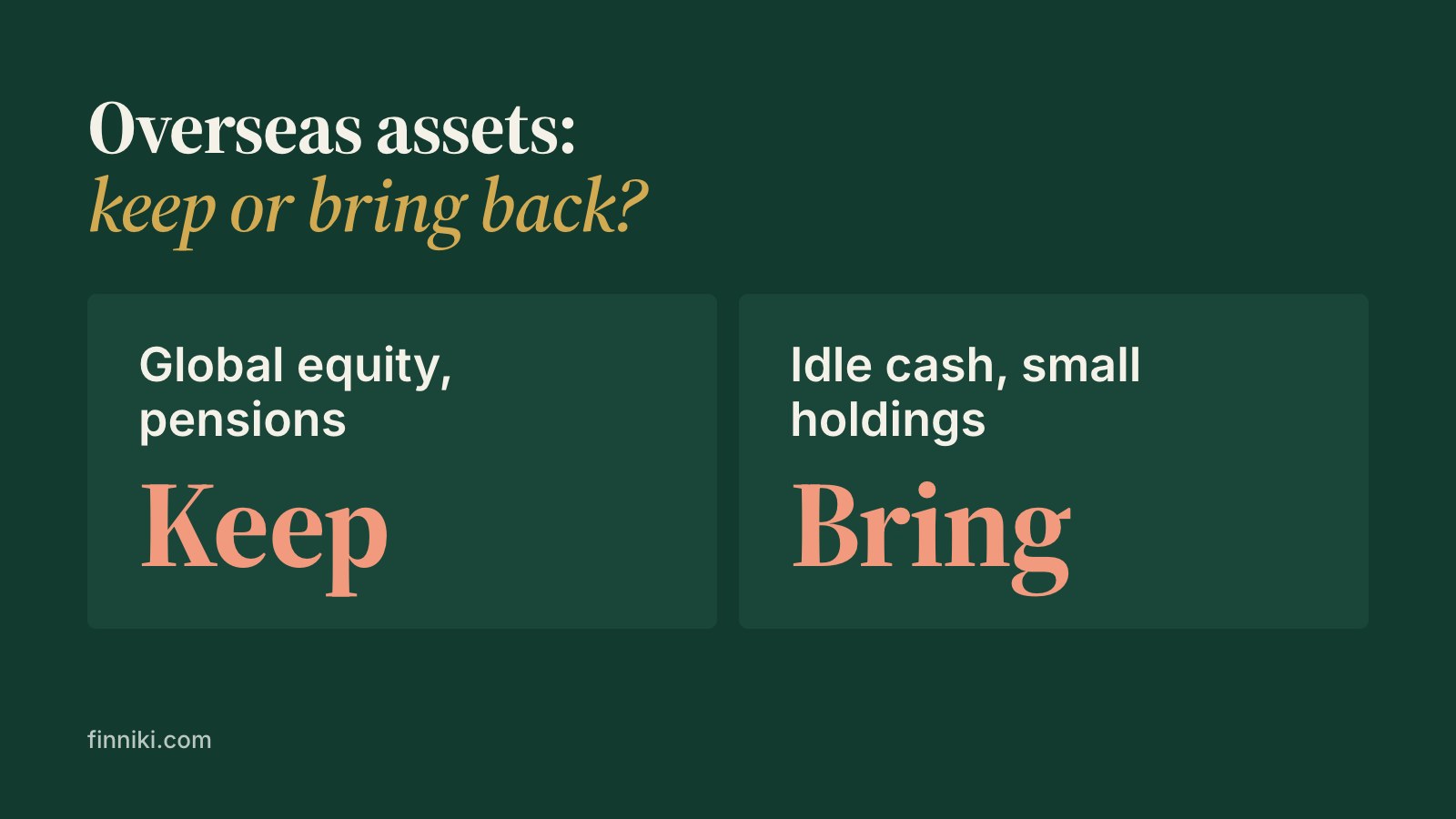
Usually stay abroad:
- Global growth assets: international equity, S&P 500 index funds, global ETFs and sector funds that give exposure India cannot, and act as a natural currency hedge.
- Retirement accounts: a UK workplace pension or an Australian superannuation fund is generally best left to compound, managed remotely. Early withdrawal can cost 30 to 40% in tax and penalties. A US 401(k) is the exception worth modelling: withdrawing inside your RNOR window can cost less than waiting, so read what happens to your 401(k) when you move back before deciding.
Usually come back:
- Idle cash in foreign savings or current accounts earning 1 to 3%.
- Small, scattered investments across several brokers or countries that add complexity without adding diversification.
Rule of thumb: if an asset contributes to growth, tax efficiency or currency diversification, it probably stays. If it only adds complexity, consolidate it and redeploy the money, in stages rather than in one lump sum.
What must you do before you board the flight?
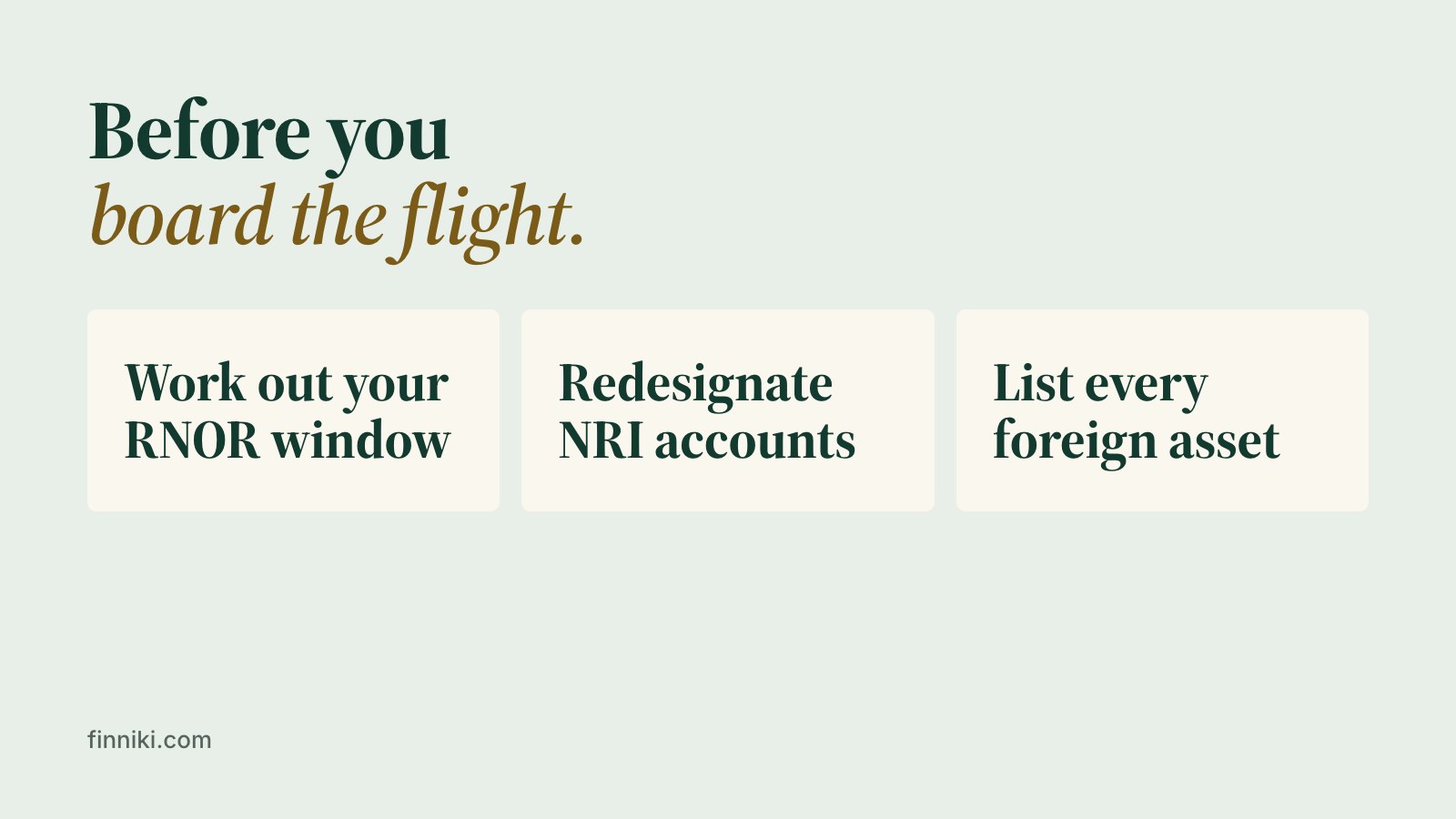
Three things, all far easier while you are still abroad.
1. Work out your RNOR window
When you return you do not immediately become a fully taxed resident. Most returning NRIs first pass through RNOR (Resident but Not Ordinarily Resident) status, during which foreign income that arises and is received outside India generally stays outside the Indian tax net. You remain RNOR if you were a non-resident in nine of the previous ten years, or spent 729 days or fewer in India in the previous seven; the status is retested every year, so it typically lasts one to three years depending on your past stays. Selling foreign shares or property while you are still a non-resident or RNOR can keep those gains out of Indian tax; do the same as a full resident and India taxes them (with credit for foreign tax under the treaty, where available). Check your window with the RNOR calculator and the NRI status calculator.
2. Restructure your accounts under FEMA
The Income Tax Act and FEMA (the Foreign Exchange Management Act) define residence differently. There is no RNOR-style buffer under FEMA: once you have returned with the intention to stay, you are a resident for banking purposes and the NRI flexibilities end. Your NRE and NRO accounts must be redesignated as resident accounts (or NRE balances moved to a Resident Foreign Currency account), and an FCNR deposit can run to maturity but cannot be renewed. Our guide to NRE, NRO and FCNR rules when you return walks through each account.
Your overseas holdings are simpler than the episode suggested. Under Section 6(4) of FEMA, a resident may keep foreign currency, foreign securities and property abroad that were acquired while non-resident, without RBI approval. What changes is what you do next: new investments abroad as a resident go through the Liberalised Remittance Scheme (up to US$250,000 a financial year). Before you leave, make a complete list of your overseas accounts, investments, properties and pensions, and decide with a specialist what to move now and what can wait.
3. Build your foreign-asset inventory for Schedule FA
While you are a non-resident or RNOR, Schedule FA generally does not apply. In your first return as a Resident and Ordinarily Resident (ROR), you must disclose every foreign asset: bank accounts, investment portfolios, retirement funds, property, and accounts where you are only a signatory. With automatic exchange of information between tax authorities, the department often already has visibility of these accounts.
The penalty for leaving a foreign asset out is up to ₹10 lakh under the Black Money Act. Since 1 October 2024 it does not apply where your non-property foreign assets total ₹20 lakh or less, but the duty to report remains, and foreign property is never covered by that exclusion. If you have already missed reporting, the FAST-DS 2026 scheme lets you regularise it until 31 December 2026; where the asset was acquired while you were non-resident and only the reporting was missed, the cost is a flat ₹1 lakh fee. Gather statements, valuations and transaction histories while you still have easy access in the country where the assets are held, not in a rush before your first filing deadline.
What does getting it wrong cost? Two returnees compared
The episode's two examples show the gap.
Rajesh spent 14 years in the UK and returned in 2021. He held a workplace pension, a stocks and shares ISA, an NRE fixed deposit and a London flat that had appreciated well. Wanting everything in one place, he sold the flat, withdrew the ISA, took a penalty on the pension and moved it all to India. UK capital gains tax on the flat and tax and charges on the pension took close to 28% of his corpus before the money landed. He then invested the rest in Indian markets near their late-2021 peak. Two years later his portfolio was well behind where it would have been had he left most assets where they were and brought back only surplus cash.
Nisha returned from Singapore after 11 years with a plan made with a cross-border adviser. She left her CPF (Singapore's provident fund) intact, kept her Singapore equity portfolio and managed it remotely, brought back only idle cash and invested it gradually over 18 months, and used her RNOR years to keep her Singapore rental income outside Indian tax. Three years on, her overseas assets have kept compounding, her Indian portfolio was built without timing risk, and her net worth is meaningfully higher.
Same decision to return. The difference was not income, market picks or luck; it was the sequence.
FAQs
Should I move all my money to India when I return?
Usually not. Many advisers suggest keeping 30 to 60% of your net worth abroad, and moving the rest in stages rather than as one transfer.
Can I keep my foreign bank account and investments after returning to India?
Generally yes. Section 6(4) of FEMA lets a resident keep foreign assets acquired while non-resident. New investments abroad as a resident go through the Liberalised Remittance Scheme.
What happens to my NRE account when I move back?
Once you are a FEMA resident it must be redesignated as a resident account, or the balance moved to a Resident Foreign Currency account, and its interest stops being tax-free.
How long does RNOR status last?
Typically one to three years. It depends on your past stays: you stay RNOR while you were non-resident in nine of the previous ten years or spent 729 days or fewer in India in the previous seven.
When do I have to report foreign assets in Schedule FA?
From your first return as a Resident and Ordinarily Resident. While you are a non-resident or RNOR it generally does not apply.
What is the penalty for not disclosing foreign assets?
Up to ₹10 lakh under the Black Money Act, except where non-property foreign assets total ₹20 lakh or less. Missed reporting can be regularised under FAST-DS 2026 until 31 December 2026.
Does the falling rupee matter if I spend only in India?
Yes. Travel, overseas education and advanced healthcare are priced in global currencies, and foreign investments gain about 3 to 4% a year in rupee terms from currency alone.
Map your money before you move it
Returning to India is a life decision; moving your wealth is an investment decision. Before you sell or transfer anything, map what you hold in rupees and in other currencies, what is liquid and what is locked, and how each piece is taxed on the way out and on the way in. Book a session to plan the sequence, or check your status with the RNOR calculator.
General information, not advice for your situation. Rules change; check your own numbers with a CA before you act.