$500K in India vs the US: Can NRIs Retire Early?
Why $500,000 lasts 7-8 years in the US but decades in India, the monthly number that decides it, and how NRIs plan an early retirement move.

Nikhil Varghese, CA · 9 min read

Quick answer: The same $500,000 that would fund only about seven to eight years of a comfortable retirement in the US can last for decades in an Indian city such as Hyderabad, because you saved in a high-cost economy and now spend in a lower-cost one. At about ₹95 to the dollar, $500,000 is roughly ₹4.75 crore. Spent at $800 to $1,200 a month (about ₹76,000 to ₹1.14 lakh), it can last 50 years or more if it earns a modest 8% while costs rise 6%. The catch: at ₹2 lakh a month, closer to what a family with private-school fees spends, the same money lasts only about 24 years. Early retirement in India works when you plan the move over years, check the monthly number honestly and decide rather than drift.
Updated October 2026. Dollar amounts are converted at about ₹95 to the dollar (the rupee closed at 94.93 on 30 October 2026). The episode's "30 to 40 years" divided the corpus by spending with no returns and no inflation; the figures below add both, and test a family budget as well.
 Watch the episode: $500K in India vs US, the NRI retirement truth
Why do so many NRIs stay abroad longer than they planned?
Because most of them never decide to stay; they just never decide to leave. Five, ten or fifteen years pass waiting for one more promotion, one more bonus or one more milestone, and the home they planned to return to slowly starts to feel unfamiliar. The question is rarely whether you want to return. It is when, and why you have not yet.
Arjun, the episode's example, spent 14 years in the Bay Area. He and his wife both worked, two incomes in Silicon Valley, yet they struggled to save meaningfully: rent, daycare, health insurance, groceries and federal and state taxes absorbed even a very good salary. After 14 years there was still no green card in sight, so one layoff could have meant a forced move on someone else's timetable. They chose to move to Hyderabad on their own terms instead.
Why does saving in dollars not always make you richer?
Because if you earn, save and spend in the same high-cost economy, your savings only buy that economy's expensive lifestyle. Saving 20% of a US salary feels disciplined, but rent, healthcare, groceries and childcare are all priced in dollars, so the savings stay hostage to dollar costs. The loop breaks only when you save in a high-income economy and spend in a lower-cost one. That is the advantage NRIs have that almost no one else does: you already know the culture, often have family and sometimes property in India, so you are not starting from zero in a foreign country.
How long does $500,000 last in the US versus India?
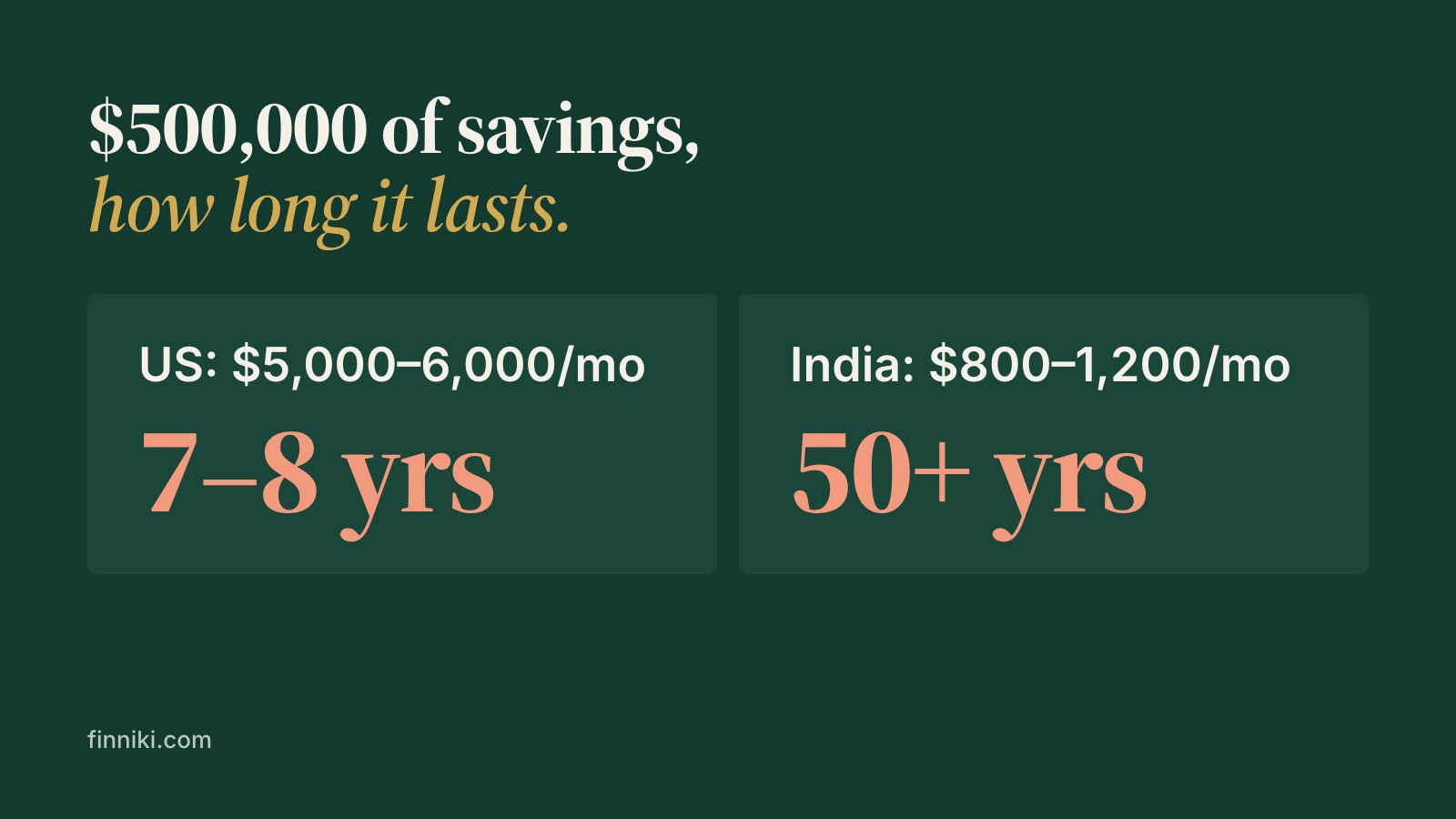
About seven to eight years in the US, against several decades in India at the episode's spending level. Here is the episode's arithmetic, recalculated:
- Saving: Arjun earns $10,000 a month and saves 20%, or $2,000 a month. Over 15 years he puts in $360,000; at a cautious 4% a year it grows to about $500,000.
- Retiring in the US: a comfortable retirement there costs about half his salary, $5,000 to $6,000 a month. Even earning 5% while costs rise 3%, $500,000 lasts only about 7 to 8 years. Retire at 40 and the money is gone by about 48.
- Retiring in India: a comfortable life in Hyderabad, with a good home, house help and family nearby, costs about $800 to $1,200 a month, roughly ₹76,000 to ₹1.14 lakh. At ₹95 to the dollar, $500,000 is about ₹4.75 crore, so that spending is a withdrawal of only about 2 to 3% a year. Earning 8% while costs rise 6%, the money lasts 50 years or more.
Does $500,000 really cover a family in India?
Only if your monthly number really is near the low end. The $800 to $1,200 figure is the episode's estimate for a comfortable but simple life. A family that wants an international school, a car and regular travel will spend more, often ₹2 to 3 lakh a month in a tier-one city, as our guide to why some NRIs regret moving back shows. On the same ₹4.75 crore, at 8% returns and 6% inflation:
- ₹1.14 lakh a month ($1,200): lasts about 55 years.
- ₹1.5 lakh a month: lasts about 35 years: from 40 to about 75.
- ₹2 lakh a month: lasts about 24 years: from 40 to about 64, before the years when healthcare costs most.
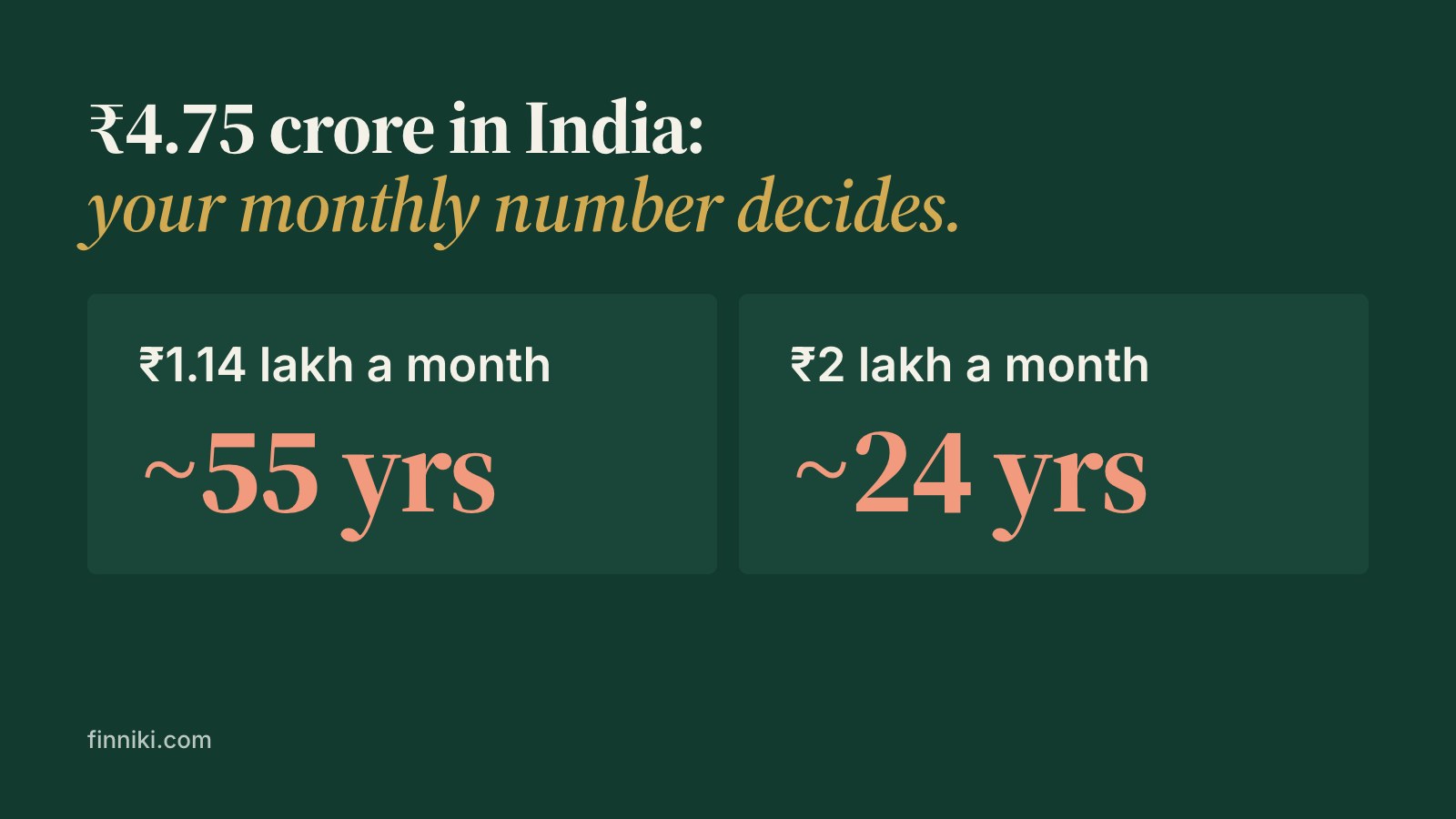
So the honest version of the $500K story is this: the move multiplies what your savings buy, but your monthly number decides whether early retirement is safe. Price your own city, school and healthcare before you treat $500,000 as enough. Our NRI retirement guide sets out typical costs by city and how to build the corpus.
When is the right time to retire early in India?
For many people, their 40s. Think of three resources: time, money and health.
- In your 20s you have time and energy but little money.
- In your 40s money is there and your career is at its peak, but free time is scarce.
- In your 60s time returns and money is still there, but travel is harder and recovery takes longer.
The window where all three overlap is short, and most people miss it while chasing the next milestone. In your 40s you can still be a present parent, you have the experience to build something that matters, and you are stable enough that a move is a choice rather than a crisis. Early retirement in India is not stepping away from your life; it is stepping into it while you still have the energy to enjoy it.
How do you plan an early retirement move to India?
Over five to seven years, not on the day you book flights. What looked dramatic from outside was, in Arjun's case, a series of quiet decisions:
- Build a base in India while still earning abroad. Real estate and investments that compound without you being there. Earn in dollars, invest in rupees, and be prepared before you move.
- Stop locking yourself into the life abroad. Prefer choices that are easy to exit; even buying a house becomes a question of whether you can get out cleanly when the time comes.
- Stress-test India before committing. Spend an extended stretch there, not as a tourist: children in short-term schooling, working remotely, living the actual routine, to see what holds up once the romance wears off.
- Simplify your finances. Consolidate old retirement accounts, close accounts you do not need, keep only what works cleanly across borders. Complexity becomes a real problem when you no longer live in the country. If you hold a US 401(k), read what happens to your 401(k) when you move back before you decide.
- Move in stages. Arjun sold the house first, gave himself breathing room and moved in phases rather than shifting his whole life at once. The lighter the move, the cleaner the break.

Check your tax position on the way: most returning NRIs pass through RNOR (Resident but Not Ordinarily Resident) status first, which changes how foreign income is taxed. The RNOR calculator shows how long your window lasts.
Is moving back to India a retreat?
No. Staying on a temporary visa with no green card means one layoff could force a rushed, unplanned return. An H-1B worker who loses a job usually has a discretionary grace period of up to 60 days to find a new sponsor or change status, and in 2026 the US Department of Homeland Security proposed removing even that. Your status is tied to your employer, and your ability to stay depends on backlogs and policy you do not control.
Choosing to leave on your own terms, with a plan and the money already in place, removes that dependency. It is not a retreat; it is taking back control of the decision.
What does early retirement in India actually look like?
Not doing nothing. In the episode's example, Arjun's children, aged eight and two and a half, now have present parents rather than tired ones still mentally in a meeting at bedtime. He is building online courses from 15 years in supply chain and warehouse technology, researching India's fast-growing quick-commerce and logistics sector and laying the groundwork for a business of his own.
The real advantage is the lower cost of living: even a small side income can cover the basics, so a business risk that fails does not destroy you. In a high-cost country you play safe; in India you can afford to bet on yourself.
What should you expect to give up?
Some of the conveniences you are used to. Do not expect to recreate America in India: traffic will test your patience, systems will not always be efficient, the pace of life is different and weekends will change. What you gain:
- Family close by: daily life with parents and relatives instead of annual visits.
- Cultural familiarity: the language, food and social norms are yours again; you stop adjusting.
- A sense of belonging: the low-level awareness of being "from somewhere else" goes, and that frees up mental bandwidth. Children often adapt faster than parents expect, especially with some continuity in schooling.
Go in clear-eyed: not starry-eyed, not cynical, just honest about what you trade and what you gain.
FAQs
How long will $500,000 last in retirement in India?
At about ₹95 to the dollar it is roughly ₹4.75 crore. Spending ₹1.14 lakh a month, with 8% returns and 6% inflation, it lasts about 55 years; at ₹2 lakh a month, only about 24 years.
How much does a comfortable retirement in Hyderabad cost?
The episode estimates $800 to $1,200 a month, about ₹76,000 to ₹1.14 lakh, for a good home, house help and family nearby. A family with private-school fees and a car will usually spend more.
Why does $500,000 not last long in the US?
At $5,000 to $6,000 a month of retirement spending, $500,000 lasts only about seven to eight years, even with modest returns.
What is the best age to retire early in India?
For many NRIs the 40s, when time, money and health overlap: there is enough money to move by choice and enough energy to enjoy the freedom.
How long should I plan before moving back to India?
Five to seven years is realistic: build Indian assets while earning abroad, spend an extended period living in India, simplify your accounts, then move in stages.
What happens if I lose my H-1B job?
You usually get a discretionary grace period of up to 60 days to find a new sponsor, change status or leave. The US government proposed removing it in 2026, so check the current rule with an immigration lawyer.
Is early retirement in India the right choice for every NRI?
No. For some people life abroad is exactly right. The point is to decide deliberately, with real numbers, rather than drift for another decade.
Decide, don't drift
If retiring early in India has crossed your mind, spend time there beyond holidays, talk it through with your family and look at your actual numbers: the real risk is not choosing wrong, it is never choosing at all. Book a session to test your own corpus and timeline, check your tax status with the RNOR calculator, or watch more on FinNiki videos.
For the full corpus maths, read how much is enough to retire in India.
General information, not advice for your situation. Rules change; check your own numbers with a CA before you act.