How Much Is Enough to Retire in India? 3 NRI Cases
The real corpus NRIs need to retire in India: the 3.5% rule, 6% inflation and three worked cases from Dubai, Singapore and the US, gaps and fixes.

Nikhil Varghese, CA · 10 min read

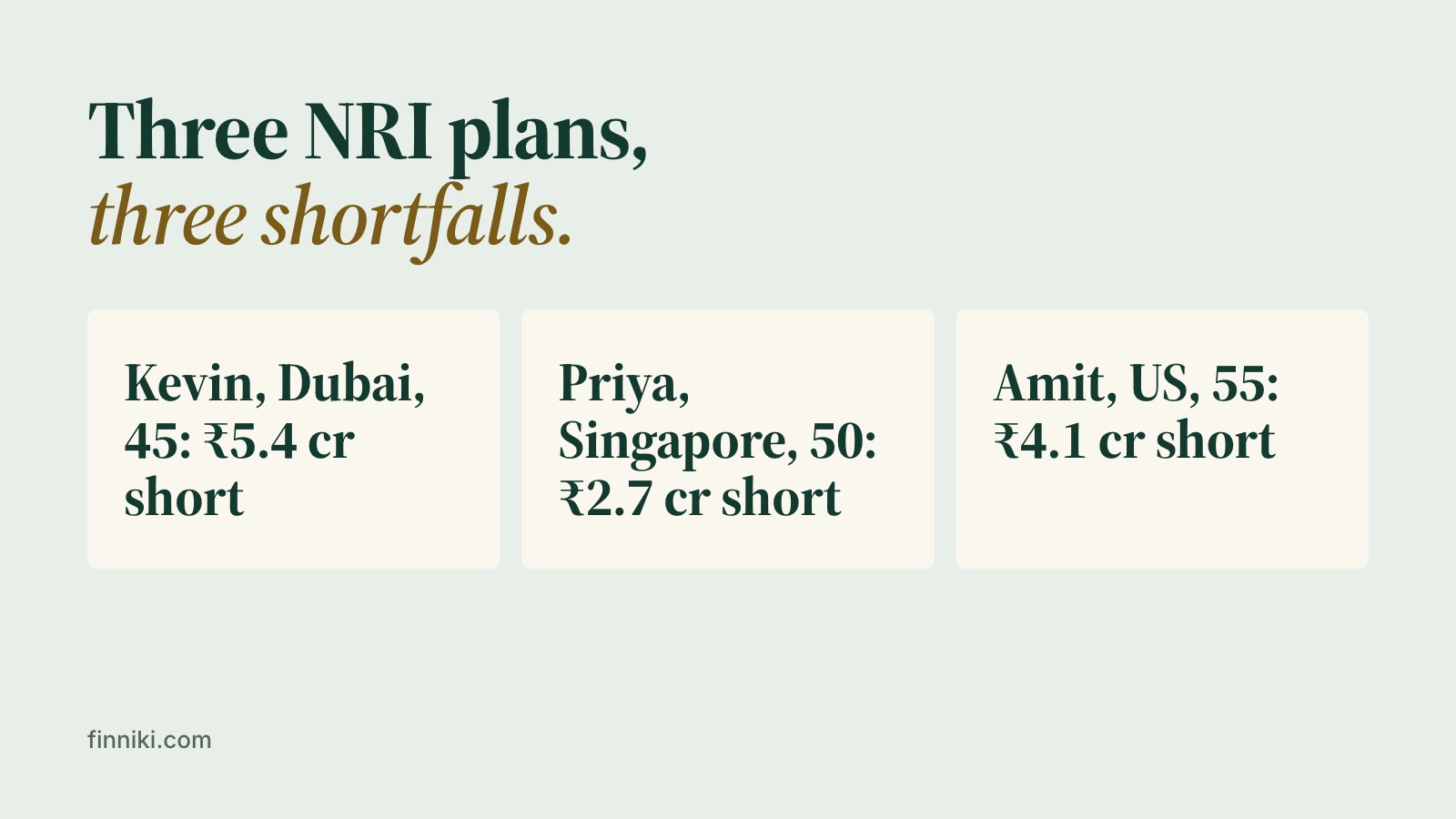
Quick answer: To retire in India you need roughly your yearly spending at retirement divided by 3.5%, about 28.6 times that year's expenses. Because Indian prices rise about 6% a year, the number is far larger than most people expect: a 30-year-old Dubai-based NRI who wants to retire at 45 on ₹1.5 lakh a month (in today's money) needs about ₹12.3 crore, not the ₹6 to 8 crore a quick estimate suggests. Worked through for three NRI profiles, each one falls short, by about ₹5.4 crore, ₹2.7 crore and ₹4.1 crore. Close the gap with a higher savings rate, a later date, a cheaper city or, usually, a mix, and keep a separate health fund and a transition buffer on top.
Updated October 2026. Currency conversions use about ₹95 to the US dollar, ₹25.9 to the UAE dirham and ₹74 to the Singapore dollar (late October 2026), so the US profile now saves about ₹2.4 lakh a month, not the episode's ₹2.3 lakh. Medical inflation uses Aon's 2026 projection for India (11.5%). Several of the episode's "what if" results are recalculated below.
 Watch the episode: ₹6 crore isn't enough to retire in India (here's why)
How much money do you need to retire in India?
About 28.6 times your annual spending in the year you retire: that is the required corpus at a 3.5% withdrawal rate. If your number is wrong, you either work five extra years you did not need to, or run out of money at an age when you can no longer earn. The answer differs by profile: what a 45-year-old Gulf NRI needs to retire in Pune is very different from what a 55-year-old US professional needs in Bengaluru. Three assumptions drive every calculation.
What inflation rate should you assume for retirement in India?
About 6% a year. At that rate a lifestyle costing ₹1 lakh a month today costs about ₹1.8 lakh in 10 years and ₹3.2 lakh in 20 years. Every expense has to be inflated forward to your retirement date before you size the corpus.
What is a safe withdrawal rate for retiring in India?
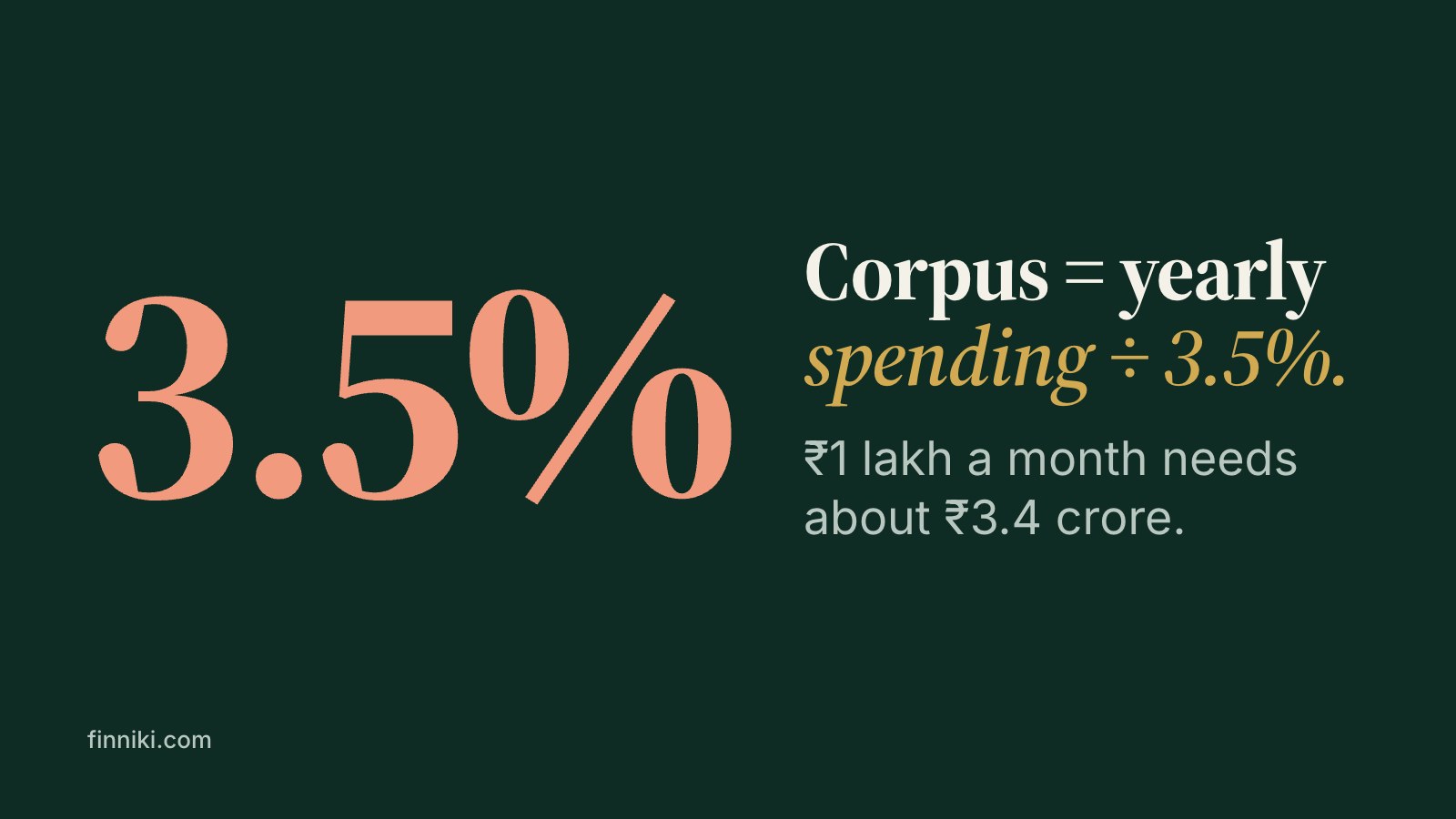
Use 3.5%, and 2.5% if you want more margin. The well-known "4% rule" comes from US data; India's higher inflation, and the 30 to 35 years of retirement many returning NRIs face, argue for something lower. The formula:
Required corpus = annual expenses at retirement ÷ 3.5%
So ₹1 lakh a month, ₹12 lakh a year, needs about ₹3.4 crore, not ₹1 crore. If you have been thinking "₹2 crore should be enough", it almost never is.
Why does a 3.5% withdrawal rate work?
Because the portfolio keeps earning more than you take out. The episode assumes a realistic blended return of about 9 to 9.5% a year after retirement, from a mix of equity mutual funds, bonds, PPF and fixed deposits. Withdraw 3.5% and the rest keeps compounding. In a smooth model where withdrawals rise 6% a year with inflation, a 3.5% start lasts about 55 years at 9% and about 46 years at 8.5%. Real markets are not smooth: a bad first few years shortens that, which is why the allocation and bucket plan below matter.
Scenario 1: Can a Gulf NRI retire in India at 45?
Not on the obvious plan. Kevin is 30, a mid-level finance professional in Dubai, saving ₹1.5 lakh a month (about AED 5,800) in Indian equity funds, NRE fixed deposits and some gold. He wants to retire at 45 in a city such as Pune or Jaipur on ₹1.5 lakh a month in today's money.
- What he builds: ₹1.5 lakh a month for 15 years at 11% a year grows to about ₹6.9 crore. (The episode quotes 10 to 11%; at 10% it is about ₹6.3 crore.)
- What he needs: ₹1.5 lakh inflated at 6% for 15 years is about ₹3.6 lakh a month, or ₹43 lakh a year. Divided by 3.5%, that is about ₹12.3 crore.
- The gap: about ₹5.4 crore.
What closes it:
- Save more. At ₹2 lakh a month the corpus reaches about ₹9.2 crore, still short. It takes about ₹2.7 lakh a month to build ₹12.4 crore.
- Retire later. Each extra year adds to the corpus, but it also inflates the target. At 48 he would have about ₹10.2 crore against about ₹14.7 crore needed; at 50, about ₹13.1 crore against ₹16.5 crore. Delay narrows the gap but does not close it alone.
- Choose a cheaper city. In a tier-two city such as Indore, Coimbatore or Mysuru, costs could be 20 to 25% lower, cutting the target to about ₹9.2 to 9.9 crore.
Retiring at 45 is achievable for a Gulf NRI, but usually through a combination of all three.
Scenario 2: Is a Singapore or UK NRI on track to retire at 50?
Closer than most, but still short, which makes it the most dangerous case because it looks fine. Priya is 35, in Singapore, saving ₹3 lakh a month (about SGD 4,050) in Indian equity funds, EPF and some Singapore equities. She wants to retire at 50 in a metro or a good tier-one city on ₹2 lakh a month in today's money.
- What she builds: ₹3 lakh a month for 15 years at 11% grows to about ₹13.8 crore.
- What she needs: ₹2 lakh inflated for 15 years is about ₹4.8 lakh a month, or ₹57.5 lakh a year, so about ₹16.4 crore.
- The gap: about ₹2.7 crore, roughly 16% short.
What closes it:
- Save about ₹3.6 lakh a month. At ₹3.75 lakh the corpus reaches about ₹17.2 crore, comfortably past the target.
- Retire at 52. She would have about ₹17.9 crore against about ₹18.5 crore needed: much closer, but still slightly short. (The episode said two more years would comfortably clear it; it does not on its own.)
- Spend ₹1.5 lakh a month instead of ₹2 lakh, realistic in a tier-one non-metro city. The target drops to about ₹12.3 crore, below what she will have.
Scenario 3: Can a US NRI retire in India at 55?
Not on a typical US savings rate. Dollar salaries look large, but federal and state taxes, housing, health insurance, cars and children absorb most of them. Amit is 38, a mid-to-senior professional, and realistically saves about $2,500 a month, about ₹2.4 lakh at today's rate, across a 401(k), Indian mutual funds through his NRE account and US index funds. He wants to retire at 55 on ₹2 lakh a month in today's money.
- What he builds: ₹2.4 lakh a month for 17 years at 11% grows to about ₹14.4 crore.
- What he needs: ₹2 lakh inflated for 17 years is about ₹5.4 lakh a month, or ₹64.6 lakh a year, so about ₹18.5 crore.
- The gap: about ₹4.1 crore. (The episode, at ₹2.3 lakh a month, put it near ₹5 crore; the weaker rupee has narrowed it.)
What closes it:
- Save $3,500 a month (about ₹3.3 lakh): the corpus reaches about ₹19.9 crore, past the target.
- Retire later. At 58 he would have about ₹21 crore against about ₹22 crore needed; at 60, about ₹26.8 crore against ₹24.7 crore. Three years is not quite enough; five is.
- Add income in retirement: rent from an Indian property, part-time consulting or dividend-paying assets that reduce what he draws from the corpus.
What should US NRIs know about 401(k) access before 59½?
That most of it is not freely available before 59½, so the money you hold outside US retirement accounts must carry you until then. If Amit retires at 55, his other investments may need to fund four to five years on their own. Two exceptions help: under the rule of 55, if you leave your employer in or after the year you turn 55, that employer's 401(k) can usually be drawn without the 10% penalty, and Roth IRA contributions (not the earnings) can be withdrawn at any time. Once you become a resident in India, the US–India tax treaty and Indian rules decide how withdrawals and gains are taxed, so take cross-border advice before you move. Our guide to what happens to your 401(k) when you move back covers the options and the RNOR window.
Why do online retirement calculators show a smaller number?
Because small changes in assumptions move the target by crores. Most calculators do not lie; they assume a higher withdrawal rate, lower inflation and shorter lives. Change just two inputs, a 4% withdrawal rate and 5% inflation, and the required corpus falls from about ₹12.3 crore to ₹9.4 crore for Kevin, from ₹16.4 crore to ₹12.5 crore for Priya and from ₹18.5 crore to ₹13.8 crore for Amit: about ₹3 to 5 crore less in each case. That is not a rounding error; it is the difference between a retirement that lasts and one that does not.
What risks sit outside the corpus?
Two, and they apply to every profile:
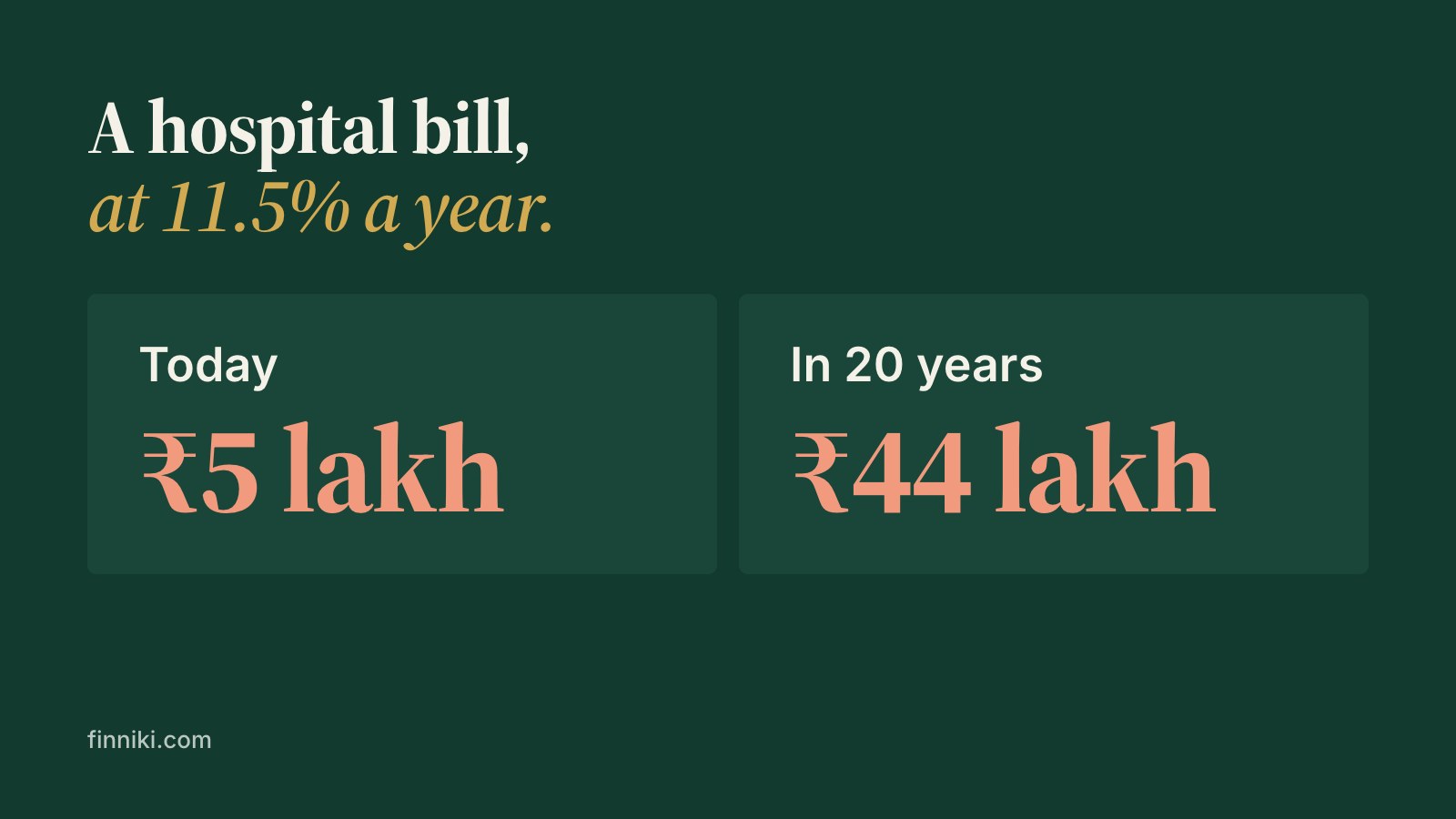
- Healthcare. Medical costs in India rise much faster than general prices: Aon projects employer medical costs in India rising 11.5% in 2026, after 13% in 2025. At 11.5% a year, a hospital bill of ₹5 lakh today becomes about ₹44 lakh in 20 years. Keep a separate health fund (the episode suggests at least ₹50 lakh) and comprehensive cover of ₹1 to 2 crore. Our health insurance guide explains how much cover you need.
- The transition years. The first two or three years back often bring big one-off costs: renovating or buying a home, family weddings, travel, helping children or parents. Budget a transition buffer of ₹30 to 50 lakh that is not part of the retirement corpus.
How should a retirement corpus be invested?
With less risk the older you are when you retire. The episode's suggested starting points:
- Retiring at 45 (about 35 years ahead): 60% equity (flexi-cap and large-cap funds), 25% debt (PPF, bonds, RBI floating rate bonds, short-duration funds), 10% international ETFs as a currency hedge, 5% gold. Expected blended return about 9.5 to 10%.
- Retiring at 50 (about 30 years): 50% equity, 30% debt, 8% international, 12% gold. About 9 to 9.5%.
- Retiring at 55 (about 25 years): 40% equity, 40% debt, 5% international, 15% gold. About 8.5 to 9%.
Adjust for your own risk tolerance, other income and comfort with volatility. Then run it as a bucket plan: two to three years of spending in cash or liquid deposits, five to seven years in safer debt, and the rest in equity; spend from the first, refill it from the second, top that up from equity gains. Our three-bucket retirement plan explains it in full, and the NRI retirement guide covers accounts, property and the RNOR window.
What surprises NRIs who retire early in India?
Three things that no spreadsheet captures:
- You spend less than expected, at first. After years of saving, spending feels unnatural, and much of what you imagined buying (business class, status hotels, premium memberships) was tied to your work identity. A first year 20 to 30% under budget is normal and settles with time.
- The social landscape has moved on. Old friends have fixed routines around children and work, and if you retire early, weekdays can feel empty. Build new circles deliberately: a sport, a club, a community around your interests.
- Your identity takes a hit. After 15 to 20 years in a high-status role, losing the title hurts, even by choice. People who handle it well evolve into mentors, creators and learners. Plan who you will be without the job title, not just the money.
FAQs
How much money do I need to retire in India?
About 28.6 times your yearly spending at retirement, using a 3.5% withdrawal rate. ₹1 lakh a month (₹12 lakh a year) at retirement needs about ₹3.4 crore.
Is ₹6 crore enough to retire in India?
It depends on your spending and age. For someone retiring at 45 on ₹1.5 lakh a month in today's money, 15 years away, the target is about ₹12.3 crore, so ₹6 to 7 crore falls well short.
Why use a 3.5% withdrawal rate instead of the 4% rule?
India's inflation is higher than the US data behind the 4% rule, and early retirees may need the money for 30 to 35 years, so a lower starting withdrawal is safer.
How fast do medical costs rise in India?
Aon projects 11.5% for 2026, after 13% in 2025, well above general inflation. At 11.5%, ₹5 lakh today becomes about ₹44 lakh in 20 years.
Can I use my 401(k) if I retire in India at 55?
Usually not freely before 59½. The rule of 55 can help with your last employer's plan, and Roth IRA contributions can be withdrawn any time, but plan for other assets to cover the early years.
What return should I assume after retirement?
The episode assumes about 8.5 to 10% blended, depending on how much equity you keep. Use the lower end if you are unsure.
What is a transition buffer?
A separate ₹30 to 50 lakh for the big one-off costs of the first few years back, such as a home, weddings and travel, so they do not eat into the retirement corpus.
Find your real number
Your number depends on your spending, your city, your age and when you stop earning. Book a session to run your own scenario, check your tax status with the RNOR calculator, or watch more on FinNiki videos.
Comparing countries? Read $500K in India vs the US.
General information, not advice for your situation. Rules change; check your own numbers with a CA before you act.